

More news on this day
Air travel across Argentina descended into chaos on Thursday as a nationwide general strike called by the powerful CGT labor confederation forced airlines to cancel or reschedule hundreds of flights, stranding tens of thousands of travelers in Buenos Aires, Córdoba, Mendoza, Bariloche, Santiago and other key cities.
Mass Cancellations Hit Domestic and Regional Networks
By mid-afternoon on February 19, Argentina’s state-owned flag carrier Aerolíneas Argentinas had canceled 255 flights across its network in response to the 24-hour strike, which targets President Javier Milei’s contentious labor reform bill. The carrier said the disruption would affect more than 31,000 passengers and generate losses estimated at around 3 million dollars, a stark illustration of the economic impact of the stoppage on tourism and business travel.
Most of Aerolíneas Argentinas’ cancellations were on domestic routes, shattering travel plans for passengers heading to and from Buenos Aires, Córdoba, Mendoza and the Patagonian tourism hub of San Carlos de Bariloche. Regional services linking Argentina with neighboring countries, including Chile and Brazil, were also curtailed, with four long-haul international flights scrubbed entirely.
The wave of cancellations was not limited to the state carrier. Low cost operator JetSMART opted to suspend its entire domestic and international program for the day, cutting 96 flights and disrupting travel for roughly 17,000 passengers. The company characterized the general strike as an external event beyond its control and offered affected travelers free date changes for journeys through mid-March.
Combined with adjustments and cancellations announced by Flybondi, LATAM, GOL Airlines and other regional players, industry observers estimated that at least 345 flights were either canceled outright or substantially rescheduled across Argentina and associated regional routes, effectively bringing much of the country’s air transport system to a standstill.
Buenos Aires Airports Turn into Waiting Rooms
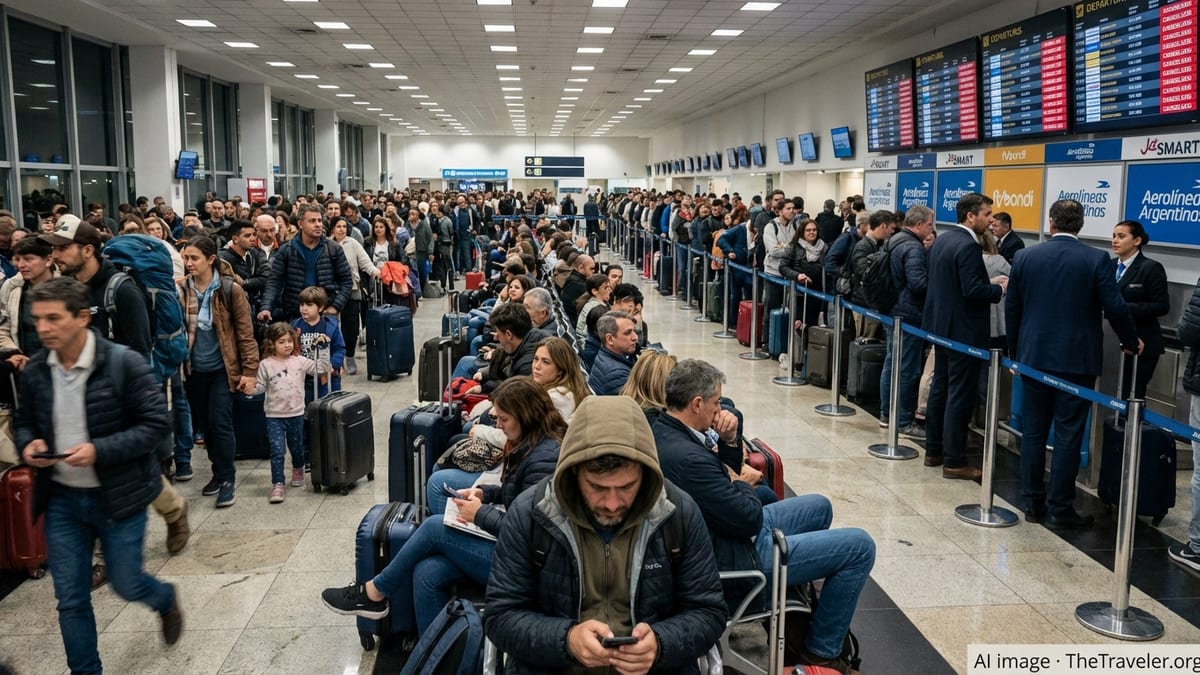
In Buenos Aires, the disruption was felt most acutely at Aeroparque Jorge Newbery and Ministro Pistarini International Airport in Ezeiza, where long lines formed at airline counters as passengers sought information about their flights. Many arrived to find departures boards marked with waves of cancellations or significant delays, with staff directing them to digital self-service channels for rebooking and refunds.
Flybondi, which typically operates a large share of its schedule from Aeroparque, shifted much of its activity to Ezeiza in an attempt to partially insulate operations from the strike’s impact on ground handling services. Even so, the carrier canceled 28 flights and modified many others, affecting travelers on popular leisure routes to Bariloche, Iguazú and the Atlantic coast.
LATAM, which relies heavily on Intercargo for ramp and ground services, reported canceling dozens of flights in and out of Buenos Aires and other Argentine cities while allowing that some services might still operate with altered times. Passengers were urged to monitor mobile apps and email notifications closely, as same-day changes remained possible depending on staffing levels and fuel availability.
Inside the terminals, scenes ranged from subdued resignation to visible frustration as families on summer holidays, business travelers and international tourists waited for news. Many passengers traveling on to other South American destinations, or with long-haul connections in São Paulo and Santiago, faced complicated rerouting and overnight stays.
Ripple Effects Reach Córdoba, Mendoza and Bariloche
Beyond the capital, major provincial hubs saw their own operations curtailed. Córdoba, a vital connection point for domestic and regional routes, experienced widespread cancellations as Aerolíneas Argentinas, JetSMART and LATAM trimmed or suspended services. Travelers aiming to connect through Córdoba to northern Argentina or neighboring countries found options sharply reduced.
In the wine region of Mendoza, airlines scaled back operations sharply, forcing many visitors to either delay departures or rework itineraries via overland transport. Hotels reported a mix of unexpected extra nights and same-day cancellations as travelers recalibrated their plans around uncertain flight availability.
San Carlos de Bariloche, one of Patagonia’s busiest summer destinations, was among the hardest hit tourist cities. With multiple daily flights from Buenos Aires and other cities canceled, mountain lodges and tour operators scrambled to accommodate guests unable to depart as scheduled. Operators warned that the disruption could have a cascading effect on upcoming bookings if confidence in air reliability deteriorates.
GOL Airlines and other Brazilian and regional carriers operating cross-border routes also adjusted schedules into secondary Argentine cities, while Chilean services saw knock-on effects due to constrained capacity and crew rotations, deepening uncertainty for travelers with multi-country itineraries.
Santiago and Regional Hubs Feel Cross-Border Shock
The impact of the strike extended beyond Argentina’s borders, notably to Arturo Merino Benítez International Airport in Santiago, a key regional hub. Chilean airport authorities reported a slate of cancellations and schedule changes on flights to and from Buenos Aires, Córdoba and Mendoza, as Argentine-based staff and services were affected by the work stoppage.
LATAM, which maintains a significant presence in both countries, adjusted its Santiago operations to reflect the disruptions in Argentina, re-timing flights where possible to ensure crew and aircraft rotations could be maintained. Nonetheless, travelers connecting through Santiago on long-haul routes to North America and Europe encountered missed connections and lengthy rebooking processes.
Brazilian airports with strong links to Argentina, including São Paulo and Rio de Janeiro, also reported irregular operations on services operated by GOL Airlines and other carriers. Some flights were consolidated, while others were postponed or canceled outright, complicating travel at the peak of the Southern Hemisphere summer season.
In neighboring Uruguay and Paraguay, smaller regional airlines and charter operators reported schedule changes due to shared ground services and crew obligations that tie their operations to Argentine infrastructure. Travel agents in Montevideo and Asunción said they were inundated with last-minute change requests from travelers unable to continue journeys via Argentina as planned.
Union Show of Force Against Milei’s Labor Reform
The aviation disruption formed just one part of a broader national shutdown orchestrated by the General Confederation of Labor, Argentina’s largest umbrella union. The 24-hour strike coincided with debate in the lower house of Congress over a sweeping labor reform package championed by President Javier Milei, which unions argue would erode long-standing worker protections and weaken the right to strike.
The proposed reform includes measures that would lengthen maximum working hours, reduce severance obligations for employers and impose stricter limits on industrial action in essential services such as air traffic control, health care and public transport. Unions view the bill as a fundamental threat to collective bargaining power and job security in an already fragile labor market.
This latest strike marks one of the most significant tests yet of Milei’s determination to push through his free-market agenda, which he says is vital to attracting investment and curbing inflation. With a large share of Argentina’s workforce unionized, and many sectors still reeling from previous economic shocks, the political stakes surrounding the labor reform are high.
While air navigation services formally remained classified as essential, unions representing ground personnel, airline employees and airport support workers aligned with the CGT strike, effectively constraining the ability of carriers to operate even where aircraft and crews were available. The result was a patchwork of minimal operations, with airlines seeking to preserve essential services while acknowledging the practical limitations imposed by the stoppage.
Passengers Scramble for Alternatives and Compensation
As cancellations multiplied, airlines rushed to publicize waivers and flexible policies to manage passenger frustration. Aerolíneas Argentinas encouraged travelers to use digital channels to rebook without charge, advance or delay their departures, or request refunds where applicable. The airline stressed that passengers should avoid going to airports unless they had confirmed, updated flight information.
JetSMART offered affected customers free changes to travel dates, allowing them to rebook for departures up to March 15 without additional fees or fare differences. LATAM announced that passengers whose flights were canceled or significantly rescheduled could change their travel dates within the year or request refunds on unused segments at no cost.
Flybondi, confronting both cancellations and shifts in airport operations from Aeroparque to Ezeiza, set out guidelines enabling customers to change flights at no extra cost if their schedules were altered by more than four hours. Travel agencies, meanwhile, became an essential intermediary for many travelers, as those who had booked through third parties were asked to contact agents directly for solutions.
In practice, the combination of peak-season demand and limited remaining capacity meant that some travelers had to accept departures days later than originally planned or pivot to long-distance buses and private car rentals. Long queues at intercity bus terminals in Buenos Aires and Córdoba attested to the surge in overland demand as flyers sought alternative ways to reach their destinations.
Tourism and Business Face Short-Term Shock
The timing of the strike, in the middle of the Southern Hemisphere summer and a key vacation period for both domestic and regional travelers, magnified its impact on Argentina’s tourism industry. Hotels, wineries, ski and mountain resorts and tour operators all reported disruptions as guests delayed arrivals, extended stays or canceled trips outright amid the uncertainty.
Business travelers also felt the pinch. Conferences and corporate meetings scheduled in Buenos Aires, Córdoba and Mendoza saw attendance affected as regional participants struggled to secure timely flights. Some events were shifted online or postponed, adding to the sense of unpredictability facing organizations that rely on reliable air links.
Analysts noted that while a single-day strike is unlikely to permanently damage Argentina’s appeal as a travel destination, repeated episodes of large-scale disruption could undermine confidence among international visitors and airlines considering capacity growth. For a country that has been courting tourists with favorable exchange rates and strong cultural appeal, maintaining stable transport links remains essential.
In the short term, tourism bodies and local authorities focused on crisis management, helping stranded travelers with information on accommodation, ground transport and rebooking options. Industry representatives called for clearer protocols to shield critical tourism flows from future industrial actions, while acknowledging that deep political and economic tensions are driving the current unrest.
Outlook: More Disruption Possible as Political Battle Continues
With the lower house still debating the labor reform bill, unions signaled that Thursday’s strike may not be the last major action if lawmakers press ahead with the government’s agenda. CGT leaders framed the stoppage as both a warning and a demonstration of the movement’s capacity to paralyze key sectors, including aviation, banking, education and public services.
For airlines, the prospect of further strikes introduces another layer of uncertainty in a market already grappling with currency volatility, fluctuating demand and tight margins. Carriers serving Argentina are expected to maintain flexible scheduling strategies and contingency plans, including shifting operations between airports, consolidating frequencies and expanding rebooking waivers when necessary.
Travelers planning to visit Argentina in the coming weeks were advised by industry experts to monitor airline communications closely, allow extra buffer time for connections, and consider travel insurance that covers disruption caused by industrial action. While the bulk of operations are expected to resume gradually after the 24-hour strike, the political backdrop suggests that labor-related turbulence could flare up again.
For now, the thousands of passengers stranded or delayed across Buenos Aires, Córdoba, Mendoza, Bariloche, Santiago and beyond remain the most immediate human face of a confrontation that stretches well beyond airport terminals, touching on fundamental questions about labor rights, economic reform and Argentina’s path forward.