

More news on this day
Singapore’s Changi Airport has again surged to the top of global aviation rankings, reclaiming the title of the world’s best airport for 2025 and reinforcing its reputation as a destination in its own right rather than merely a place to catch a flight.
Get the latest news straight to your inbox!
A Record-Breaking Return to the Top
According to the latest Skytrax World Airport Awards, Singapore Changi Airport has been named the World’s Best Airport for 2025, reclaiming the crown from Doha’s Hamad International Airport and extending its lead as the most decorated hub in the survey’s history. Publicly available information shows that this is Changi’s 13th overall win, adding to a run of eight consecutive titles from 2013 to 2020 and further victories in 2000, 2006, 2010 and 2023.
Published coverage of the 2025 rankings indicates that Changi outperformed other major hubs in key passenger satisfaction metrics, edging out Hamad International in Doha, which placed second, and Tokyo’s Haneda Airport, which came third. The results underscore a broader regional trend, with Asian airports once again dominating the upper tier of the global league table.
The accolade comes at a time when global air travel has largely rebounded, placing new pressure on airports to manage surging volumes while maintaining service standards. In this environment, Changi’s ability to combine efficiency, design and entertainment has helped it stand out in what analysts describe as an increasingly competitive field for transfer and destination traffic.
Record Traffic and Relentless Operational Precision
Recent figures from Changi Airport Group and other publicly available data show that Changi handled close to 70 million passengers in 2025, surpassing previous records and confirming its recovery from the pandemic-era downturn. Aircraft movements and cargo volumes also rose, strengthening the airport’s role as both a passenger gateway and a key freight node in Asia.
Despite the higher traffic, Changi’s operational performance has remained tightly calibrated. Industry reporting points to consistently strong on-time performance, streamlined security and immigration processes, and well-managed transfer corridors. Aviation analysts note that these fundamentals, often less visible than headline attractions, are central to the airport’s success in international rankings.
Behind the scenes, Changi has steadily expanded its use of data and automation to keep operations flowing. From smart baggage systems to dynamic gate allocation tools and real-time crowd management, the airport is functioning more like a complex logistics ecosystem than a traditional terminal, a shift that commentators say is increasingly defining the world’s top-performing hubs.
Reimagining the Airport as an Urban Resort
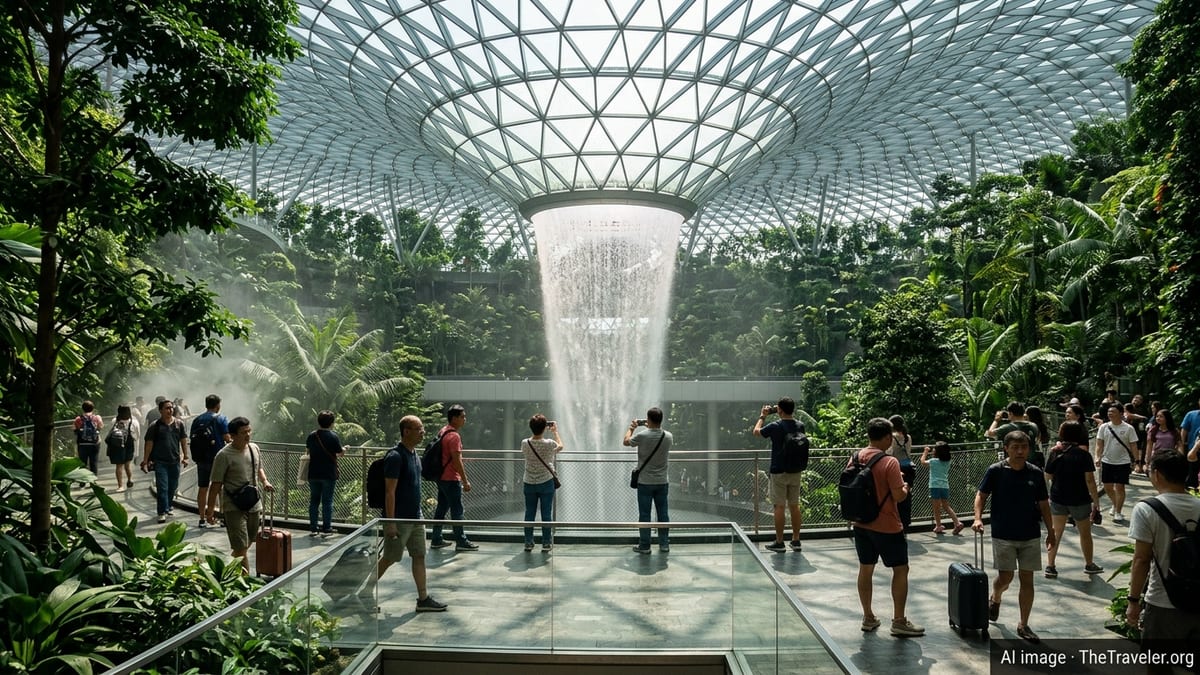
Changi’s repeat success also reflects its continued evolution as a lifestyle destination. The airport’s now-iconic Jewel complex, anchored by its indoor forest and towering central waterfall, remains a focal point for visitors, with retail, dining and leisure spaces that blur the boundary between airport and city mall.
In addition to headline attractions, the terminals themselves are lined with themed gardens, art installations and quiet relaxation zones, creating a series of “micro-destinations” that give travelers reasons to linger. Reports highlight that this emphasis on greenery, natural light and open sightlines helps reduce stress and orient passengers, particularly those navigating long-haul transfers.
Family-friendly amenities, from playgrounds and movie zones to transit-area attractions, round out the offering for travelers with long layovers. Industry observers note that by investing early and aggressively in non-aeronautical experiences, Changi helped set a template that other major airports are now racing to emulate.
Revolutionary Amenities from Dining to Wellness
The 2025 Skytrax results show that Changi did not just win the overall title; it also topped several specialist categories, including World’s Best Airport Dining, World’s Best Airport Washrooms and Best Airport in Asia. Travel media coverage points out that these awards highlight the airport’s focus on everyday touchpoints that strongly influence passenger perception.
Food and beverage options span Singaporean hawker-style favourites, regional Asian cuisines and international concepts, with many outlets operating extended hours to serve passengers across time zones. Curated dining streets and open-concept food halls aim to replicate the city’s culinary reputation inside the terminals, turning meal stops into a memorable component of the journey.
Changi’s emphasis on comfort and wellness has expanded in recent years with additional rest zones, pay-per-use lounges, spa services and even short-stay hotel rooms within the secure area. Showers, nap pods and quiet workspaces are designed for travelers facing long transits, while thoughtful touches such as well-signposted nursing rooms and accessible facilities contribute to the airport’s strong scores on family and inclusivity measures.
Technology, Sustainability and the Road to Terminal 5
Looking ahead, Changi is preparing for an even more ambitious phase of development as it progresses plans for its massive Terminal 5 project on the airport’s eastern side. Official project documents and local media coverage describe T5 as a “next-generation” terminal designed to handle tens of millions of additional passengers annually, effectively creating a second airport precinct linked to the existing terminals.
In preparation, the airport has been piloting new technologies that hint at the direction of future operations. Industry reports refer to tests of autonomous baggage vehicles able to move laterally into loading bays, expanded biometric identity solutions at check-in and boarding, and more sophisticated predictive maintenance regimes for critical infrastructure.
Sustainability has become another pillar of Changi’s long-term strategy. Public reports outline investments in more energy-efficient cooling systems, solar generation on airport rooftops, and building designs that maximise natural light while reducing heat gain in Singapore’s tropical climate. Waste reduction initiatives across retail and food operations also form part of a broader push to align with international environmental benchmarks.
As global aviation continues to recover and evolve, Singapore’s flagship airport appears determined to remain several steps ahead of its rivals. With record traffic, a string of new awards and transformative projects on the horizon, Changi is positioning itself not only as the world’s best airport in current rankings but as a model for how future airports might look and feel.