

More news on this day
Singapore’s Changi Airport has emerged as a standout global hub for spontaneous human interaction, with a new ranking highlighting how its gardens, waterfalls and lifestyle zones create unusually fertile ground for chance encounters compared with other mega-airports such as Seoul Incheon, London Heathrow, Dubai, New York JFK, Istanbul and Tokyo Haneda.
A New Kind of Airport Ranking Focused on Human Connection
The latest recognition for Changi comes from a global “Love Connection Score” compiled by aviation legal-tech firm AirAdvisor, which assesses how likely passengers are to experience serendipitous real-world encounters while in transit. Instead of focusing only on punctuality or luxury, the index blends passenger volumes, route diversity, transfer traffic, comfort levels, reviews and the density of cafés, bars and shared social spaces to evaluate airports as social ecosystems.
In the February 2026 release of the ranking, Changi was named one of the world’s top airports for meeting new people, scoring highly on passenger comfort and the quality of public areas. While Istanbul, London Heathrow, Seoul Incheon, Dubai, New York JFK and Tokyo Haneda all made the global top tier, Changi stood out as the only Southeast Asian airport near the top and one of the very few that are explicitly designed as a lifestyle destination as much as a transport node.
The study’s authors argue that airports which encourage people to linger in communal spaces, rather than funnel them quickly from security to gate, naturally generate more opportunities for conversation. In this respect, Changi’s long-standing strategy of combining nature, attractions, retail and open seating has become a model for how mega-hubs can foster human connection even as they grow busier and more complex.
Industry analysts note that the new index arrives at a moment when air travel has largely recovered from the pandemic shock and passenger numbers are again hitting record highs. The question for leading hubs is no longer simply how to move people efficiently, but how to turn unavoidable waiting time into a positive, even memorable, part of the journey.
How Changi’s Design Nurtures Spontaneous Encounters
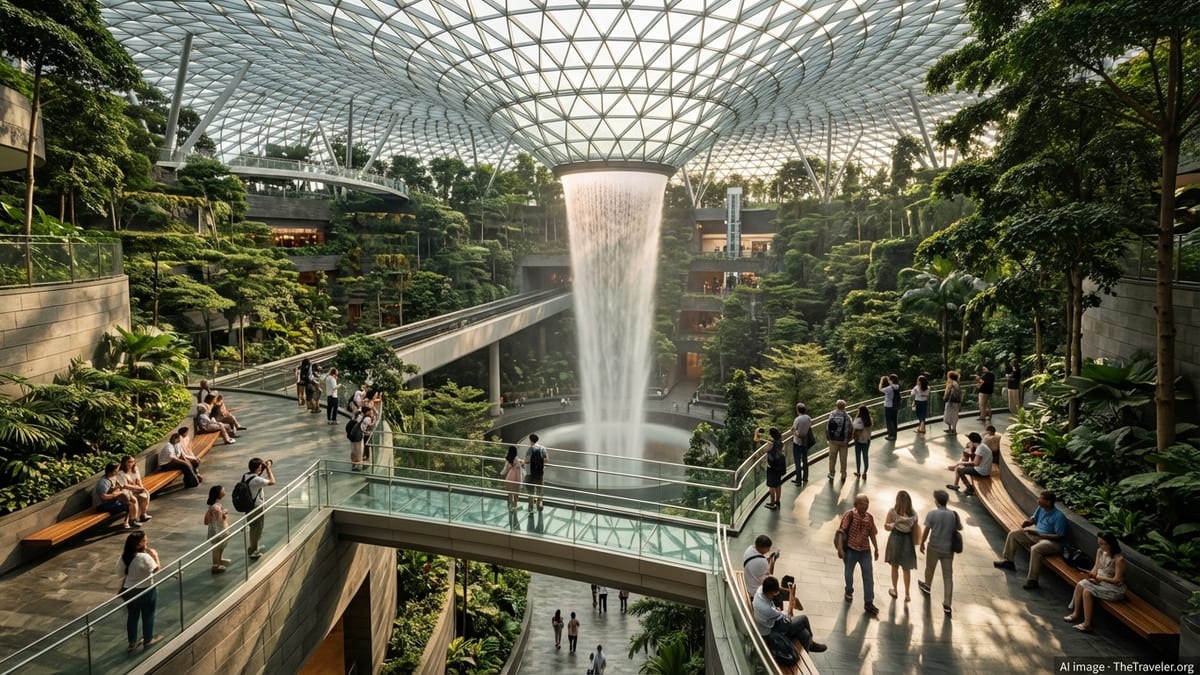
Central to Changi’s performance in the new ranking is the way its physical design slows passengers down in deliberate ways. The Jewel complex, which opened in 2019 between the passenger terminals, anchors this approach with its soaring glass dome, the 40 meter high indoor waterfall known as the HSBC Rain Vortex and a multi-level forest valley filled with more than 2,000 trees and palms. The result is a public space that feels more like an urban park than an airport concourse, inviting visitors to wander, sit and look around.
Architects and planners speak of biophilic design and horizontal and vertical green integration, but for travelers the impact is simple: stress levels drop, people linger and they become more receptive to their surroundings. The open terraces, bridges and seating clusters in Jewel and across the terminals are arranged to create multiple sightlines, where passengers crossing paths may notice one another more than they would in a narrow corridor lined only with duty-free counters.
This philosophy extends beyond Jewel into the main terminals. Refurbished areas in Terminal 2 and Terminal 3, for instance, include towering indoor gardens, natural daylight from skylights and quiet seating zones separated from the main traffic flow. Even in more functional areas such as boarding piers, clusters of communal tables, charging points and soft seating encourage travelers to share space rather than retreat into isolated corners.
For Changi Airport Group, the investment in such environments is not purely aesthetic. A calmer, greener terminal can ease operational bottlenecks by distributing crowds and reducing tension during delays, while also creating the kind of setting where striking up a conversation with a stranger feels more natural. The Love Connection Score effectively quantifies this once-intangible benefit of good design.
Social Programming Turns a Transit Hub into a Meeting Place
Beyond architecture, Changi’s calendar of events and curated experiences also plays a role in making the airport a place where people meet intentionally as well as by chance. In recent years, the airport has hosted family overnight camps in Jewel, horticulture workshops within its indoor gardens and themed festivals such as light and music shows around the Rain Vortex and seasonal floral displays.
These events draw local residents as well as travelers, transforming parts of the airport into a semi-public square for Singaporeans. Families attend airport camps together, students come for educational programs, and couples visit Jewel’s indoor forest and canopy attractions on dates. The steady flow of non-flying visitors increases the mix of people using the space, expanding the potential for offbeat encounters between international passengers and locals.
Changi also leans on food and retail to create social micro-hubs. A dedicated cluster of Singaporean brands in Jewel brings in visitors seeking specialty snacks, fashion and café experiences that are hard to find elsewhere in the city. Regular promotions around local cuisine, pop-up markets and live performances turn the concourses into temporary gathering points, giving solo travelers and groups alike an excuse to pause and share the same experience.
Airlines based at Changi have adopted similar strategies inside their lounges. Singapore Airlines’ premium lounges, for example, now feature a tea house concept and flexible seating areas that are designed as much for quiet conversation and cultural exchange as for private work. These moves reinforce the broader trend: the airport is no longer conceived solely as a place to pass through, but as a destination where social life unfolds in parallel with the machinery of global aviation.
How Changi Compares with Other Global Mega-Hubs
The new ranking places Changi alongside some of the world’s busiest and most connected airports, but the way it competes in the social dimension differs from its peers. London Heathrow, for example, dominates global connectivity tables, with tens of thousands of potential international connections within a six-hour window on peak travel days. Istanbul and Dubai have also surged as transfer super-hubs, funnelling millions of passengers through expansive terminals each year.
These airports excel at moving vast numbers of people and offer extensive retail and lounge networks, yet much of their built environment remains oriented around rapid throughput. Long linear concourses, tightly sequenced security and immigration checkpoints, and departure areas focused on gate proximity can leave travelers with limited incentive to venture far from their assigned zones. When unexpected social interactions do occur, they often happen in queues, crowded food courts or packed boarding areas.
By contrast, Changi’s footprint is organized less as a single monumental hall and more as a collection of interconnected districts. Jewel acts as a shared central plaza for all terminals, while each terminal’s public zones include themed gardens, art installations and viewing decks. For transfer passengers with a few hours to spare, this layout makes it easier to wander, double back or simply sit in a visually rich environment that feels safely removed from the most hectic parts of the operation.
Seoul Incheon and Tokyo Haneda have increasingly adopted similar ideas, with landscaped indoor spaces, cultural pavilions and curated dining streets aimed at encouraging people to linger. However, the Love Connection Score suggests that Changi’s long-standing emphasis on being “more than an airport” gives it an edge when measuring how conducive the environment is to serendipity. While each hub has its strengths, Changi’s combination of comfort, greenery and accessible attractions gives it an outsized presence in this emerging metric.
New York, London, Dubai and Istanbul Under the Social Microscope
In the AirAdvisor index, several major hubs in Europe, the Middle East and North America also rank highly for potential real-world connections. New York’s JFK, for instance, benefits from heavy transfer traffic and the fact that its passengers are often continuing into one of the world’s most socially active cities. Long layovers and delays can spill over into impromptu conversations in bars, shared seating areas and security lines, with the possibility of meetings continuing in the city beyond the airport.
London Heathrow and Istanbul Airport similarly score strongly on passenger numbers and network reach. Long-haul travelers connecting between continents find themselves spending extended periods in expansive terminals that now include art exhibitions, premium retail and open dining spaces. Dubai International Airport, which has undergone successive expansions to keep pace with rising demand, offers a dense grid of shops, mosques, quiet rooms and seating zones where travelers cross paths around the clock.
Yet for all their energy, these hubs also bear the hallmarks of continuous expansion: sprawling gate piers, complex terminal transfers and security processes that can leave passengers more focused on navigation than on their surroundings. The result, according to researchers behind the Love Connection Score, is that conditions for interaction may be more situational, depending on the time of day, crowding levels and how comfortable travelers feel at a given moment.
Changi’s advocates argue that by prioritizing intuitive wayfinding, short walking distances and a high ratio of natural spaces to commercial frontage, the Singapore hub reduces the cognitive load on passengers. When basic needs such as seating, greenery, power outlets and clear signage are easily met, people have more bandwidth for conversation. In a ranking that values ease, mood and mutual visibility as much as raw traffic, this difference matters.
The Science of Comfort and Mood in Airport Design
A notable feature of the Love Connection Score is its emphasis on comfort and mood as key components of social readiness. Changi scored at or near the top of the index on these factors, supported by consistently strong customer reviews that highlight cleanliness, calm and the perception of safety across its terminals and Jewel complex.
Environmental psychologists have long pointed to lighting, greenery, acoustics and crowd density as critical variables in determining whether public spaces feel approachable. Changi’s heavy use of plants, water features and natural light is aligned with research showing that even short exposure to nature-like environments can lower heart rate and stress, making people more open and less defensive in social situations.
Temperature control and air quality are also part of the equation. The Rain Vortex and surrounding forest valley in Jewel help create a localized microclimate that feels cooler and less stuffy than a conventional transit hall. Across the wider airport, careful zoning separates noisier retail and dining strips from quieter relaxation areas, giving travelers options according to their preference. Providing choice is seen as crucial: people who feel in control of their surroundings are more likely to smile, make eye contact and strike up informal conversations.
Crucially, the ranking’s designers note that comfort alone is not enough. An airport can be calm yet isolating if seating is too compartmentalized or if amenities are pushed into enclosed lounges. Changi’s blend of open communal tables, shared viewing decks and accessible attractions introduces what planners sometimes call productive friction: small, low-stress moments where paths naturally cross and social signals can be exchanged without obligation.
From Family-Friendly Hub to Social Laboratory
Changi’s high score for spontaneous interactions builds on its growing reputation in other passenger-focused rankings. In 2025, a major industry survey placed the airport second worldwide for family friendliness, citing amenities such as interactive exhibits, children’s play areas and stroller services. It also continues to feature prominently in lists of the world’s best and most photogenic airports, reinforcing its dual identity as both travel infrastructure and leisure destination.
Family-oriented features, while designed primarily for convenience, can also feed into the airport’s social dynamic. Parents often congregate around play zones, nursing rooms and family security lanes, creating natural clusters where conversations begin with shared experiences of travel. Attractions such as the Changi Experience Studio and canopy play structures in Jewel bring together children and adults from different countries in the same space, creating icebreakers that might not exist in a conventional gate lounge.
These patterns are instructive for other airports looking to boost their own social scores. By investing in inclusive spaces that feel welcoming to families, solo travelers and older passengers alike, hubs can create diverse micro-communities instead of segregating users into purely transactional environments. Changi’s example suggests that an airport can be both intensely efficient and quietly sociable if its public spaces are treated as civic infrastructure rather than mere circulation corridors.
With expansion plans underway for a new Terminal 5, Changi’s next challenge will be scaling this model without losing the intimacy that underpins its success. Planners have signalled that future facilities will continue to emphasize greenery, flexible social zones and intuitive layouts, turning the upcoming terminal into a testing ground for how mega-projects can preserve the conditions for serendipity even as passenger numbers climb.
A Template for the Next Generation of Global Hubs
The emergence of rankings built around interpersonal connection marks a subtle but important shift in how airports are judged. For decades, metrics such as on-time performance, retail yield and gate utilization dominated industry scorecards. Now, as long-haul travel becomes more routine and competition between hub cities intensifies, softer qualities like ambiance, community engagement and social opportunity are moving closer to the center of strategic planning.
Changi’s position in this new landscape sends a clear signal: investments in gardens, waterfalls, cultural programming and inclusive seating are not mere embellishments, but core components of a hub’s value proposition. While airports such as Seoul Incheon, London Heathrow, Dubai, New York JFK, Istanbul and Tokyo Haneda each bring enormous strengths in connectivity and scale, Singapore’s flagship shows how a sustained focus on human experience can shape global perceptions in a different way.
For travelers, the impact is felt in small, personal moments: a conversation struck up on a viewing deck, a shared laugh over a light show by the Rain Vortex, a chance meeting at a café that continues in another country. For cities and nations, the stakes are larger. Airports are often the first and last physical touchpoints with a destination. If they can reliably generate positive, sometimes even meaningful, human interactions, they become ambassadors not only for efficiency and modernity, but for openness and connection.
As the world’s major hubs look ahead to the next wave of expansion projects and terminal redesigns, many will be studying Changi’s example. The message from the latest rankings is straightforward: in the race to connect continents, the airports that also connect people may gain the most enduring advantage.