

Passengers across Asia and beyond faced a day of turmoil as widespread disruptions at Singapore Changi Airport and Jakarta’s Soekarno-Hatta International Airport saw 757 flights delayed and 9 canceled, snarling operations for major carriers including Singapore Airlines, Garuda Indonesia, AirAsia, Scoot and Lion Air and sending shockwaves through regional and long-haul networks.
Two Key Hubs Brought To A Standstill
The latest disruption unfolded across two of Southeast Asia’s most important aviation hubs, Singapore Changi and Jakarta’s Soekarno-Hatta, where a convergence of operational bottlenecks, weather challenges and tight scheduling combined to push the system beyond its limits. By the end of the operating day, airport and airline data showed 757 flights delayed and 9 canceled across affected networks, a figure more commonly associated with major storms or air traffic control failures than routine peak traffic.
Changi, which handled close to 70 million passengers in 2025 and has already been operating at near-record volumes into early 2026, proved particularly vulnerable to cascading delays. Even modest schedule slippages at a hub built on precise connectivity quickly translated into missed connections, aircraft out of position and mounting queues at rebooking counters, as thousands of transit passengers found carefully timed itineraries disrupted.
In Jakarta, Soekarno-Hatta’s chronic congestion and recent weather-related strains left little buffer to absorb knock-on effects. The airport, which only weeks earlier had battled significant delays linked to heavy rain and temporary runway constraints, again found gate space, taxiways and airside logistics under pressure as aircraft waited for slots and passengers lingered in crowded departure halls.
While the raw numbers tell only part of the story, aviation analysts noted that the scale of disruption in a single operational window was striking, even by Southeast Asia’s increasingly delay-prone standards. The impact spread well beyond Singapore and Jakarta, touching Kuala Lumpur, Bangkok, Sydney and onward long-haul routes to the Middle East, Europe and North Asia.
Major Carriers Struggle To Keep Schedules Intact
Among the hardest-hit operators were Singapore Airlines and its low-cost affiliate Scoot, which together run dense shuttle schedules between Singapore and Jakarta as well as key regional links to Kuala Lumpur and Bangkok. With aircraft rotations already finely tuned and spare capacity limited, any prolonged delay in one sector rapidly spilled into subsequent departures, forcing operations teams to juggle equipment swaps and crew duty limitations.
Garuda Indonesia, Lion Air and Indonesia AirAsia, all significant players at Soekarno-Hatta, also reported widespread delays on Jakarta-originating and inbound services. These carriers underpin Indonesia’s domestic connectivity while linking Jakarta to regional gateways such as Singapore, Kuala Lumpur and Bangkok. As holding patterns lengthened and turnaround times stretched, departures that were initially pushed back by 30 minutes often slipped to more than two hours behind schedule.
For AirAsia, which channels substantial Southeast Asian low-cost traffic through hubs in Kuala Lumpur and Bangkok, the disruption at Singapore and Jakarta translated into misaligned connections across its point-to-point network. Passengers who had booked self-connecting itineraries, common in the budget segment, were especially exposed, with missed onward flights frequently treated as separate, non-protected journeys.
Although only 9 flights were ultimately canceled, operations managers cautioned that this relatively low cancellation number masked just how stretched airlines had become. Many services operated with extensive delays to avoid outright cancellations that would have left passengers with no same-day alternatives. That choice, while sparing some travelers from overnight stays, contributed to the rolling backlog as delayed aircraft and crews flowed through the system.
Passengers Face Long Queues, Frayed Tempers And Missed Trips
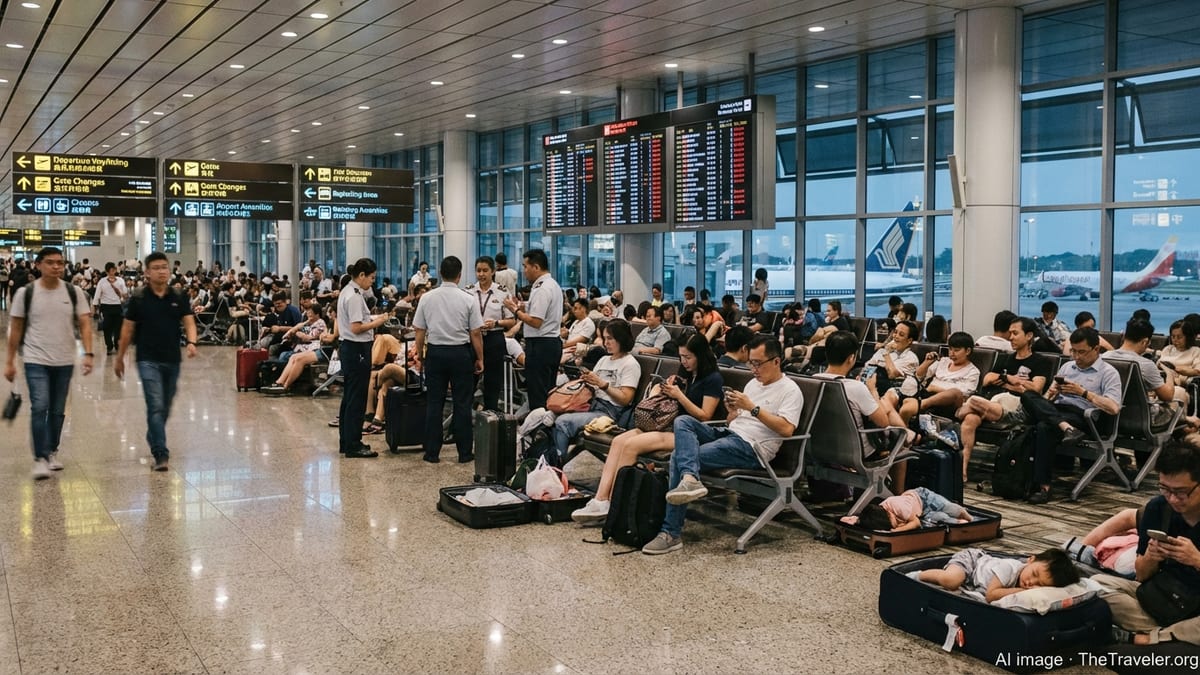
Inside terminal buildings at Changi and Soekarno-Hatta, the human cost of the disruption was unmistakable. Information boards flickered with red and amber alerts, while lines at customer service desks quickly snaked through concourses as travelers sought new routing options, overnight accommodation or at least clarity on when they might depart.
Families connecting through Singapore to holiday destinations in Bali, Phuket and Sydney were among those hardest hit. Many arrived from overnight or early-morning flights only to discover that their onward sectors had been heavily delayed, with minimum connection times blown apart. For some, even short delays of 60 to 90 minutes were enough to break carefully sequenced itineraries that linked multiple carriers across different tickets.
Business travelers between Singapore and Jakarta, one of Southeast Asia’s busiest corporate corridors, also felt the impact. Morning shuttles that executives rely on to make same-day meetings in either city departed late, compressing already tight schedules and leading to a wave of rescheduled appointments and virtual calls. The disruption underlined how dependent regional commerce remains on reliable short-haul connectivity.
At Jakarta’s Soekarno-Hatta, meanwhile, domestic passengers bound for cities such as Surabaya, Makassar and Medan experienced a knock-on effect as aircraft arriving late from Singapore or other international points struggled to turn around in time for onward domestic legs. For many, the delays translated into late-night arrivals in regional centres that lack extensive ground transport options after dark, complicating onward journeys home.
From Local Logjams To Global Ripples
Although the most visible disruption was concentrated at Singapore and Jakarta, the effect rippled along aviation corridors stretching from Southeast Asia to Australia, the Middle East and Europe. Flights connecting through Changi to Sydney, Melbourne and Brisbane, for instance, faced tight turnaround windows that left long-haul aircraft waiting for delayed feeder traffic, or in some cases departing with empty seats where connecting passengers failed to make the new departure times.
In Kuala Lumpur and Bangkok, both important regional hubs in their own right, airlines reported increased pressure on rebooking channels as passengers attempted to reroute journeys around the worst-affected points. Travel agents and online booking platforms were drawn into the scramble, as corporate clients sought alternative routings for time-sensitive trips via secondary hubs such as Hong Kong, Seoul or Dubai.
The disruption arrived against a backdrop of mounting operational strain across Asia’s aviation system. Recent weeks have already seen several days with more than a thousand delayed flights regionwide, driven by a mix of volatile weather, infrastructure works and tight post-pandemic staffing. Singapore, Jakarta and Manila have all featured prominently in those tallies, underscoring the limited margin for error at airports where demand has outpaced incremental capacity upgrades.
For global carriers that rely on Southeast Asian hubs as key waypoints in their long-haul networks, even short-lived disruptions can reverberate for days. Aircraft and crews out of position in Asia may miss their scheduled rotations to Europe or North America, while airport slots and curfews at distant destinations further constrain recovery options.
Behind The Numbers: Why 757 Delays Hit So Hard
Aviation experts argue that the severity of the latest disruption is not just about headline numbers but also timing and geography. The 757 delayed flights were concentrated heavily in peak morning and evening periods, when airports already operate close to their maximum throughput and airlines depend on precise waves of departures and arrivals to funnel connecting passengers through hubs.
The Singapore Jakarta air corridor, one of the busiest in the region with dozens of daily frequencies operated by Singapore Airlines, Scoot, Garuda and other carriers, illustrates this vulnerability. When early morning services depart late, they not only jeopardize same-day return trips for business travelers but also compress the schedule for aircraft that might be used on multiple sectors throughout the day, shrinking the ability to recover from further delays.
At Soekarno-Hatta, ongoing airside works and periodic runway and taxiway restrictions have also narrowed the operating envelope. Even when formal closures are limited to specific windows or zones, they can reduce the airport’s flexibility to resequence arrivals and departures in response to sudden weather changes or technical issues, contributing to longer ground holds and airborne holding patterns.
Capacity constraints are not unique to Southeast Asia, but the region’s rapid recovery in demand since 2023, coupled with lingering supply chain and fleet delivery challenges, has left many airlines with fewer spare aircraft than in the past. As a result, there is less slack to absorb irregular operations, turning what once might have been manageable pockets of delay into full-scale network disruptions.
Airlines’ Response: Waivers, Rebookings And Operational Fixes
As delays mounted, airlines including Singapore Airlines, Garuda Indonesia, AirAsia, Scoot and Lion Air moved to activate their irregular operations playbooks. Passenger handling teams were reinforced at key transfer points, additional call center staff were brought online and digital channels were updated to encourage travelers to self-manage rebookings where possible, helping to reduce pressure on airport counters.
Several carriers introduced temporary fee waivers, allowing affected passengers to rebook onto later flights or shift travel to subsequent days without penalties, subject to seat availability. In some cases, travelers on canceled services were reaccommodated onto competing airlines, particularly on trunk routes between major hubs where interline agreements or ad hoc arrangements could be activated.
Operationally, airlines prioritized aircraft and crew allocation to routes with the highest passenger loads and limited alternatives, such as late-night departures to Australia or early morning shuttles feeding long-haul banks. Less time-sensitive services, particularly intra-regional leisure routes, absorbed a disproportionate share of the delay burden as carriers concentrated resources on protecting critical connections.
Airport operators at Changi and Soekarno-Hatta also played a coordination role, convening joint operations centers to monitor congestion in real time and adjust gate assignments, towing plans and ground handling resources. While such measures cannot erase the impact of large-scale delays, they can help prevent localized logjams from cascading into safety or security concerns.
What Travelers Can Learn For Future Trips
The latest wave of disruption offers important lessons for travelers planning to navigate Southeast Asia’s crowded skies in the coming months. With demand surging and infrastructure running close to capacity, passengers relying on tight self-made connections or separate tickets between low-cost and full-service carriers face heightened risk if even minor delays occur at major hubs.
Travel advisors increasingly recommend building in longer connection times at super-hubs such as Singapore, Jakarta and Kuala Lumpur, especially when journeys involve multiple airlines or cross-regional links to Australia, the Middle East or Europe. For critical trips, such as key business meetings or once-in-a-lifetime events, arriving a day early rather than relying on same-day connections can provide a valuable buffer.
Passengers are also being urged to make full use of airline and airport apps, which often provide the earliest indications of schedule changes and gate adjustments. Online rebooking tools, now standard across many full-service and some low-cost carriers, can significantly reduce the need to queue at service desks, particularly during broad disruptions when staff are stretched.
Frequent flyers note that understanding fare conditions and insurance coverage has become more important as irregular operations grow more common. Policies that explicitly cover missed connections, overnight accommodation and alternative routing can soften the blow of disruption that, as recent events have shown, is increasingly a feature rather than an anomaly of modern air travel in the region.
Strain Exposes Wider Questions About Regional Capacity
Beyond the immediate discomfort for passengers, the scale of the delays at Changi and Soekarno-Hatta has reignited debate about Southeast Asia’s readiness for the next phase of aviation growth. With major fleet upgrades pending at flagship carriers and low-cost airlines continuing to expand, runway and terminal capacity may struggle to keep pace without substantial new investment.
Singapore is already progressing with the multi-stage expansion of Changi, including the development of a future Terminal 5, but those projects will take years to translate into additional operational headroom. In the interim, the airport will remain heavily reliant on precision scheduling, advanced air traffic management and close coordination with airlines to avoid recurrent flashpoints of delay.
Indonesia, for its part, faces a broader network challenge. Jakarta’s Soekarno-Hatta must handle both dense domestic flows and growing international demand, while secondary gateways such as Bali and Makassar are themselves approaching capacity at busy times. Efforts to expand infrastructure and improve resilience are under way, yet the pace of demand growth continues to test the system.
Industry observers warn that without a deliberate focus on resilience, including contingency capacity, staffing robustness and modernized air traffic systems, the kind of disruption that produced 757 delayed flights and 9 cancellations in a single operational window could become increasingly frequent. For the region’s travelers and tourism economies, that prospect is more than a logistical inconvenience. It is a strategic challenge that will shape how, and how reliably, people move across one of the world’s most dynamic air travel markets.