

The Changing of the Guard at Syntagma Square is one of Athens’ most quietly powerful rituals, an encounter with living history that unfolds in the heart of the modern city every single hour. More than a photo opportunity, it is a meticulously choreographed ceremony in front of the Tomb of the Unknown Soldier, where the elite Evzones of the Presidential Guard keep watch over Greece’s war dead.
For travelers, understanding the story behind the slow, deliberate steps and the distinctive uniforms turns a brief stop on a city stroll into one of the most memorable experiences of a visit to Athens.
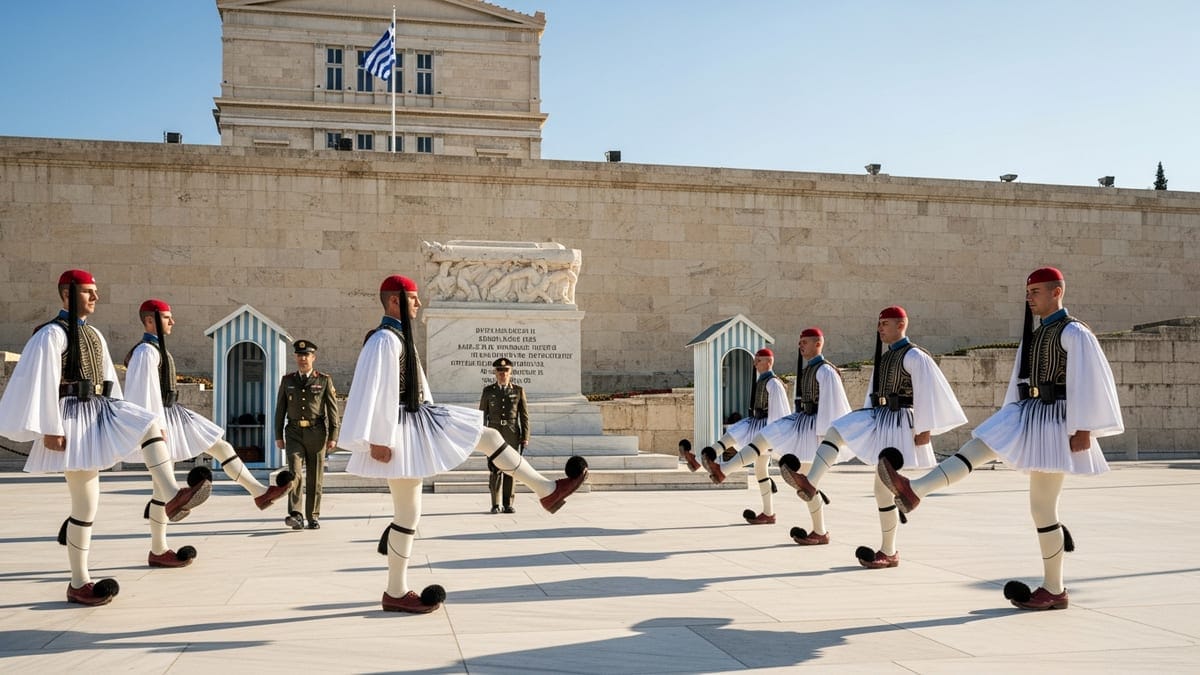
What Is the Changing of the Guard at Syntagma Square
The Changing of the Guard is the ceremonial relief of the Evzones who stand guard at the Tomb of the Unknown Soldier directly in front of the Hellenic Parliament on Syntagma Square. Every hour, on the hour, two guards are replaced by two new ones in a sequence of precisely timed movements and symbolic gestures. The guards stand absolutely motionless during their shift and come to life only when the change begins.
The ritual has become a signature Athens experience because it combines military discipline with deeply rooted national symbolism. The tomb itself is a cenotaph honoring all unidentified Greek soldiers who died in war, while the Evzones represent the country’s historic fighters, particularly those who fought in the Greek War of Independence. The ceremony is not a performance staged for tourists, but an active duty of the Presidential Guard and an expression of state respect for the fallen.
For visitors, this means that what they witness on the marble terrace above Syntagma Square is both everyday routine and national ritual. Crowds gather, cameras click, and children watch wide-eyed, yet the guards remain focused on their task: maintaining an unbroken vigil and executing each movement with ritual precision, regardless of weather, season, or onlookers.
Guard Change Times and Daily Schedule
The Changing of the Guard at the Tomb of the Unknown Soldier takes place every day of the year, 24 hours a day. The standard change occurs every hour, on the hour. At any given moment, you will find two Evzones on duty in front of the monument, accompanied by a supervising officer who oversees the ceremony and ensures both discipline and safety.
On most days, the regular hourly ceremony is relatively brief. The new guards march from their nearby barracks and approach the monument along Vasilissis Sofias Avenue or Amalias Avenue, depending on the route and traffic controls in place at the time. They then meet the outgoing guards in front of the tomb and perform a slow, mirrorlike sequence of leg lifts, steps, and synchronized turns before taking up their new positions.
Throughout the day and night the pattern remains the same, although crowds are typically larger from late morning through early evening. Even in the small hours before dawn, the Evzones maintain the same solemn routine, their movements illuminated only by the lights on the facade of Parliament and the monument itself. The constancy of the schedule makes it easy to plan a visit, since you can simply aim to be on Syntagma Square a few minutes before any hour that suits your itinerary.
The Grand Sunday Ceremony and Special Dates
While the hourly change is worth seeing at any time, the most impressive ceremony takes place every Sunday at 11:00 in the morning. This is often referred to as the Grand Change. Instead of just a pair of guards, an entire platoon of Evzones marches from their barracks behind Parliament down Vasilissis Sofias Avenue to the Tomb of the Unknown Soldier, accompanied by a military band. For this weekly parade, parts of the avenues are briefly closed to traffic, and the area around the monument fills with spectators.
During the Grand Sunday ceremony, more of the unit participates and the guards wear their full traditional dress uniform. The sequence around the monument is more elaborate, with large coordinated formations rather than the simple exchange of two sentries. For many visitors, this is the most dramatic and photogenic version of the Changing of the Guard, although it is also the most crowded.
The ceremony gains even more significance on key national days, especially Greek Independence Day on March 25 and Ohi Day on October 28. On these dates, the area around Syntagma hosts parades, official wreath layings, and extended commemorations, with the Evzones playing a central ceremonial role. If your visit coincides with one of these days, expect tighter security, larger crowds, and a particularly solemn atmosphere around the tomb.
The Evzones: Greece’s Presidential Guard
The guards you see at Syntagma belong to the Presidential Guard, the elite ceremonial unit of the Hellenic Armed Forces. Commonly known as Evzones, they trace their institutional roots back to the 19th century, when they served as a royal guard unit. Today they are under the authority of the Presidency of the Republic and perform primarily ceremonial and honor guard duties.
Service as an Evzone is highly selective. Guards are chosen from among conscripted soldiers and must meet strict criteria, including height, physical condition, discipline, and the ability to undergo demanding training. They serve around-the-clock shifts, not only at the Tomb of the Unknown Soldier but also at the Presidential Mansion and other state locations on specific occasions.
Evzones are known for their extraordinary stillness and concentration. During their one-hour duty at the tomb they must remain motionless, regardless of temperature, rain, or the behavior of observers. The slow, sweeping movements during the changing ceremony help restore circulation after this hour of immobility. Behind the formality, their presence at the tomb represents a living link between the modern Greek state and generations of men and women who fought in its wars.
Uniforms, Symbolism and Ritual Movements
The Evzones’ uniform is one of the most distinctive in Europe and is steeped in symbolism. The centerpiece is the white pleated skirt known as the foustanella, which traditionally features 400 pleats said to represent the 400 years of Ottoman rule. This is worn with a white shirt with wide sleeves, a finely embroidered waistcoat, a crimson fez-like cap with a long black tassel, and woolen leg garters. The traditional footwear, the tsarouchia, are leather clogs with large black pompons and heavy nailed soles that can weigh roughly three kilograms per shoe.
On Sundays and major national holidays, the guards typically appear in this full traditional white uniform. On regular weekdays, they usually wear either a khaki or dark uniform, depending on the season, with a slightly simplified appearance but with the same distinctive shoes and headgear. Each uniform is handmade and tailored to the individual guard, reflecting traditional designs associated with freedom fighters and mountain warriors from the 19th century.
The movements of the Changing of the Guard are carefully codified. The guards lift their legs high, often to shoulder level, and bring the tsarouchia down in a firm, echoing step that resonates off the marble. Their arms swing in a stylized arc. Each gesture is mirrored by the other guard so that the pair appears to move as one. The slow pace is more than ceremonial; it gives their muscles time to adapt after an hour of stillness and is sometimes interpreted as a symbolic “knocking” on the ground to signal to the fallen that the nation remains free.
A supervising officer, often not in Evzone dress, accompanies the guards. He ensures that the ceremony remains undisturbed, corrects any imperfections in position, and intervenes in cases of medical discomfort or inappropriate behavior from spectators. His presence underlines that, despite the cameras, this remains a military duty carried out with full seriousness.
History of Syntagma Square and the Tomb of the Unknown Soldier
Syntagma Square stands at the political and symbolic center of modern Athens. Its name means Constitution Square, commemorating the constitution granted after an uprising in 1843 that forced King Otto to accept a constitutional monarchy. The neoclassical building that dominates the east side of the square was once the royal palace and has housed the Greek Parliament since the 1930s. The square has long served as the city’s primary civic stage, the site of protests, celebrations, and national commemorations.
The Tomb of the Unknown Soldier, directly in front of Parliament, was inaugurated on March 25, 1932. The monument is a marble cenotaph with a relief of a fallen hoplite-like figure and inscriptions that include excerpts from the funeral oration of the Athenian statesman Pericles. Like similar monuments in other capitals, it honors all unidentified soldiers who died in war, rather than a specific individual. The decision to give such a prominent place to an anonymous soldier reflects a desire to recognize the sacrifices of ordinary Greeks in the nation’s turbulent military history.
From its earliest days, the tomb has been the focal point for national mourning and remembrance. Official ceremonies on Independence Day, Ohi Day, and other military anniversaries almost always involve wreath-laying at the monument. Over time, the presence of a permanent honor guard and the development of a distinctive changing ritual transformed the site into both a sacred national space and one of Athens’ most recognizable attractions.
In recent years, the Greek authorities have taken additional steps to protect the monument from vandalism and disruptive protests, reflecting its status as a symbol of the state’s continuity and the sacrifices of its citizens. Travelers are expected to treat the area as a place of respect, even as they photograph and observe the ritual.
Where and How to Watch the Ceremony
The Changing of the Guard takes place on the marble terrace facing Amalias Avenue, at the eastern edge of Syntagma Square. The Hellenic Parliament building forms the backdrop, with the Tomb of the Unknown Soldier set into the steps below its facade. Syntagma itself is one of Athens’ primary transport hubs, and reaching the ceremony is straightforward from almost anywhere in the city center.
The easiest access is via the Syntagma metro station, which serves lines 2 and 3 and opens directly onto the square. Multiple bus and trolleybus routes also stop at or near Syntagma, and the central tram line terminates here. Once you exit the station or alight from a bus, look for the broad staircase leading up to the Parliament building; the ceremony takes place at the top of these steps, in full view from much of the square.
For the regular hourly change, it is usually enough to arrive 10 to 15 minutes before the hour to secure a good vantage point, particularly on weekdays. On Sunday mornings, and especially for the 11:00 Grand Change, plan to arrive earlier. Crowds often deepen around 10:30 as tour groups gather, families spread out along the railings, and police begin managing pedestrian and vehicle traffic around the square.
Good viewing spots include the low barriers directly in front of the monument, the central area of Amalias Avenue when it is temporarily closed for the ceremony, and the upper steps of the square that offer a more elevated perspective. If you want unobstructed photographs, position yourself toward the center but be prepared for guards and officers to ask spectators to move back slightly to preserve a clear ceremonial path.
Etiquette, Photography and Practical Tips
Although the Changing of the Guard is widely photographed and shared on social media, it is first and foremost a military ceremony at a war monument. Basic etiquette is therefore expected. Visitors should not shout, push, or attempt to cross the ceremonial path during the change. Touching the guards or their uniforms is strictly prohibited and is considered disrespectful. Children can watch from the front, but adults should discourage them from getting too close or trying to make the guards laugh.
Photography is allowed and very common. You may take pictures and short videos from the front and sides as long as you do not obstruct the ceremony or climb on barriers and structures. When a guard is standing still on duty, it is permissible to stand beside him for a photograph, but you should avoid physical contact and maintain a respectful distance. If a supervising officer instructs you to move, follow directions immediately; the safety and dignity of the guards take priority over any photo opportunity.
From a practical perspective, consider the season when planning your visit. In summer, the marble around the monument reflects heat and can become very hot, so a hat, water, and sunscreen are recommended. In winter, cold winds can sweep down from the surrounding hills, and rain can make the marble slippery. The guards perform in all conditions, which can be an impressive sight, but visitors should prepare accordingly with appropriate footwear and clothing.
Because Syntagma Square is a major transportation node and frequent site of demonstrations and rallies, it is wise to keep an eye on local news or ask your hotel about any scheduled protests or road closures. During large political events, access around the Parliament building might be restricted or heavily policed, and ceremonies can be harder to view or briefly adapted for security reasons.
Combining the Guard Change with Nearby Sights
The central location of Syntagma Square makes it easy to incorporate the Changing of the Guard into a broader exploration of Athens. Directly behind the Parliament building lie the National Gardens, a lush 19th century park that offers shade, walking paths, and a tranquil contrast to the busy square. Many visitors choose to watch the ceremony, then stroll into the gardens for a quieter interlude among palm trees, ponds, and statues.
To the south and west, the streets leading from Syntagma flow into the historic Plaka neighborhood and the slopes of the Acropolis. After witnessing the Changing of the Guard, you can wander downhill through neoclassical streets, stop at a café or bakery, and make your way to major landmarks such as the Acropolis Museum, the Roman Agora, and the Temple of Olympian Zeus. The distance is walkable for most visitors in reasonable weather.
The square itself holds points of interest beyond the ceremony. The Syntagma metro station is known for its displays of archaeological finds unearthed during construction, while the surrounding area includes prominent hotels, shops, and government buildings. In the evening, the illuminated fountain and the lit facade of Parliament create a different, more atmospheric setting for the hourly change, which continues silently as the city’s nightlife awakens.
By timing your visit thoughtfully, you can use the guard change as the starting point for a full day’s itinerary or as a defining moment between museum visits and neighborhood explorations. Whether you choose a quiet hourly change at night or the full spectacle of the Sunday parade, the ceremony anchors your experience in the ongoing story of modern Greece.
The Takeaway
The Changing of the Guard at Syntagma Square is far more than a postcard moment. It is a living ritual that brings together the memory of Greece’s war dead, the pageantry of the Presidential Guard, and the everyday life of a busy European capital. By understanding the history of the Tomb of the Unknown Soldier, the meaning of the Evzones’ uniforms and movements, and the significance of Syntagma as a political and civic stage, travelers can appreciate the ceremony as an expression of national identity rather than just an entertaining show.
Because the guard change takes place every hour, visitors can easily fit it into their plans at almost any time of day. Those who seek the full spectacle can aim for the Sunday 11:00 Grand Change, while others may prefer the quieter, more contemplative atmosphere of an evening or nighttime ceremony. Respectful behavior, simple practical preparation, and a few minutes’ early arrival are all that is required.
For anyone coming to Athens, spending time at the Changing of the Guard offers a powerful reminder that history is not confined to museums and ruins. On the marble terrace above Syntagma Square, the past and present meet every hour, in the echoed stamp of heavy shoes, the precise swing of arms, and the stillness of guards who stand for all those whose names are known only to history and to the city they served.
FAQ
Q1. What time is the Changing of the Guard at Syntagma Square?
The standard Changing of the Guard takes place every hour, on the hour, 24 hours a day, in front of the Tomb of the Unknown Soldier at the Hellenic Parliament.
Q2. When is the big or “Grand” Changing of the Guard in Athens?
The Grand Change happens every Sunday at 11:00 in the morning, when a full platoon of Evzones and a military band march to the tomb for an extended, more elaborate ceremony.
Q3. Do I need a ticket to watch the Changing of the Guard?
No ticket is required. The ceremony is free to watch and takes place in a public space at the edge of Syntagma Square.
Q4. How early should I arrive to get a good viewing spot?
For regular hourly changes, arriving about 10 to 15 minutes before the hour is usually sufficient. For the Sunday 11:00 ceremony, aim to arrive at least 30 minutes early, especially in high season.
Q5. How long does the ceremony last?
The standard hourly change typically lasts several minutes from the guards’ arrival to their departure. The Sunday Grand Change is longer because it includes the march from the barracks, the band, and a larger number of guards.
Q6. Can I take photos or videos of the Evzones?
Yes, photography and filming are allowed, provided you do not obstruct the ceremony, climb on barriers, or touch the guards. Always keep a respectful distance and follow any instructions from supervising officers.
Q7. Is there a dress code or special etiquette I should follow?
There is no formal dress code, but modest, respectful behavior is expected. Avoid shouting, joking loudly, or crossing the ceremonial path, and never try to touch or distract the guards during their duty.
Q8. What is the best way to reach Syntagma Square for the ceremony?
The most convenient way is by metro to Syntagma station, which opens directly onto the square. Many buses, trolleybuses, and the central tram line also stop here, making it one of the easiest places to reach in Athens.
Q9. Are there specific days when the ceremony is canceled or changed?
The Changing of the Guard continues every day, though the format or access can be adjusted during major political events, state visits, or large demonstrations. During national holidays, ceremonies may be expanded and the area more heavily policed.
Q10. Is the ceremony suitable for children and families?
Yes, many families watch the Changing of the Guard, and children often find the uniforms and movements fascinating. Just be sure to keep children close, remind them not to touch the guards, and arrive a bit early so they can see clearly without pushing through the crowd.