

More news on this day
Thousands of travellers are facing severe disruption at Sydney, Melbourne and Brisbane airports today, as a wave of delays and cancellations involving Qantas, Air New Zealand, Emirates and other major carriers ripples across key routes to the United States, Japan, New Zealand, Thailand and beyond, contributing to 532 delayed and 52 cancelled flights worldwide and leaving passengers stranded in hubs from Los Angeles and Tokyo to Auckland and Bangkok.
Severe Weather and Strained Operations Collide
A potent combination of harsh seasonal weather and mounting operational strain has pushed airline schedules to a breaking point across Australia and key long-haul routes. In Sydney, Melbourne and Brisbane, airlines have been juggling ground holds, runway flow restrictions and aircraft repositioning as thunderstorms and heavy rain in eastern Australia intersect with major winter storms sweeping parts of North America and East Asia. Together, these conditions have choked already busy networks that link Australian gateways with Los Angeles, Tokyo, Auckland, Bangkok and other major hubs.
Carriers including Qantas, Air New Zealand and Emirates have been particularly exposed because they operate dense banks of long-haul and regional flights that must connect tightly across time zones. When departure slots are lost in Sydney or Melbourne, the knock-on effect can cascade for hours across the Pacific and into Asia, forcing airlines to delay or cancel onward services. Aviation analysts say the current total of 532 delayed and 52 cancelled flights reflects not a single failure, but a chain of compounding disruptions across several continents.
Airlines and airport operators are stressing that safety remains the overriding priority as they navigate the weather systems. However, the mounting tally of affected services underscores the fragility of global aviation at peak travel periods, where even short ground stops can quickly unravel finely tuned international schedules.
Passengers Face Long Queues, Missed Connections and Overnight Stays
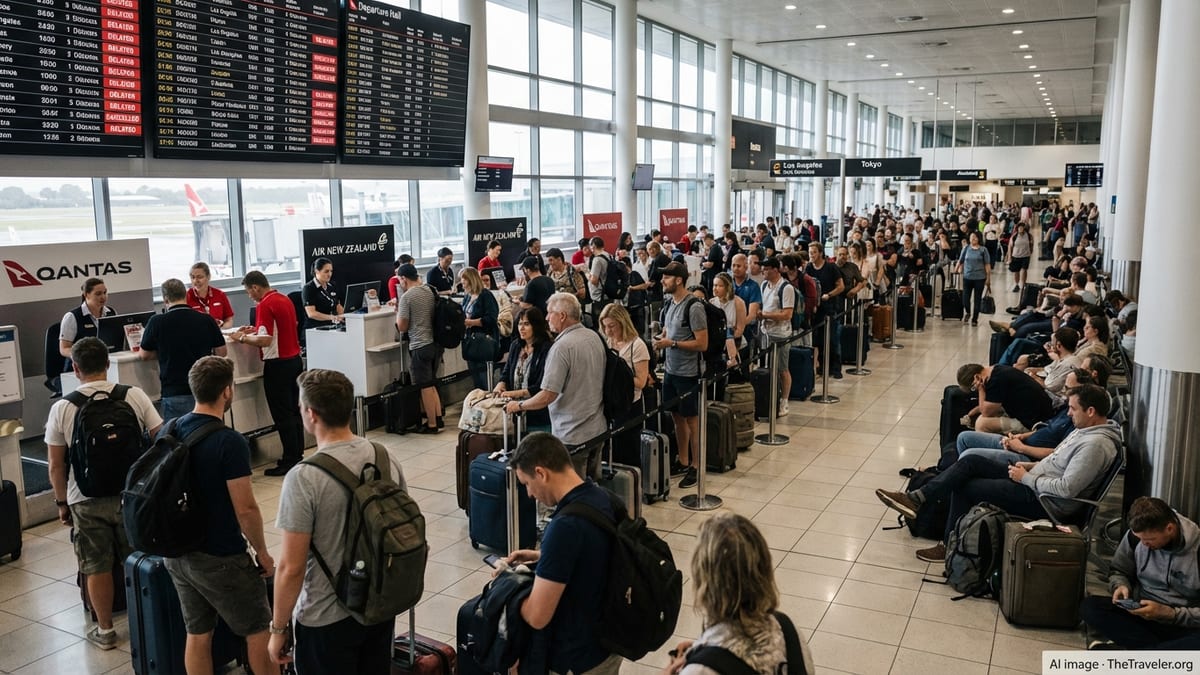
Inside terminals across Sydney, Melbourne and Brisbane, passengers have reported dense queues at check in, security and airline service desks as rolling delays build throughout the day. Departure boards at all three airports have been dotted with red and amber status updates, with many services pushed back by several hours and a smaller number scrubbed entirely. Families returning from school holidays, business travellers on tight timetables and tourists with onward connections have all been swept up in the disruption.
At Sydney Airport, many travellers bound for the United States and Japan have missed or risked missing onward connections at Los Angeles International and Tokyo’s major airports as late departures from Australia compress connection windows. Some passengers arriving late into Los Angeles have been rebooked onto later domestic services, while others have been issued hotel vouchers and meal allowances as they wait for space on the next available flights. Similar scenes have played out in Tokyo and Auckland, where arriving services from Australia have landed well behind schedule.
Social media posts from stranded passengers show crowded gate areas, long lines at airline counters and tired travellers sleeping on terminal floors as they wait for updates. While some airlines have responded by adding extra staff and opening overflow customer service points, the scale of the disruption has meant that many passengers are facing hours-long waits just to speak with an agent or secure alternative travel options.
Global Ripple Effects Reach Los Angeles, Tokyo, Auckland and Bangkok
The impact of the Australian disruptions has extended far beyond Sydney, Melbourne and Brisbane, complicating operations at several of the world’s busiest international hubs. Los Angeles, a critical gateway for trans-Pacific traffic, has seen arrival patterns bunch as delayed flights from Australia and New Zealand land within short windows. That has placed additional strain on immigration halls, baggage systems and connecting domestic banks operating to US cities across the West Coast, Midwest and East Coast.
In Tokyo, where carriers funnel passengers onward to North American and European destinations, late-running services from Australia have forced airlines to rework connection plans on short notice. Travellers who had been banking on smooth transfers to cities such as New York, London or Vancouver have instead been handed revised itineraries that add several hours or, in some cases, an extra overnight stay to their journeys. The same is true in Auckland and Bangkok, where disrupted Australia-bound services have thrown off aircraft rotations and crew schedules.
Because many of these routes operate at or near full capacity, airlines have limited ability to absorb the shock by simply moving passengers to later flights. Some carriers have begun prioritising travellers with essential commitments, such as medical appointments or critical business engagements, while others are urging customers whose plans are flexible to voluntarily shift to later dates, easing pressure on immediate departures.
Qantas, Air New Zealand, Emirates and Other Carriers Under Scrutiny
The latest wave of cancellations and delays has drawn renewed attention to on time performance across the region’s biggest airlines. Qantas and its regional arm QantasLink, already under pressure after previous bouts of disruption and regulatory scrutiny, have once again found themselves in the spotlight as passengers vent frustrations over communication, rebooking options and compensation. Traveller advocacy groups say they have been inundated with complaints from customers who feel they were left without clear information as schedules unravelled.
Air New Zealand has also experienced mounting strain on services touching Sydney, Melbourne, Brisbane and key New Zealand hubs, as aircraft and crews fall out of position and ground times are extended. For Emirates and other long haul carriers that rely on precise departure and arrival banks to feed their global networks, each delayed Australian departure triggers a rebalancing act in their home hubs and along connecting routes. Industry observers note that while airlines cannot control the weather, they can improve resilience and customer care when operational pressures mount.
Several carriers affected by the 532 delayed and 52 cancelled flights have issued statements acknowledging the disruption and apologising to customers. They have cited severe weather systems, air traffic control restrictions and knock on effects from overseas disruptions as primary causes. At the same time, they have promised to review resourcing, rostering and contingency planning to better withstand similar shocks in the coming months.
Airports Struggle With Capacity and Communication
Airport operators in Sydney, Melbourne and Brisbane have likewise been forced into crisis management mode as they attempt to juggle gate allocations, baggage handling and passenger flows in terminals built to operate near capacity but not to absorb prolonged bouts of irregular operations. With inbound and outbound flights constantly shifting, teams have been working in real time to reassign gates, move ground crews and reroute baggage to keep people and planes moving as smoothly as possible.
Yet many of the travellers caught in today’s disruption say the weakest point in the chain has been communication. Some report learning of cancellations through departure board changes rather than direct alerts, while others received text messages or app notifications only minutes before scheduled boarding times. Confusion has been magnified for those with multi sector itineraries involving US, Japanese, Thai or New Zealand connections, where responsibility for rebooking can fall between multiple airlines within alliance or codeshare arrangements.
Airport representatives have urged passengers to arrive early, travel with carry on only where possible and stay in close contact with their airlines via official apps and customer service channels. They have also encouraged travellers to keep receipts for food, transport and accommodation costs incurred during the disruption, as these may be needed for any later claims under airline policies or consumer protection rules.
Government Oversight and Passenger Rights in Focus
The scale and frequency of recent aviation disruptions in Australia are sharpening debate over passenger rights and regulatory oversight. Authorities have been working on stronger consumer protections around flight delays and cancellations, including clearer rules on when travellers are entitled to refunds, rebooking, meal vouchers or accommodation. Today’s widespread delays and cancellations are likely to lend urgency to those reforms as lawmakers field fresh complaints from affected constituents.
Consumer advocates argue that while extreme weather can legitimately limit airline liability, passengers should not be left in the dark about their options when flights are disrupted. They are calling for standardized information to be provided at booking and check in, outlining what support travellers can expect if schedules collapse. Airlines, for their part, say that tighter regulations must recognise the complexity of global operations and the financial impact of mandatory compensation in cases beyond their control.
Industry experts note that similar schemes in other markets, including North America and Europe, have gradually pushed carriers to build more robust contingency plans and improve the way they communicate with customers during crises. Whether Australia’s aviation sector moves in the same direction may depend in part on how quickly operations stabilise after the current disruption, and how visibly airlines step up support for stranded travellers.
How Travellers Can Navigate the Ongoing Disruption
For passengers already in transit, the most immediate advice from travel agents and airport staff is to stay closely engaged with official airline channels and to act quickly when rebooking options are offered. Travellers whose flights are significantly delayed or cancelled are being urged not to wait in long terminal queues if they can make changes via mobile apps, websites or call centres, which may offer the same rebooking inventory and voucher options without the need to stand in line.
Those yet to depart are being encouraged to build extra buffers into their itineraries, particularly if they have onward international connections through Los Angeles, Tokyo, Auckland, Bangkok or other major hubs already under pressure. Where possible, advisers recommend scheduling important meetings, tours or events at least a full day after expected arrival to allow for potential disruptions. Travel insurance policies that include trip interruption and delay cover are also being highlighted as a tool to help recover some costs associated with unexpected hotel stays or missed prepaid arrangements.
Despite the scale of today’s disruption, aviation authorities stress that most flights are still operating, albeit with delays. They emphasise that the current situation, while highly disruptive for those affected, should gradually ease as weather systems pass and aircraft and crew rotations return to normal. However, with climate related weather volatility and high global demand for air travel both on the rise, few expect this to be the last major test of resilience for airlines and airports in Australia and across the wider region.