

More news on this day
Thousands of travellers have been left stranded at Melbourne, Sydney, and Brisbane airports after 542 flights were delayed and 54 cancelled, disrupting services operated by Qantas, Cathay Pacific, Emirates and other carriers on key routes linking Australia with New Zealand, the United States, Singapore and beyond.
Severe Weather and System Strain Ripple Across Networks
The latest disruption, unfolding across Australia’s east coast hubs on February 23 and 24, comes as airlines grapple with a volatile mix of seasonal storms in both hemispheres and mounting operational strain. Heavy rain and thunderstorms across parts of New South Wales and Queensland, combined with knock-on effects from a historic winter blizzard in North America and unsettled weather in Asia, have pushed already tight schedules beyond breaking point.
While Australia’s major airports frequently experience weather-related slowdowns, the scale of the current disruption is notable. Industry data and airport dashboards on Monday pointed to a combined total of 542 delayed and 54 cancelled flights tied to operations through Melbourne Tullamarine, Sydney Kingsford Smith and Brisbane, impacting both domestic shuttles and long-haul international services. Short-haul sectors to Auckland, Queenstown and other New Zealand gateways have also been hit, amplifying the sense of gridlock.
Operational pressures are compounding the weather challenges. Airlines and ground-handling firms continue to manage crew rostering constraints and aircraft positioning issues dating back to the busy southern summer holiday period. As delays stack up, aircraft and crews are ending the day in the wrong cities, forcing late adjustments that cascade through timetables in Australia, the Pacific and further afield.
Air traffic management capacity has also come under renewed scrutiny. Previous reports from Airservices Australia highlighted how staffing and weather can combine to slow departures and arrivals along the east coast corridor. On one of the year’s busiest travel weekends so far, those underlying structural issues have resurfaced visibly for passengers stuck in lengthy queues.
Passengers Face Long Queues and Missed Connections
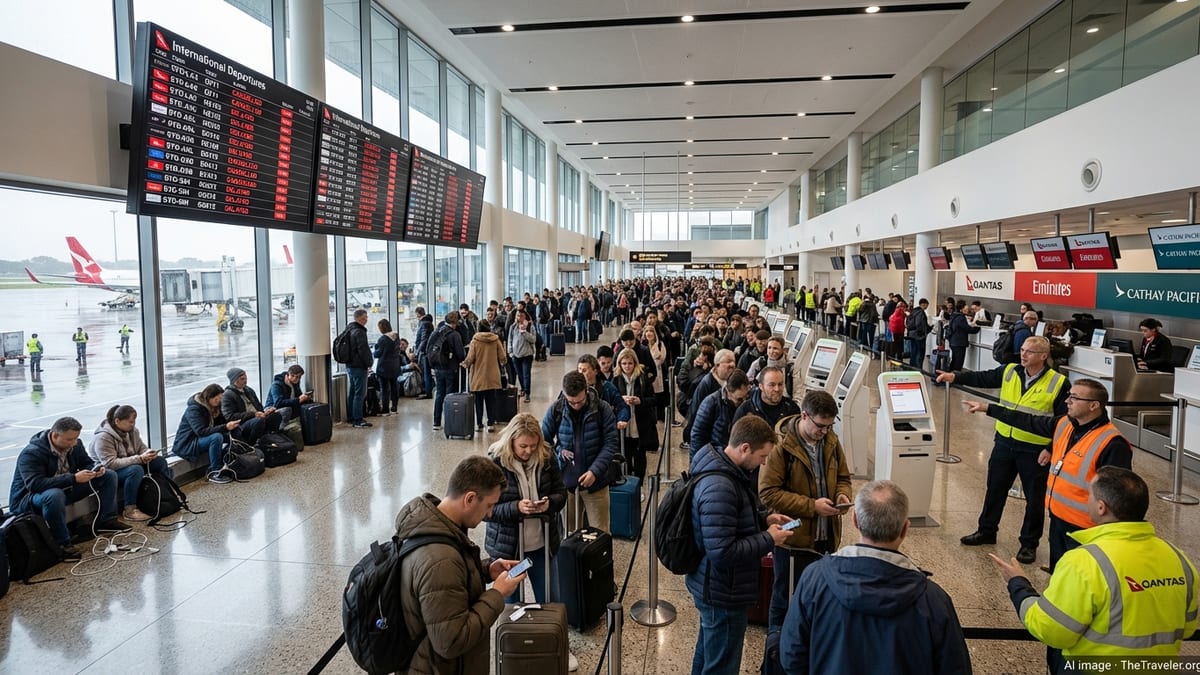
Inside terminal buildings, the disruption has translated into scenes of frustration familiar to frequent flyers. Departure halls at Sydney, Melbourne and Brisbane have filled with snaking check-in and bag-drop lines, while security and border control lanes intermittently buckle under the sheer volume of rebooked passengers. Overhead departure boards have been dominated by red "delayed" notices and rolling gate changes.
Families bound for school holidays in Queensland and the Pacific have found themselves camped on the floor near power outlets, while business travellers connecting to North America and Asia have been forced into last-minute itinerary overhauls. With aircraft arriving late from prior sectors, key morning bank departures from Australia to hubs such as Singapore, Hong Kong and Dubai have pushed back by hours, eroding connection windows onward to Europe and the United States.
Missed onward flights have been particularly acute for services routing via Los Angeles, San Francisco and Dallas, where a separate winter storm system has recently snarled traffic and consumed spare seat capacity. Travellers attempting to reach New York and other northeast US cities from Australia via Pacific gateways have struggled to find same-day alternatives, with some re-accommodated via circuitous routings that add a full day or more to their journey.
At the same time, regional links feeding into the big three Australian hubs have borne the brunt of schedule reshuffles. Flights between Sydney and Brisbane, as well as the key shuttle route linking Melbourne and Sydney, have recorded multiple delays as airlines juggle aircraft utilization. Even relatively short disruptions on these trunk sectors reverberate across long-haul rotations, creating a feedback loop of late arrivals and missed slots.
Major Carriers Hit: Qantas, Emirates, Cathay Pacific and More
Australia’s flag carrier Qantas has been among the most visible operators affected, with delays and cancellations rippling across its domestic and international network. Heavily trafficked morning and evening departures along the east coast triangle have faced rolling hold-ups as crews and aircraft are shuffled, while long-range services to Los Angeles, Dallas, Singapore and London via Perth have experienced extended turnaround times as incoming flights arrive behind schedule.
International partners and rivals have been similarly squeezed. Emirates’ services linking Brisbane, Sydney and Melbourne with its Dubai hub have encountered departure delays, complicating connections for passengers bound for Europe, Africa and the Middle East. Cathay Pacific flights through Hong Kong have also felt the strain, particularly for travellers connecting between Australia and secondary destinations in mainland China and North Asia.
Air New Zealand and other trans-Tasman operators have reported disruption on the busy Australia–New Zealand corridor, where aircraft shuttling between Auckland, Wellington, Christchurch and Australian gateways have been held on the ground or forced into longer flight times around storm systems. Delays on Sydney–Auckland and Melbourne–Auckland routes have translated into missed onward services to North America and the Pacific Islands.
Singapore-based carriers have not escaped unscathed either. Services between Australia and Singapore, a vital transfer point for routes into Southeast Asia, India and Europe, have been affected by flow-on delays from earlier sectors. This has been particularly challenging for travellers booked on tight back-to-back itineraries, with some airlines urging customers to allow extra connection time where possible.
Global Knock-on Effects From Los Angeles to Auckland
The impact of the Australian disruption has quickly spread worldwide, underlining how tightly interconnected global air networks have become. In Los Angeles, one of the key North American gateways for passengers from Australia and New Zealand, arrival banks have been punctuated by late-running widebody jets, compressing immigration and customs processing and squeezing turnaround times for return flights.
In Auckland, the principal hub for New Zealand, the effects have been equally pronounced. Late departures from Sydney, Melbourne and Brisbane have led to bunching of arrivals, forcing airport operations teams to juggle gate allocations and baggage handling resources. Travellers heading onward to domestic destinations such as Queenstown and Wellington have confronted sudden gate changes and short-notice rebookings as local carriers try to reset their schedules.
Further afield, airports including Dubai, Singapore and Hong Kong have absorbed streams of late-arriving passengers from Australian flights who have missed onward departures to Europe, South Asia and North Asia. With February already a busy period for corporate travel and late-summer holidaymakers from the southern hemisphere, spare capacity on alternative services has been limited, making it harder for airlines to recover quickly.
Global data from flight-tracking services shows that the tally of disrupted flights connected to the current Australian bottleneck continues to climb as the day progresses. Even where services are still operating broadly on time, carriers are warning that knock-on effects, from delayed baggage to out-of-position crews, may linger into the week, particularly on long-haul patterns that take several days to fully cycle.
What Travellers Can Expect in the Coming Days
Airlines serving Melbourne, Sydney and Brisbane have urged customers to monitor flight status closely in the coming days and to arrive at the airport earlier than usual, particularly for international departures. With storms and unsettled conditions still present on some key routes, schedule adjustments and rolling delays remain possible even as carriers work to clear backlogs.
Passengers already at airports are being encouraged to utilize self-service tools such as airline apps and kiosks to rebook disrupted journeys where available. However, heavy demand has at times overwhelmed call centres and online platforms, leaving many travellers reliant on in-person assistance at transfer and customer service desks. Those with complex itineraries spanning multiple airlines or alliance partners are facing some of the lengthiest waits for new arrangements.
Consumer advocates in Australia and overseas have again highlighted the importance of passengers understanding their rights to refunds, rebooking and assistance when flights are significantly delayed or cancelled. The patchwork of regulations and policies across jurisdictions means entitlements can vary widely depending on the operating carrier and the specific route.
For now, aviation authorities and airport operators are focused on restoring stability to one of the southern hemisphere’s most important air corridors. As weather systems gradually ease and aircraft and crew rotations realign, operations are expected to slowly normalize, though travellers connecting through Melbourne, Sydney and Brisbane should be prepared for residual delays and packed flights for several days to come.