

More news on this day
Dubai International Airport, the world’s busiest hub for international travel, has been plunged into chaos after regional airspace closures and missile strikes forced authorities to suspend flights, leaving tens of thousands of passengers stranded and rippling disruption across global aviation networks.
Flights Suspended as Gulf Skies Fall Silent
Flight operations at Dubai International Airport (DXB) and Dubai World Central Al Maktoum International (DWC) were suspended until further notice over the weekend, after a cascading series of airspace closures across the Middle East in the wake of U.S.-Israeli strikes on Iran and subsequent Iranian retaliation. The United Arab Emirates’ civil aviation authority confirmed that national airspace had been partially closed as a safety measure while security assessments continued.
Dubai Airports, the state operator, urged passengers not to travel to the terminals and to contact airlines directly for the latest information, as departure boards filled with cancellations and delays. The disruption marks one of the most serious interruptions to operations at DXB in decades, sharply contrasting with its reputation for efficiency and rapid passenger processing.
The immediate trigger was the decision by multiple countries, including the UAE, Qatar, Bahrain, Kuwait, Iran and Israel, to close or restrict their airspace amid fears that civilian aircraft could be caught in the crossfire of missile and drone barrages. Flight-tracking data on Saturday and Sunday showed vast stretches of usually crowded Middle Eastern skies almost empty of commercial traffic.
Missile Strikes Cause Damage and Injuries at Dubai Hub
While officials stressed that the physical damage at Dubai International was limited, the incident underscored how deeply the regional conflict has penetrated what had long been seen as a secure aviation crossroads. Authorities confirmed that one concourse at DXB sustained minor damage after debris from an Iranian missile or drone strike reached the facility. Fire services and airport emergency teams quickly contained the situation.
According to statements from local officials, four airport employees were injured in the incident at Dubai, even as operations were already being wound down because of the unfolding security crisis. Footage shared on social media showed smoke rising from a departures building and emergency vehicles clustered on the tarmac, though the main terminal structures remained intact.
Elsewhere in the UAE, Zayed International Airport in Abu Dhabi reported one fatality and several injuries after a related incident overnight, believed to be linked to the same wave of Iranian strikes aimed at military and strategic locations across Gulf states. Taken together, the events shattered the sense of distance many residents and travelers felt from the front lines of the conflict, bringing the war directly into one of the world’s most important civilian transport hubs.
Global Airlines Scramble as Passengers Are Stranded
The suspension of operations in Dubai sent shockwaves through airlines and travelers on nearly every continent. Emirates, Dubai’s flagship carrier and the world’s largest long-haul airline, temporarily halted all flights to and from its home hub, advising customers with bookings in the coming days that they could rebook within a limited window or request refunds.
Flydubai also suspended its operations, while Air Arabia cut services across the UAE. Further afield, Etihad Airways in Abu Dhabi stopped departures for an extended period, and Qatar Airways halted flights to and from Doha as Qatar joined neighboring states in closing its airspace. Major European and Asian carriers rerouted or cancelled services to the region, upending itineraries for hundreds of thousands of passengers.
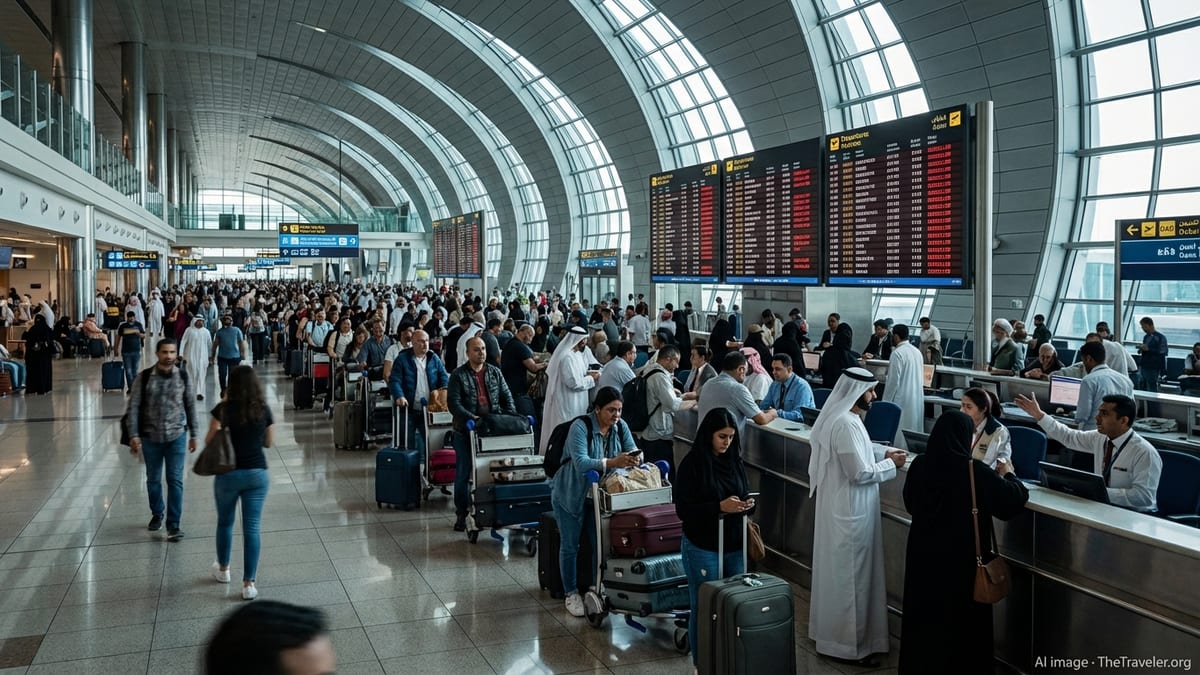
Inside Dubai International, stranded travelers described long queues at airline service desks, crowded departure halls and confusion over rebooking options as schedules were revised hour by hour. Some passengers who had already boarded long-haul flights found their aircraft forced to return to Dubai or divert when airspace ahead suddenly closed, adding to the operational tangle as planes and crew were left out of position.
Travel industry analysts warned that even a short-lived shutdown at Dubai can create logistical challenges that take days to unwind, given the airport’s role as a central connector linking Europe, Asia, Africa and the Americas. With many travelers depending on Gulf hubs for onward connections, disruptions in Dubai and neighboring cities quickly cascaded across global networks.
Security Concerns and Official Warnings Intensify
The regional conflict, sparked by joint U.S.-Israeli strikes on Iran and intensified by Iranian missile and drone attacks against targets in Gulf states, has dramatically raised safety concerns for civil aviation. Europe’s aviation safety regulator warned of a high risk to commercial flights operating in affected airspace and advised carriers to avoid large swaths of the Middle East where military operations and potential retaliatory strikes are ongoing.
In the UAE, officials emphasized that the temporary closure of airspace and the grounding of flights were driven by precaution and the need to safeguard passengers and crew amid an unpredictable security environment. Authorities also moved to restrict drones, gliders and recreational aviation for at least a week, citing the heightened risk of misidentification during a period of intense military activity.
Governments well beyond the region updated travel advisories, cautioning citizens about nonessential trips to the Gulf and neighboring states and urging those already in the area to follow local guidance closely. Airports in Europe, Asia and North America issued alerts about flights to and from Dubai and Doha, as well as onward connections that rely on Middle Eastern hubs.
Security experts noted that while commercial aircraft are rarely direct targets, their vulnerability in crowded conflict zones has long troubled regulators and airlines. The current shutdowns and diversions, they said, reflect a broader recognition that even near misses or debris incidents can carry unacceptable risks for packed long-haul jets.
Uncertain Timeline for Recovery as Travelers Await Clarity
By Sunday, some Gulf carriers were beginning to hint at limited resumptions of service subject to evolving security assessments, but there was no clear timetable for a full return to normal operations at Dubai International. Officials in the UAE described the situation as fluid and warned that schedules would likely change at short notice as regional airspace restrictions were adjusted.
For passengers, the immediate focus remained on finding beds for the night and securing alternative routes home. Local authorities said they were working with airlines to provide hotel accommodation, meals and rebooking assistance for those stuck in transit, although capacity in nearby hotels was quickly stretched by the sudden surge in demand.
Travel consultants advised affected customers to stay in close contact with their airlines via official apps and call centers, and to avoid heading to the airport without confirmed new travel arrangements. With key corridors over Iran, Iraq and the Gulf effectively closed, many carriers are exploring longer detours around the region, raising operating costs and lengthening flight times on already busy routes.
Industry observers cautioned that even after hostilities ease and airspace begins to reopen, the psychological impact of missile strikes reaching Dubai and Abu Dhabi could linger, potentially reshaping traveler perceptions of safety in the Gulf’s once seemingly insulated aviation hubs. For now, the images of grounded jets, crowded terminals and anxious passengers at Dubai International stand as a stark sign of how swiftly regional conflict can bring global travel to a standstill.