

More news on this day
A wave of flight cancellations and severe delays at Daniel K. Inouye International Airport in Honolulu is stranding hundreds of travelers, disrupting long-planned vacations, and raising new questions about how prepared Hawaii’s busiest gateway is for extreme weather and infrastructure stress.
Get the latest news straight to your inbox!
Weather Turmoil Triggers Major Travel Disruptions
The latest disruption appears closely tied to a powerful Kona storm system that has brought days of heavy rain, flooding and power issues across parts of Hawaii. Publicly available weather discussions describe intense thunderstorms, strong winds and widespread outages on Oahu and neighboring islands, creating challenging conditions for air traffic and ground operations.
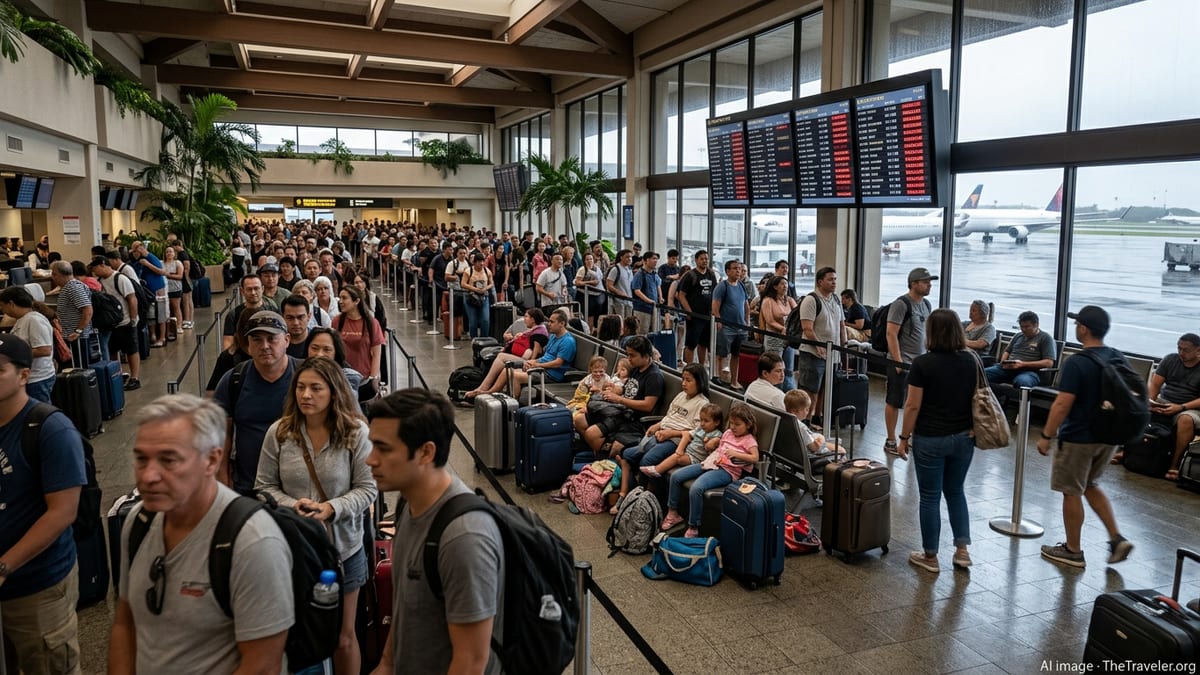
Reports from travelers and local observers indicate that the bad weather has translated into rolling delays, diverted flights and sudden cancellations at Daniel K. Inouye International Airport, the primary hub for both interisland and trans-Pacific routes. While runways have generally remained open, the combination of saturated ground, lightning risk and intermittent power problems has repeatedly slowed the airport’s ability to move passengers and aircraft efficiently.
The impact has not been uniform across airlines, with some carriers managing to maintain limited schedules while others have experienced cascading disruptions as aircraft and crews ended up out of position. This uneven recovery has added to frustration among passengers who see flights departing next to their own grounded aircraft.
Stranded Passengers Face Long Lines and Limited Options
Travelers describe scenes of overcrowded terminals, long customer service queues and exhausted families camping out near gates as they wait for rebooking options. Social media posts from passengers in Honolulu reference multiple cancellations in a row, extended overnight stays inside the airport and difficulty obtaining clear information about when flights might realistically depart.
Many visitors to Hawaii had built once-in-a-lifetime trips around fixed dates, leaving little flexibility when flights were suddenly scrubbed. With seats on outbound flights in and out of Honolulu already tight during peak travel periods, rebooking options have often involved multi-stop itineraries, lengthy layovers or departures several days later than planned.
For some, the disruption has created unexpected costs as hotel stays, rental cars, pet boarding and time away from work extend beyond original plans. Public posts suggest that not all travelers have been able to secure accommodation near the airport on short notice, leading some to spend the night on terminal floors or in crowded seating areas while they await updated departure times.
Confusion over airline policies on vouchers, meal support and overnight lodging has further fueled passenger anger. Travelers have shared accounts of inconsistent assistance, with some receiving hotel and meal support while others in similar situations report being told to manage expenses on their own.
Operational Vulnerabilities Exposed at Hawaii’s Main Gateway
The latest chaos is shining a spotlight on how quickly operations at Daniel K. Inouye International Airport can unravel when severe weather or power instability hits. Previous planning documents highlight the airport’s reliance on backup generation for critical systems, but recent anecdotal reports of darkened concourses and stranded aircraft suggest that keeping all functions running smoothly under stress remains a challenge.
When storms disrupt radar, ground handling, baggage systems or terminal power, delays can rapidly multiply across a tightly timed schedule. If aircraft arrive late or crews reach duty time limits, entire waves of flights may be canceled or significantly delayed, even after conditions begin to improve. Honolulu’s role as a central hub means that problems here can ripple outward across neighbor island routes and mainland connections.
Published traffic statistics for the state’s airports show that Honolulu handles millions of passengers annually, underscoring how even a short period of instability can affect a large volume of travelers. As airlines operate closer to capacity with lean spare aircraft and staff, there is less room to absorb shocks, making each disruption more likely to trigger wider operational breakdowns.
Observers note that recent global incidents involving IT outages, staffing shortages and extreme weather have already prompted discussion about resilience across the aviation sector. The events in Honolulu are likely to intensify calls for more robust contingency planning tailored to Hawaii’s unique geographic isolation and reliance on air travel.
Tourism Industry Confronts Fresh Reputational Risks
Hawaii’s tourism economy depends heavily on the seamless flow of visitors through Daniel K. Inouye International Airport. When images and first-hand accounts of stranded travelers and chaotic terminals circulate widely online, they risk undercutting years of marketing that emphasizes ease of access and stress-free island getaways.
Economic forecasts for the state have long stressed the sensitivity of visitor arrivals to perceived travel hassle and reliability. Even a temporary spike in cancellations and missed connections can influence how prospective visitors weigh Hawaii against other beach destinations, particularly for long-haul travelers who must commit to costly, multi-leg journeys.
Local businesses that rely on predictable arrivals, from hotels and vacation rentals to tour operators and restaurants, are also exposed. When visitors arrive late, shorten their stays, or cancel entirely due to travel uncertainty, the financial impact extends well beyond the airport perimeter. Recent storm-related flooding and power issues on other islands have compounded these concerns, with some travelers questioning whether infrastructure across the state is prepared for more frequent bouts of extreme weather.
Published commentary from tourism analysts has highlighted the growing need for destination-wide resilience planning. That includes stronger communication strategies so that visitors understand risks, know their options when flights are disrupted, and feel confident that airlines and airport operators are coordinating responses effectively.
Calls Grow for Better Communication and Contingency Planning
In the aftermath of the latest wave of cancellations, attention is turning to how information is shared with the traveling public during fast-moving crises. Travelers at Honolulu have described receiving fragmented or conflicting updates about departure times, gate changes and rebooking options, often relying on third-party apps or informal online communities to piece together the full picture.
Analysts argue that clearer, more consistent messaging from airlines, airport management and tourism agencies could help reduce confusion and anxiety when operations begin to fray. This includes realistic timelines for recovery, transparent explanations for cancellations, and proactive guidance on lodging, food and ground transport for those unexpectedly stranded.
There is also renewed discussion about investments that might reduce the severity of future disruptions, from infrastructure upgrades that harden the airport against power and flooding problems to more robust backup systems for check-in and baggage handling. Scenario planning for extreme weather, including detailed contingency schedules and rapid surge staffing, is being cited as an important part of ensuring that chaos on the scale recently seen at Daniel K. Inouye International Airport becomes less likely.
For now, travelers with upcoming flights through Honolulu are being advised by airline notices and travel advisories to monitor their bookings closely, build in extra time for connections, and prepare for possible last-minute changes. As the storm system gradually weakens and operations stabilize, the experience is likely to inform how Hawaii’s aviation and tourism sectors prepare for the next major test.