

More news on this day
Another delay for Los Angeles International Airport’s Automated People Mover has reignited frustration over gridlocked terminals and raised fresh questions about whether record infrastructure spending can actually untangle U.S. airport congestion.
Get the latest news straight to your inbox!
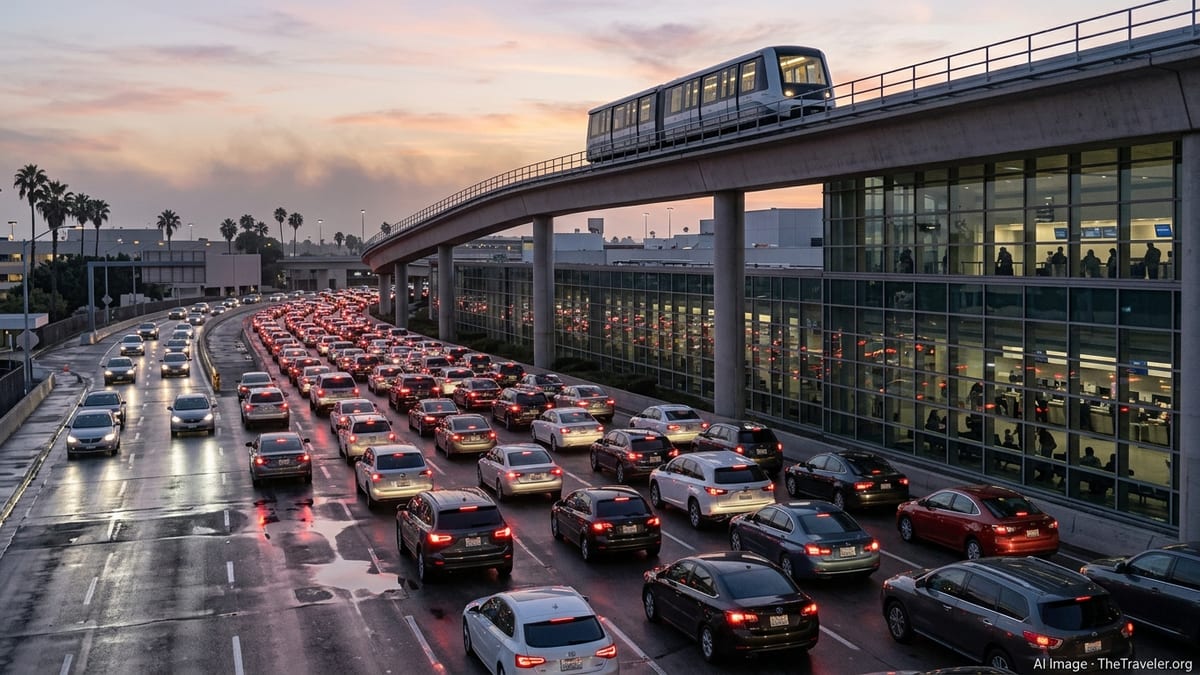
A Rail Link Meant To End Curbside Chaos Keeps Slipping
The 2.25‑mile Automated People Mover snaking above the roadways at Los Angeles International Airport was supposed to be the signature fix for one of the country’s most notorious terminal bottlenecks. When the contract was signed in 2018, public information shows the train was expected to be running by late 2023, linking the terminals with a consolidated rental car hub and a new Metro rail station.
Instead, the elevated system has become a symbol of delay. Published coverage indicates the opening date has been repeatedly pushed back, first into 2024, then to early 2025, then January 2026, and most recently into the second half of 2026, more than two years behind the original schedule and uncomfortably close to the 2026 FIFA World Cup. The project’s own documentation and independent reporting now point to June 2026 at the earliest, with some commentary suggesting the date could slip further.
In the meantime, the airport’s horseshoe roadways remain a rolling traffic jam. Ride‑hailing vehicles, hotel shuttles, rental car buses and private cars all compete for limited curb space, leaving passengers inching toward terminals in backups that can stretch far beyond the airport boundary. The new consolidated rental car center opened in stages and is now fully operational, but without the people mover, it relies on yet more buses feeding already saturated roads.
Billions Spent, Hundreds of Millions Over Budget
The people mover is part of a broader multibillion‑dollar modernization program at LAX, one of the largest airport capital plans in the United States. Publicly available contract and financial summaries indicate the 25‑year public‑private partnership for the rail system was originally valued at about 4.9 billion dollars, covering design, construction, financing, operations and maintenance.
That figure has since swelled. Arbitration rulings and airport authority reports describe a series of disputes between Los Angeles World Airports, the city agency that runs LAX, and the private consortium building the system. According to recent summaries, the airport has agreed to more than 880 million dollars in dispute‑related payments on top of the base contract cost, as delays mounted and the parties clashed over responsibilities for design changes, systems integration and access to key sites.
Credit rating analyses have noted the repeated schedule revisions and cost pressures, even as they affirm that most of the physical construction is substantially complete and that the remaining work centers on complex testing and integration of train control, communications and fire‑life‑safety systems. For travelers, those technical hurdles are invisible. What they see is an almost finished train gliding past in occasional test runs while curbside traffic remains as snarled as ever.
A National Airport Building Boom Meets Old Bottlenecks
The problems at LAX are unfolding against a backdrop of unprecedented airport investment across the United States. Federal data show that the Bipartisan Infrastructure Law, enacted in 2021, set aside about 20 to 25 billion dollars for airport improvements through specialized programs aimed at terminals, runways and air traffic facilities. Successive grant announcements from the Federal Aviation Administration describe almost one billion dollars at a time being allocated to dozens of airports for new concourses, expanded security areas and passenger circulation upgrades.
Many of those projects echo LAX’s ambitions. Airports from Tampa to Pittsburgh have secured federal funds for automated people movers, terminal connectors and redesigned access roads intended to separate local traffic from airport traffic. The stated goal is to speed up passenger flows, shorten curbside dwell times and reduce the emissions and travel time lost to idling vehicles around terminals.
Yet the same publicly available records show that large, technically complex airport projects frequently encounter delays and cost escalation, especially when they depend on tight coordination between local airport agencies, private partners and separate rail or transit authorities. Systems like the LAX people mover must mesh with citywide communications networks, regional transit operations and existing terminals that cannot shut down for construction, which can cause schedule slippage even when funding is in place.
Will New Money Actually Unclog U.S. Airports?
The central question now facing travelers is whether the surge of federal and local spending can deliver visible relief from gridlock, or whether marquee projects like the LAX people mover risk becoming cautionary tales. On paper, the strategy appears sound. Airport terminal programs emphasize more gates, larger hold rooms, wider security checkpoints and direct links to rail or rental car centers, all designed to pull vehicles out of crowded terminal loops.
However, experience at LAX and other major hubs suggests that infrastructure alone may not be enough if it arrives late, opens in phases or is not accompanied by operational changes. When new train links and roadways lag behind passenger growth, demand often simply fills whatever space is added. Analysts who track airport performance have noted that U.S. passenger volumes have rebounded strongly since the pandemic, outpacing some pre‑project forecasts and putting pressure on systems that were already strained.
There is also the question of resilience. As climate‑driven extreme weather, public health concerns and evolving airline schedules reshape travel patterns, airports may find that projects conceived a decade earlier need further tweaks as soon as they open. People movers, parking garages and curbside expansions designed around today’s mix of ride‑hailing, private cars and rental vehicles may have to adapt quickly to changing behavior, from microtransit to autonomous shuttles.
For Travelers, Short‑Term Chaos and Long‑Term Uncertainty
For the millions of passengers who pass through LAX each month, the debate over timelines and federal grant programs is largely academic compared with the day‑to‑day reality of reaching a gate on time. Until the people mover is operational, they remain dependent on shuttle buses weaving through congestion, ride‑share drivers navigating unfamiliar detours and security lines that can begin before a traveler even steps inside a terminal.
Even once the train eventually opens, its impact will depend on how quickly surrounding pieces fall into place. The full benefit is designed to come from seamless transfers between the Metro rail network, the consolidated rental car facility, remote parking and each terminal, with frequent, predictable service that makes it easier to leave cars at home. If any part of that chain underperforms, some of the anticipated congestion relief could evaporate.
For now, LAX stands as a vivid test case for the broader U.S. airport modernization push. If the people mover finally begins carrying passengers around the time global attention turns to North America for the 2026 World Cup, it could showcase how sustained investment can reshape a chronically congested gateway. If delays stretch on, it may instead reinforce public skepticism that even record spending can truly fix airport gridlock in the United States.