

More news on this day
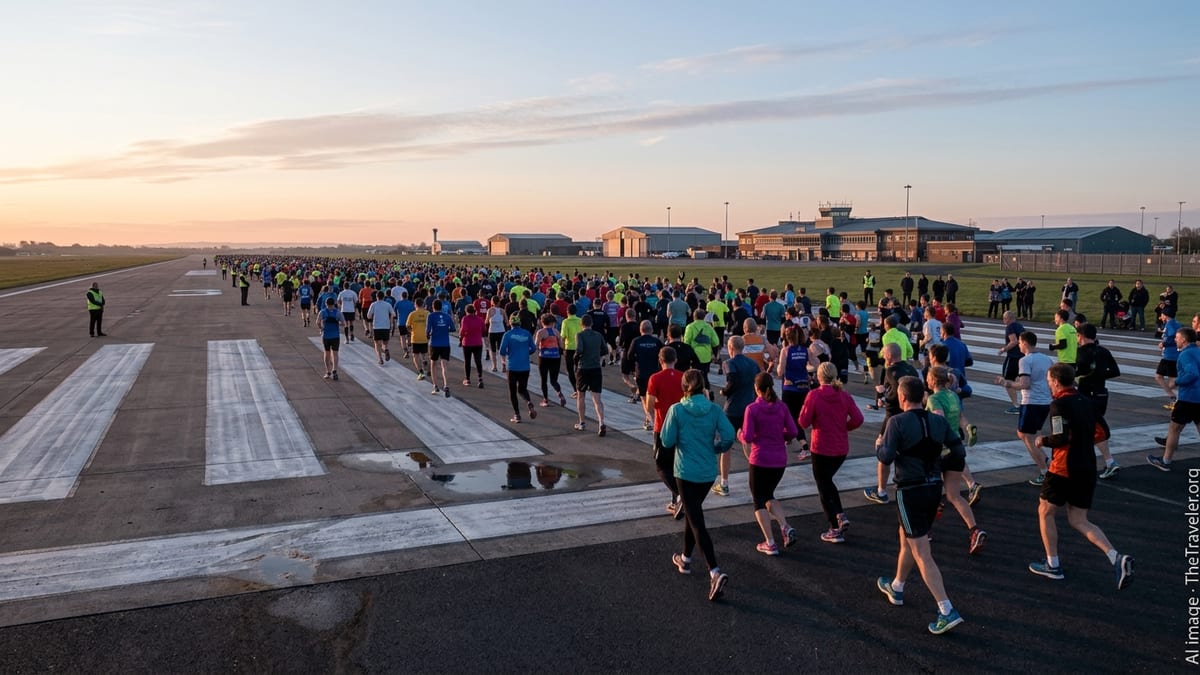
Thousands of runners and spectators converged on the dormant runway at Doncaster Sheffield Airport for a charity race that doubled as a powerful showcase of public support ahead of the site’s planned return to commercial aviation.
Get the latest news straight to your inbox!
Symbolic Homecoming on a Silent Runway
The one-off charity event transformed the usually restricted tarmac into a temporary community arena, bringing families, fun-runners and club athletes onto the same strip that once handled commercial jets. For many local residents, being able to step onto the runway for the first time turned the race into a symbolic homecoming at an airport that has been closed to passenger flights since late 2022.
Publicly available information about the event indicates that participant places sold out quickly, with waiting lists forming as word spread across South Yorkshire running clubs and community groups. The turnout is seen locally as a vivid indicator of how strongly the airport’s fate has resonated with residents in Doncaster and surrounding towns.
The race course took advantage of the site’s long, wide runway and adjacent taxiways, offering a rare, flat and completely traffic-free route. Organisers framed the run as both a fundraiser and a celebration of the airport’s new chapter, with branded banners, timing arches and charity stalls lining sections of the tarmac that previously echoed only with the sound of maintenance vehicles.
For many attendees, the atmosphere mixed nostalgia with optimism. The sight of thousands of people in running gear flooding a space once associated with departures boards and holiday flights underscored the emotional connection that has helped keep the reopening campaign in the public eye.
Charity Focus and Community-Led Revival
Reports indicate that the event directed entry fees and on-the-day donations to regional causes, including health, youth and community initiatives in and around Doncaster. The charity focus added a wider social dimension to the day, positioning the runway race as part of a broader effort to channel the airport’s revival into tangible benefits for local people.
Local coverage shows that volunteers from community organisations, running clubs and nearby schools played a visible role in stewarding the course, managing water stations and supporting participants. That level of civic involvement mirrors the grassroots pressure that has helped keep the airport’s future on the political agenda since its closure.
Public campaigns to “save” or “reopen” the airport have remained active since scheduled passenger operations ceased. According to published coverage, petitions, rallies and ongoing social media activity have drawn attention not only to sentiment around the former Robin Hood Airport, but also to its perceived importance within South Yorkshire’s economic strategy.
By blending charity fundraising with a public show of support for the site’s rebirth, the event reflected how the airport has become a focal point for wider debates about jobs, connectivity and long-term regional investment.
Reopening Timeline and New Operating Model
The runway race comes at a time when formal plans to bring Doncaster Sheffield Airport back into operation are advancing. Public documents from local and regional authorities describe a staged reopening, with work under way to restore aviation infrastructure, secure airline interest and complete regulatory processes.
The airport closed after its previous private owner concluded that commercial operations were no longer financially viable. In response, the City of Doncaster Council negotiated control of the site and, according to publicly available council and combined authority reports, is working to reopen it within a wider “airport city” development vision that includes logistics, advanced manufacturing and green technology activity alongside passenger flights.
Recent corporate and government reports reference substantial allocations of public funding to support the turnaround, including tens of millions of pounds from regional investment funds and central government commitments designed to safeguard the site and underpin future operations. Updated forecasts submitted to regulators and regional leaders point to lower, more conservative passenger numbers than earlier projections, reflecting a shift toward a more measured growth strategy.
According to industry coverage, a specialist airport operator has been identified to run the site on behalf of local partners, with a focus on rebuilding connectivity gradually rather than attempting to replicate pre-closure route networks immediately. The target for the resumption of commercial flights has moved within a mid-decade window, with regional plans now combining aviation with freight, training and innovation facilities.
Economic Stakes for South Yorkshire
The revival of Doncaster Sheffield Airport is closely linked to long-term economic planning for South Yorkshire. Official strategy documents from the South Yorkshire Mayoral Combined Authority and the City of Doncaster Council portray the airport as a central asset within a wider “South Yorkshire Airport City” concept, aimed at attracting high-value employment, new investment and tourism.
Forecasts set out in these documents suggest that, if successful, the reopened airport and surrounding development could support thousands of jobs over the coming decades, from airside roles and ground handling to hospitality, logistics and technology. The site’s location close to major road and rail corridors is highlighted as a competitive advantage for freight and just-in-time supply chains.
Supporters of the project argue that a functioning airport can improve South Yorkshire’s profile with investors and visitors, counteracting the perception that the region sits between better-connected hubs such as Manchester, Leeds and the East Midlands. The charity race, heavily shared across regional media and social channels, served as a timely visual reminder of the strength of local backing as decision-makers refine investment and route development plans.
At the same time, the scale of public funding committed to the project has prompted scrutiny about value for money and environmental impact. Commentators have questioned whether resources might deliver greater benefits if directed to rail, bus and active travel schemes, underscoring that the airport’s future remains a live policy debate rather than a settled issue.
Balancing Environmental Concerns and Regional Connectivity
As enthusiasm builds around the airport’s comeback events, environmental and climate considerations remain central to the conversation. Commentary from analysts and local campaigners highlights the tension between expanding air travel and regional net-zero commitments, especially given the historic financial performance of smaller UK airports.
Planning and policy documents signal an effort to address some of these concerns by framing Doncaster Sheffield as part of a more sustainable aviation and transport ecosystem. References to greener ground operations, the potential for low- or zero-emission ground vehicles and support for future low-carbon aircraft technologies are now common in official language around the project.
The runway charity race itself was promoted in a way that encouraged public transport, car sharing and cycling to the site where practical, reflecting a broader push to embed sustainability into activity around the airport. In visual terms, however, the event also reinforced the symbolism of aviation in regional identity, as participants took selfies on the runway and posed with aircraft hangars and terminal buildings in the background.
For South Yorkshire leaders and residents, the challenge will be to reconcile those environmental priorities with the desire for better connectivity and economic opportunity. The sheer scale of public interest in an early-morning fun run on a silent runway suggests that Doncaster Sheffield Airport’s story will continue to be watched closely, both by those who see it as a vital economic catalyst and by those concerned about its long-term climate footprint.