

More news on this day
Travelers moving through Charlotte Douglas International Airport are facing a difficult day after publicly available flight-tracking data showed 114 delays and three cancellations affecting PSA Airlines, American Airlines, Frontier Airlines and Spirit Airlines, with disruptions extending to New York, Atlanta and other major U.S. cities.
Get the latest news straight to your inbox!
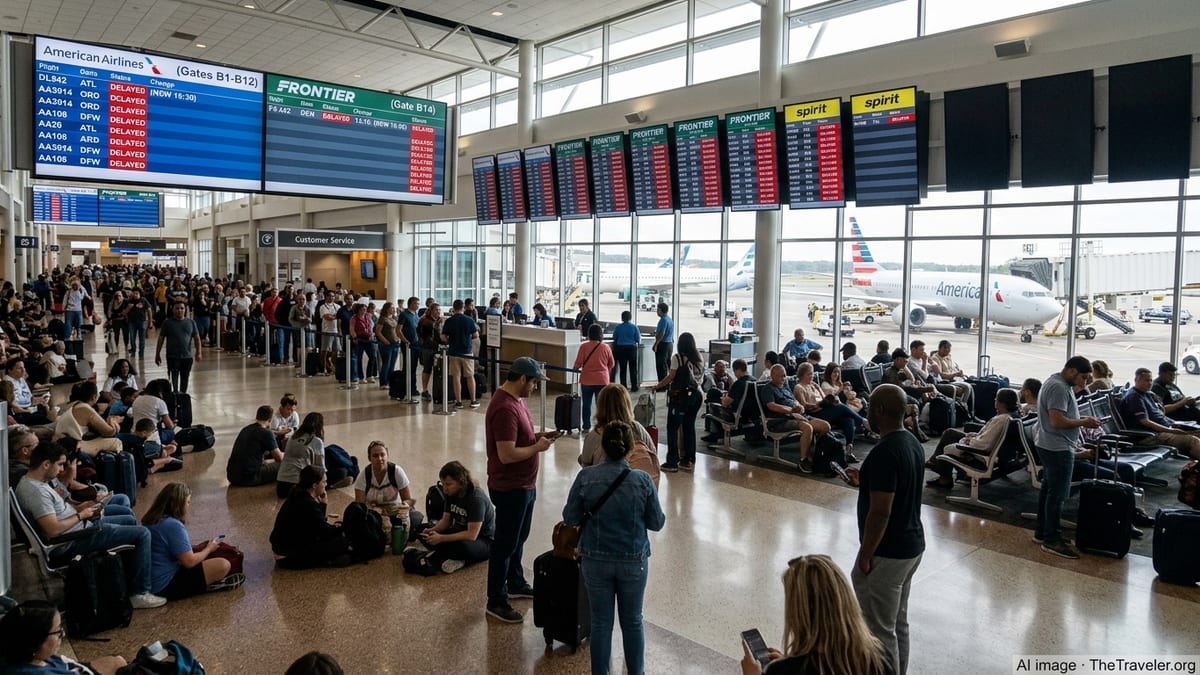
Delays Mount at One of the Nation’s Busiest Hubs
Charlotte Douglas International Airport, a major connecting point in the Southeast, has seen operations slow as delays build across multiple carriers. Flight-tracking boards on Thursday indicated that PSA Airlines, American Airlines, Frontier Airlines and Spirit Airlines collectively accounted for 114 delayed departures and arrivals linked to Charlotte, alongside three outright cancellations.
The interruptions are centered on routes between Charlotte and other high-traffic markets, including New York and Atlanta, as well as connections to additional major U.S. cities. Many of the affected flights are part of tightly timed hub-and-spoke schedules, magnifying the impact for travelers connecting onward through Charlotte.
Publicly available data shows that American Airlines and its regional affiliate PSA, which operate the majority of traffic at Charlotte Douglas, make up a significant share of the disruptions. Low-cost carriers Frontier and Spirit, which run point-to-point services into Charlotte and other large hubs, are also experiencing knock-on delays as aircraft and crews fall out of position.
While the total of three cancellations is modest compared with large-scale weather or operational meltdowns, the high number of delayed flights is creating extended gate holds, rolling departure times and missed connections for passengers across the network.
Ripple Effects in New York, Atlanta and Beyond
The disruption pattern extends well beyond North Carolina. Flights between Charlotte and New York area airports, as well as services linking Charlotte and Atlanta, are among those reporting late departures and arrivals, according to real-time tracking boards reviewed on Thursday.
Because Charlotte is heavily banked around peak connection periods, delays on inbound flights from New York, Atlanta and other major markets are feeding directly into subsequent departures. When an arriving aircraft runs late, the same plane often operates the next leg to another city, creating a domino effect that can spread across several states over the course of the day.
Travel industry observers note that congestion in Northeastern and Southeastern airspace can quickly translate into ground delays at hub airports. When combined with tight turn times and high passenger volumes, even relatively short holdups can spill into later banks of flights, affecting evening departures from Charlotte to destinations throughout the Midwest, Texas, Florida and the Caribbean.
By midafternoon, the accumulating delays were evident in crowded gate areas at Charlotte and in longer-than-usual lines at customer service desks in other impacted cities as travelers sought rebooking options and overnight accommodations.
Operational and Weather Factors Behind the Slowdown
Airline performance data published by the U.S. Department of Transportation indicates that carriers such as American, PSA, Frontier and Spirit typically face a mix of air carrier and national aviation system delays, including maintenance issues, crew scheduling challenges and nonextreme weather events. Those same categories appear to be contributing to Thursday’s disruptions, based on patterns in the delay codes visible on flight-tracking services.
Recent late-winter and early-spring weather systems across parts of the East Coast and Southeast have periodically tightened capacity, especially during peak travel periods. Even when conditions at Charlotte Douglas are largely flyable, constraints elsewhere in the network can force airlines to slow operations, hold departures at origin airports or reroute traffic around congested airspace.
Operational constraints such as aircraft availability and crew duty-time limits can also play a role. When an aircraft arrives significantly behind schedule, or when a crew nears its legally mandated maximum working hours, airlines must adjust subsequent legs, which can translate into rolling delays and, in some cases, cancellations.
On Thursday, the modest number of cancellations compared with the volume of delays suggests that airlines were attempting to preserve as much of the schedule as possible, even if that meant pushing many flights beyond their planned departure or arrival times.
What Travelers Through Charlotte Are Experiencing
For passengers, the operational picture translates into longer dwell times in concourses, crowded seating near gates and uncertainty around connection windows. At Charlotte Douglas, where many American and PSA flights feed into tightly timed banks, even 30 to 60 minute delays can cause travelers to miss onward flights to New York, Atlanta and other large markets.
Low-cost carriers Frontier and Spirit, which generally operate fewer daily frequencies on each route compared with larger network airlines, can be particularly challenging for disrupted travelers. When one of these flights is delayed for several hours or canceled, options to be rebooked later the same day may be limited, especially on routes that operate only once or twice daily.
Travel forums and social media posts in recent days have reflected mounting frustration from travelers encountering rolling delays, gate changes and last-minute cancellations on several of the affected airlines. Passengers connecting through Charlotte often describe sprinting between concourses, waiting in extended lines for assistance and, in some cases, seeking last-minute hotel rooms when their trips extend unexpectedly overnight.
Families, business travelers and international passengers with onward domestic connections through Charlotte are all among those dealing with itinerary changes, lost vacation time and added out-of-pocket expenses for meals, lodging and ground transportation.
Tips for Navigating Ongoing Disruptions
With disruptions affecting multiple carriers and key routes, travel advisers encourage passengers to build in extra time when planning connections through large hubs such as Charlotte, particularly during seasons when storms and heavy traffic are more frequent. Longer layovers can provide a buffer against moderate delays on the first leg of a journey.
Checking real-time flight status across more than one platform can also help travelers react quickly. Airline apps, airport display boards and independent tracking services may show slightly different information at any given time, but taken together can offer a clearer view of likely departure times, gate changes and aircraft swaps.
Passengers who see their flights delayed or at risk of misconnection are often advised to seek rebooking options as early as possible through mobile apps or online channels, rather than waiting until they arrive at the airport and encountering longer queues at customer service counters. Same-day standby lists and alternative routings through other hubs can sometimes preserve travel plans, even when original flights are significantly disrupted.
As airlines work through Thursday’s backlog of delayed flights at Charlotte Douglas and other major airports, residual impacts could linger into subsequent days, especially on routes with limited daily frequencies. Travelers scheduled to pass through Charlotte, New York, Atlanta or connected cities are being urged by travel-planning resources to monitor conditions closely and prepare for continued schedule changes.