

More news on this day
Passengers traveling through Charlotte Douglas International Airport are facing a fresh wave of flight cancellations and lengthy delays as a partial U.S. government shutdown disrupts operations at several airlines, affecting routes to Nashville, Memphis, Minneapolis and other key domestic destinations.
Get the latest news straight to your inbox!
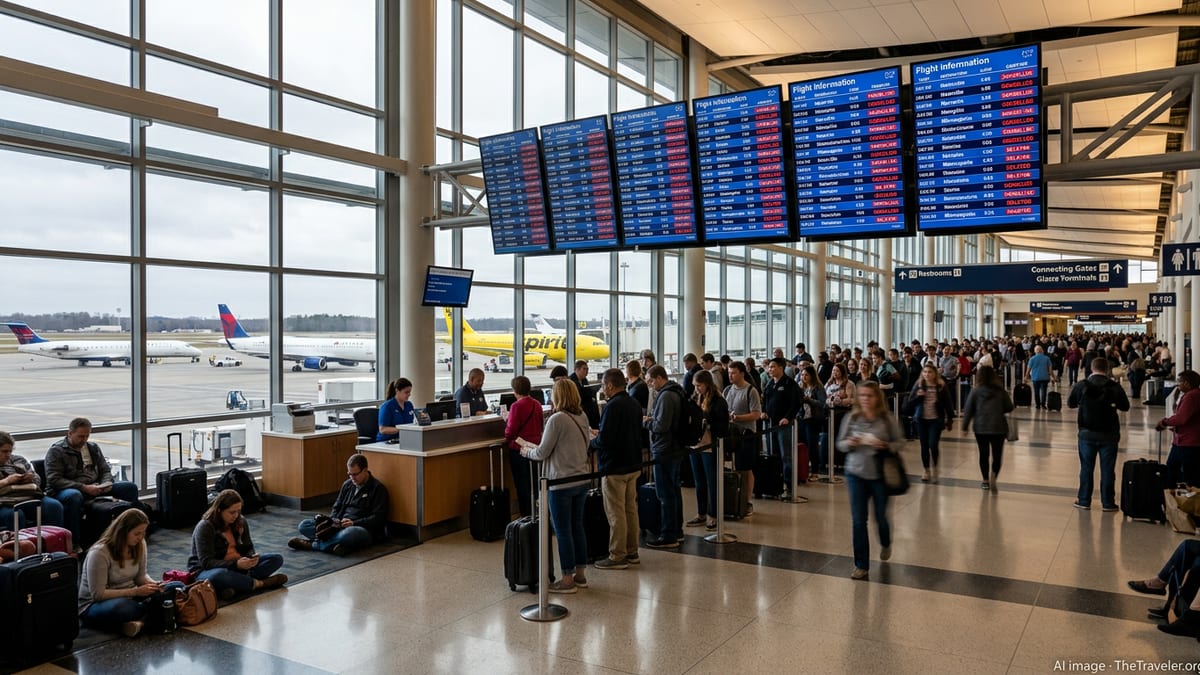
Carriers Cancel Dozens of Flights Out of Charlotte
Flight tracking data and published airport information indicate that Charlotte has seen more than a dozen flight cancellations in recent hours, with disruptive knock-on delays across the departure board. The disruption is concentrated among low-cost and regional carriers, including Spirit Airlines, Republic Airways and PSA Airlines, which collectively operate a dense network of short-haul routes through Charlotte Douglas International Airport.
Departures to major regional hubs such as Nashville, Memphis and Minneapolis have been particularly affected, with several services scrubbed outright and others pushed back by multiple hours. Additional delays are being reported on flights to other Southeast and Midwest cities, complicating travel plans for passengers who rely on Charlotte as both an origin and a critical connecting point.
Publicly available information shows that while some mainline operations continue to move, the thinning out of regional schedules has reduced options for rebooking. As cancellations stack up over the day, later flights are filling quickly, leaving many travelers with limited same-day alternatives and forcing some to consider overnight stays or multi-stop routings to complete their journeys.
The timing of the disruption has been especially challenging for business travelers and families returning from winter breaks, many of whom had chosen early weekend departures to maximize short trips. Social media posts from affected passengers describe crowded gate areas, long lines at service desks and growing uncertainty over when normal operations will resume.
Shutdown Strains Aviation System Capacity
The flight disruptions in Charlotte come amid a partial federal government shutdown that has reduced staffing levels at critical aviation facilities across the national airspace system. Published coverage of the shutdown’s impact on air travel points to pressure on air traffic control centers and airport security checkpoints, both of which rely heavily on federal employees whose pay and scheduling have been disrupted.
According to operational summaries shared by aviation data providers, reduced staffing can trigger flow-control measures that slow the rate of arrivals and departures at busy hubs, even if local weather conditions are favorable. When those constraints are applied to a major connecting airport such as Charlotte, small reductions in hourly capacity can translate into cascading delays across multiple airlines and routes.
Regional carriers such as Republic Airways and PSA Airlines are particularly sensitive to these system-wide constraints. Their aircraft and crews often operate tight rotations between multiple cities in a single day. When an early flight encounters an extended ground hold or is canceled outright, subsequent legs on that aircraft may also be delayed or dropped from the schedule, amplifying the impact for passengers downline in places like Nashville, Memphis or Minneapolis.
Industry analysts note that the current situation resembles earlier shutdown-related disruptions in which airlines were forced to trim schedules, prioritize certain hubs and reallocate aircraft to maintain at least a basic level of connectivity. For Charlotte, a major southeastern hub, those decisions are now being felt most acutely on shorter domestic routes that depend on precise timing to support connections.
Charlotte’s Role as a Hub Magnifies Passenger Impact
Charlotte Douglas International Airport functions as both a large local market and a significant connecting hub, which magnifies the effect of any operational disruption. Many travelers affected by the current cancellations are not only origin and destination passengers, but also connecting customers whose itineraries route through Charlotte on the way to other cities.
Published airport statistics show that regional affiliates such as PSA Airlines and Republic Airways carry a sizable share of Charlotte’s connecting traffic, feeding smaller and mid-sized markets into the hub. When those carriers pare back operations because of staffing constraints or broader network adjustments, passengers can quickly lose access to convenient one-stop options that normally make use of Charlotte’s central location in the eastern United States.
For travelers bound for cities like Nashville or Memphis, the disruption at Charlotte can mean longer journey times, additional connections or, in some cases, the need to reroute through alternative hubs such as Atlanta, Dallas or Chicago. For those heading toward Minneapolis and other Upper Midwest destinations, limited nonstop options from the Southeast increase reliance on Charlotte’s hub structure, so cancellations there can be particularly disruptive.
Reports from passenger forums and travel tracking platforms describe a patchwork of conditions across the airport. Some concourses are moving relatively smoothly where schedules remain intact, while others show clusters of canceled flights, crowded seating areas and lines for customer service that stretch far beyond their usual footprint as travelers seek new options.
Travelers Confront Rebooking Challenges and Uncertain Timelines
As cancellations accumulate, passengers in Charlotte are encountering the complex realities of rebooking during a period of systemic strain. Many of the affected flights are operated by regional partners on behalf of larger network airlines, which can complicate efforts to secure space on alternative services, especially when operating carriers and marketing carriers must coordinate seat availability and ticket changes.
Reports from airline customer channels indicate that some travelers are being moved to later same-day departures where seats remain, while others are offered travel on subsequent days or through different connecting hubs. For those on time-sensitive trips, the limited number of remaining seats on unaffected flights can drive difficult choices between extended delays, overnight stays or cancellations of plans altogether.
Passengers on low-cost carriers such as Spirit Airlines face additional constraints because of generally leaner schedules and fewer interline arrangements with other airlines. When a Spirit flight from Charlotte to a city like Nashville or Minneapolis is canceled, there may be no immediate same-carrier alternative, and travelers must either accept a later date or purchase new tickets on competing airlines at prevailing last-minute fares.
Consumer advocates observing the situation are encouraging travelers to review airline policies on cancellations, delays and duty of care, noting that the cause of disruption can influence eligibility for meal vouchers, hotel accommodations or refunds. However, publicly available commentary also underscores that in a shutdown-driven environment, even clear policies may be difficult to apply consistently when call centers and airport service desks are facing surging demand.
Guidance for Passengers Planning to Use Charlotte
With uncertainty over the duration of the partial government shutdown and its impact on aviation staffing, travel experts are advising passengers with upcoming itineraries through Charlotte to monitor their flights closely and build additional flexibility into their plans. Same-day schedule changes, rolling gate holds and last-minute cancellations remain possible as airlines adjust to evolving capacity constraints across the air traffic system.
Common recommendations shared by airline tracking services and travel advisors include confirming flight status repeatedly in the 24 hours before departure, arriving at the airport earlier than usual to account for potential security delays, and using airline mobile apps or websites where possible to handle rebooking rather than relying solely on in-person agents at the gate.
Travelers who have not yet purchased tickets but intend to fly through Charlotte in the coming days are being urged to consider itineraries that include longer connection times, particularly when traveling to or from cities such as Nashville, Memphis and Minneapolis that are already experiencing multiple cancellations. Longer layovers can offer a buffer if inbound flights are held or rescheduled because of system-wide flow controls.
For now, operations at Charlotte Douglas International Airport continue under constrained conditions, with periods of relative normalcy punctuated by clusters of cancellations and extended delays. As the partial shutdown persists, the experience of passengers in Charlotte is likely to remain a barometer of how prolonged federal funding disruptions can ripple through one of the country’s busiest air travel hubs.