


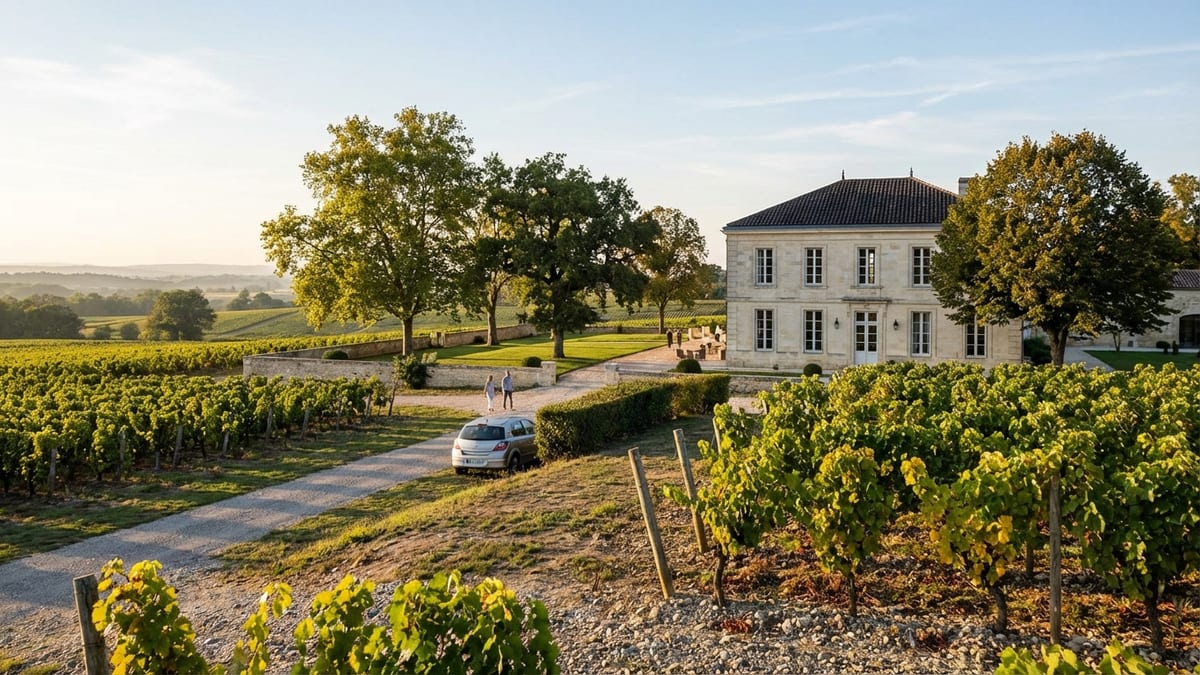
I spent two nights at Château Fage, in the Graves de Vayres area east of Bordeaux, specifically to see whether the wine tasting and wider estate experience justified the detour from the more famous names around Saint Emilion.
I had seen photos of a beautifully restored château-hotel surrounded by vines, with the promise of relaxed tastings, vineyard walks and a serious on-site restaurant. What I found was a place with undeniable charm, a few genuinely memorable wine moments, but also some inconsistencies and practical frustrations that are worth knowing about before you commit.
Getting There: Close to Bordeaux, Not Quite Effortless
Château Fage sits in Arveyres, in the relatively discreet Graves de Vayres appellation, roughly half an hour’s drive from central Bordeaux and a short hop from Libourne and Saint Emilion. On paper it looks simple: fly into Bordeaux, rent a car, and you’re tasting in the countryside by late afternoon. In practice, the approach felt a bit less romantic than the brochures suggest.
I drove in from Bordeaux on a weekday afternoon, and the last stretch involves typical peri-urban sprawl before you finally turn off towards vines and woodland. Signage to the estate is modest, so if, like me, you tend to rely on a quick last-minute glance rather than meticulously pinned maps, it is easy to overshoot a turn. Once I reached the gate, though, the atmosphere changed quickly: long views over vineyards, tall trees, and that slightly hushed, manicured quiet that tells you someone has invested real money in this place.
Public transport is technically possible if you reach Libourne by train and then take a taxi, but based on what I saw and the rural setting, I would not recommend visiting without a car. There are no convenient buses looping past the gate, and if you decide to explore other properties or Saint Emilion, you would either be ordering taxis repeatedly or limiting yourself to what is within walking or cycling distance from the estate. For a region selling itself on easy city escapes, the last mile still depends heavily on private wheels.
First Impressions: A Design Hotel Wrapped Around a Working Vineyard
Château Fage markets itself first as a four-star château-hotel and only second as a wine estate, and that hierarchy is very clear when you arrive. The central building is immaculate, with fresh stonework, carefully curated contemporary furniture and a landscaped park dotted with old trees. It looks and feels more like a modern design hotel that happens to be in the countryside than a rustic farm that later added rooms.
My check-in was friendly, if slightly formal. Staff spoke good English and shifted smoothly into the familiar rhythm of high-end hospitality: credit card, IDs, quick explanation of breakfast, restaurant service, and pool. When I mentioned I was particularly interested in the vineyard and tasting, I was given a short printed description and told tastings required advance booking, ideally at least 48 hours before, and were “depending on availability.” There was no sense of “you are on a wine estate where we are delighted to pour you something whenever you like,” which slightly undercut my initial enthusiasm.
The contrast between the polished hotel side and the relatively low-key presentation of the wine estate summed up my overall impression. The spaces where guests sleep and eat have been thoughtfully designed. The storytelling around the vineyard itself, and the casual access to that world, felt underdeveloped for a place that bills itself as a wine destination.
The Wine Estate & Tasting Formats: Structured, Not Spontaneous
Château Fage farms about 40 hectares in the Graves de Vayres appellation, including a small organic portion, producing both red and white wines typical of the Bordeaux vineyards. You would not necessarily grasp that scale from walking around the main courtyard. The winemaking side is discreet, tucked away from the main guest areas, and while I appreciate not having tractors rumbling under my window at dawn, I did miss a more visible sense of being on a working farm.
The estate offers structured tastings rather than a casual walk-in bar. During my stay, the core offer was the “Initiation” tasting, billed as an immersion into Bordeaux and the house’s own wines, around one hour, at 18 euros per person with a minimum of two people, and a more in-depth “Discovering Graves de Vayres” tasting at 40 euros per person, also one hour and also requiring at least two people. Both required booking at least 48 hours in advance and were subject to availability. As a solo traveler who booked my room only a few days beforehand, this policy immediately created friction.
I eventually joined the Initiation session by asking reception to check if they could attach me to an existing booking. To their credit, they tried, but the process felt more like negotiating a treatment at a spa than showing up at a wine estate where tastings are a core activity. If you are the sort of traveler who likes to decide on the day whether you feel like tasting, this structure is likely to frustrate you. On the other hand, if you plan your days well ahead and are traveling as a couple or group, the format will suit you fine.
The Tasting Experience: Informative but Aimed at Beginners
Once seated for the Initiation tasting, the experience was more satisfying. Our guide clearly knew the wines and the wider region and was comfortable switching between French and English. We started with a fairly classic overview of Bordeaux’s left and right banks before circling back to the specificities of Graves de Vayres. This is one of those “confidential” appellations that many visitors will never have heard of, and to be honest, the estate does a decent job of contextualizing its place between the marquee names of Pomerol, Saint Emilion and Graves proper.
We tasted several wines, both red and white, across different cuvées. The whites, built largely on Sauvignon and Sémillon, were the clear highlight for me: bright, citrus-driven, with a mineral edge that felt more serious than the easy “holiday sipper” category. The reds were competent, with the expected Merlot and Cabernet profile, but I found them a bit safe and polished, especially compared with the more characterful bottles you can find a short drive away in less manicured cellars.
For someone at the very beginning of their wine journey, the tasting would be excellent. The explanations were clear, the pace was manageable, and the setting, in a dedicated, nicely decorated space rather than a working cellar, made the experience approachable. As someone who has visited a fair number of wine estates, I did find the content somewhat basic. There was little opportunity to go into technical detail or taste older vintages or experimental cuvées, and the line-up focused heavily on the current, readily available wines.
One detail worth mentioning: the tasting is firmly a seated, appointment-style event. There is no sense that you can later drop into a bar area for a glass of something different or ask to try a single specific cuvée outside the framework of a formal session. If you are looking for flexibility or depth, you may come away slightly underwhelmed.
Vineyard Walks, “Bulle Verte” & On-Site Activities
Château Fage participates in the “Bulle Verte” concept, which here translates into marked walking and cycling routes through and around the property, ending in a wine tasting. On paper, this looked like exactly what I wanted: an unhurried wander through the vines and woods, a bit of interpretation about the landscape and grape varieties, and a relaxed glass at the end.
The reality was mixed. The routes themselves are pleasant, especially the version that takes you along the edge of the forest, with good views across the rows and a feeling of stepping slightly away from the formal hotel bubble. However, the interpretive material is light. I would have appreciated more detail on vineyard practices, soil types, or seasonal work rather than the fairly generic nuggets on local history and nature that you can find in many rural walking leaflets.
The pricing for these activities felt reasonable, around 15 to 25 euros per person depending on duration, with a short walk or ride and tasting of a couple of wines at the end. Still, you need to book and coordinate timings to align with tasting availability, which reintroduces the same planning rigidity I experienced with the main estate tastings. If you treat this as a structured activity, almost like booking a guided tour with a fixed slot, you will likely enjoy it. If you hope to grab a bike spontaneously on a sunny morning and see what happens, the system is not really built for that.
Beyond the wine-focused experiences, the estate offers cooking classes, especially in a feature called “The Chef & You,” where you can prepare one or two recipes with the resident chef in a custom space. Here, too, the pricing reflects the hotel’s four-star ambitions more than a rustic farmhouse vibe. It struck me as a nice option for food-obsessed couples looking for a special-occasion weekend, but it is not a casual add-on you slip into an already packed itinerary without thought.
Rooms, Restaurant & Service: Stylish Comfort With Some Rough Edges
The rooms at Château Fage are one of its strongest assets. Mine was in the “Comfort” category, not even the highest tier, yet it felt spacious, well-equipped and thoughtfully decorated. There were vineyard views, a comfortable bed, a modern bathroom and the usual four-star touches: Nespresso machine, minibar, air conditioning and good Wi-Fi. This part of the experience matched or even slightly exceeded my expectations, especially relative to some more old-fashioned wine châteaux that charge similar prices for tired decor.
The restaurant, La Maison des Vignes, leans into local produce and traditional regional dishes with a modern twist. My dinners were good, occasionally very good, but not mind-blowing. I enjoyed a well-executed fish dish paired with one of the estate’s white wines that showed both wine and kitchen to advantage. Another evening, a meat dish arrived slightly overcooked, and when I pointed it out, the response was polite but a bit defensive rather than immediately solution-seeking. It did not ruin the meal, but it chipped away at the luxe illusion.
Breakfast was classic French hotel fare: breads, pastries, some charcuterie, cheese, eggs, fruit and yogurt. It was adequate for a place in this price bracket but did not have the sense of curated local produce or homemade specialties that you sometimes find in similarly priced rural boutique hotels. Given the focus on “epicurean escapes” in the estate’s marketing language, I expected a bit more personality on the breakfast table.
Overall service was courteous, sometimes warm, but slightly inconsistent. Certain staff members felt genuinely engaged and eager to talk about the wines or local recommendations. Others seemed more detached, almost as if they had been imported from a generic city hotel and had not fully absorbed the wine estate’s culture. This inconsistency is subtle but noticeable when you compare back-to-back interactions over the course of a stay.
Practical Details: Bookings, Hours, Seasons & Pricing Reality
On a practical level, Château Fage operates very much on a booking-oriented model. The hotel itself, being a four-star property, expects advance planning for rooms, and special packages are often tied to fixed periods and conditions. When I checked, many offers were valid from Tuesday to Sunday between early May and mid-March, with annual closure periods around late December. For tastings and experiences, the rule of thumb was to book at least 48 hours in advance, and often a week ahead for cooking classes or more elaborate workshops.
The restaurant is open most days during the active season, but non-resident visitors should not expect to simply drop in without a reservation, especially in busy periods. If you are driving from Bordeaux or Saint Emilion solely for a meal and tasting, you will want to call or email ahead, both to confirm that the restaurant is serving and that a wine experience slot is available in your language.
Pricing reflects the dual nature of the place: you are paying simultaneously for a comfortable country hotel experience and for access to a working wine estate. Room rates are in line with a four-star château-hotel near Bordeaux, not with a rustic bed-and-breakfast; wine tastings, at 18 to 40 euros per person for the standard options, are on the higher side compared to basic cellar-door stops, but not outrageous given the guided format and context. Activity packages that bundle lodging, dinners, bike circuits and tastings can add up quickly. For a couple, it is entirely possible to spend as much on a two-night stay with meals and wine experiences here as on a longer, simpler stay in a modest guesthouse combined with multiple tastings in the surrounding appellations.
One positive detail: staff were quite transparent about seasonal closures and the exact dates when certain offers were valid. However, the website and printed materials are heavy on poetic language and light on at-a-glance practical tables of opening hours, which led to a few unnecessary questions and clarifications. A bit more blunt clarity would benefit anyone trying to piece together a tight itinerary.
Is It Worth It Compared With Other Bordeaux Wine Experiences?
If your primary goal is to taste as widely and deeply as possible across Bordeaux, Château Fage on its own does not justify a dedicated trip from the city. The wines are good, the setting is lovely, but this is not a grand cru estate with cellars full of legendary vintages or an experimental microdomain where you uncover esoteric, one-off bottlings. The experience here is more about blending comfortable rural hospitality with accessible wine education than chasing iconic labels.
However, if you value being based in one pleasant place where you can sleep, eat and explore vines without constantly getting in and out of a car, it becomes more appealing. The location near both Bordeaux and Saint Emilion makes it a convenient base to explore the wider region while coming “home” to a quieter, greener environment at the end of the day. You could easily spend a morning in Saint Emilion, an afternoon at another nearby château, and then retreat to Fage for a late swim, dinner and a final glass of its own white on the terrace.
Compared with more rustic wine estates that open their cellars for quick tastings without appointments or frills, Fage clearly positions itself at a different point in the spectrum. You are not only paying for what is in the glass but also for carpets, designer chairs and landscaped lawns. Whether that trade-off feels worthwhile will depend on your priorities. Personally, I enjoyed the comfort but occasionally caught myself missing the unpolished charm of more modest properties where someone is bottling in the next room while you taste.
The Takeaway
Looking back, I am glad I visited Château Fage, but I would approach it differently next time. I went in expecting a place where the wine estate aspect would dominate, with the hotel as a pleasant add-on. The reality is closer to a refined countryside hotel that happens to own a vineyard and offers a curated set of wine experiences. Once I adjusted my expectations, the stay made more sense.
For travelers who like their wine experiences to be structured, comfortable and wrapped in four-star amenities, Château Fage is a solid choice. Couples seeking a quiet, romantic base near Bordeaux, with one or two relaxed tastings and perhaps a cooking class or bike ride through the vines, will probably be very happy here, especially if they book a package that bundles room, dinner and tasting into a coherent whole.
On the other hand, if you are a serious wine geek looking for deep dives into cellar practices, vertical tastings of older vintages or spontaneous bar-style flights, this is not the most rewarding stop. Likewise, if your budget is tight and you prefer to allocate funds to bottles rather than beds, you may be better off with simpler accommodations and more varied tastings across smaller local producers.
In short, Château Fage is worth visiting under specific conditions. Go if you want a comfortable, design-forward base in the vines, are willing to plan your tastings and activities ahead of time, and are more interested in an overall gentle immersion into Bordeaux wine country than in chasing headline estates. Do not go expecting a bargain, or a gritty, hands-in-the-cellar experience. Take it for what it is: a polished, somewhat curated version of vineyard life, with enough genuine warmth and good wine to justify a couple of days, provided you arrive with your eyes open and your schedule confirmed.
FAQ
Q1. Do I need to book the wine tasting at Château Fage in advance?
Yes. During my stay, tastings required booking at least 48 hours in advance and were subject to availability, so last-minute walk-ins were not encouraged.
Q2. Can I visit Château Fage just for a tasting without staying at the hotel?
Yes, non-resident visitors can book tastings, but you still need to arrange your slot ahead of time and it is wise to confirm opening days and languages available.
Q3. Is Château Fage easy to reach without a car?
Not really. You can take a train to Libourne and then a taxi, but once there, having your own vehicle makes a big difference for exploring other estates and nearby villages.
Q4. Are the wine experiences suitable for beginners?
Very much so. The Initiation tasting is clearly aimed at people who are new to Bordeaux and want an accessible introduction rather than a highly technical session.
Q5. How expensive are the tastings at Château Fage?
When I visited, the basic Initiation tasting was around 18 euros per person and the more in-depth Graves de Vayres experience about 40 euros per person, both for about an hour.
Q6. Is the restaurant at Château Fage worth planning around?
The food is good and sometimes very good, with a comfortable dining room, but it did not reach the level of a destination restaurant on its own; it works best as part of the overall stay.
Q7. Can I explore the vineyards on my own?
Yes, to an extent. There are marked walking and cycling routes as part of the Bulle Verte concept, but they are structured activities rather than completely free-form roaming.
Q8. Is Château Fage a good base for visiting Saint Emilion?
Yes. It is a short drive from Saint Emilion, making it a practical and quieter base if you want to combine that famous village with a more secluded countryside stay.
Q9. Would I recommend Château Fage for serious wine collectors?
Only partially. It is pleasant, but the tastings are more introductory than deep, and collectors may prefer to allocate more time to estates offering verticals or broader line-ups.
Q10. Would I stay at Château Fage again, and what would I change?
I would consider staying again for a relaxed weekend, but next time I would pre-book tastings, restaurant dinners and any activities well in advance, and I would plan additional visits at other nearby châteaux to round out the wine side of the trip.