


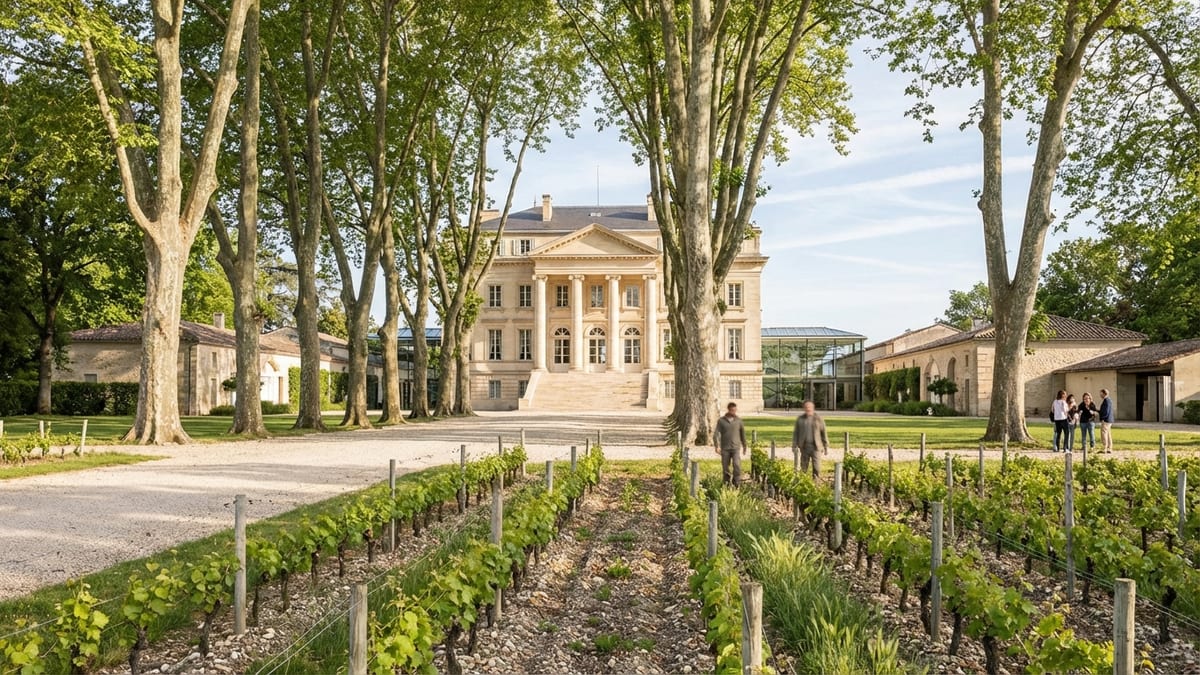
In the world of fine wine, very few names carry the almost mythical aura of Château Margaux. This stately estate on Bordeaux’s Left Bank has come to embody the idea of perfumed elegance: Cabernet-driven reds of haunting aroma, satiny tannins and remarkable longevity, shaped by centuries of savoir-faire and one of the most privileged terroirs in the Médoc.
For the curious traveler or serious collector, understanding Château Margaux means delving into history, geology, architecture, and meticulous winemaking, then finally experiencing those layers of complexity in the glass.
The Legacy of a First Growth
Château Margaux sits at the heart of the Margaux appellation, about 25 kilometers north of Bordeaux, and was one of only four estates ranked Premier Grand Cru Classé in the famous 1855 Classification of the Médoc. That coveted status codified what merchants and connoisseurs had already recognized for generations: in blind tastings and price records, the wines of Margaux consistently fetched the highest prices and inspired the greatest admiration for their finesse and aromatic depth.
The estate’s roots stretch back to the late Middle Ages, when the property was known as “La Mothe de Margaux,” a sign that it already occupied one of the area’s prized gravel mounds. By the 17th century the land had begun its transformation into a single, coherent wine estate, with the noble Lestonnac family consolidating holdings and expanding vineyards. Over the following centuries, as viticulture flourished and Bordeaux trade boomed, Château Margaux became a benchmark for what the Margaux style could be: delicate floral perfume, refined structure, and notably silky tannins even in youth.
Ownership changed many times, but the 20th century brought an especially critical chapter. After a period of decline and underinvestment in the mid-1900s, the estate was purchased in 1977 by Greek businessman André Mentzelopoulos. His substantial reinvestments in the vineyard, cellar, and technical team laid the foundation for the estate’s modern renaissance. After his death, his daughter Corinne Mentzelopoulos took over stewardship, becoming one of the most influential figures in contemporary Bordeaux and guiding Château Margaux to renewed greatness across the 1980s, 1990s, and well into the 21st century.
Today, Château Margaux remains family-owned under Corinne Mentzelopoulos, with managing director and winemaker Philippe Bascaules overseeing viticulture and production. The château is both a working wine estate and a symbol: of continuity amid change, of a region’s history carried forward by meticulous daily work in the vines and cellars.
Architecture, Estate & Sense of Place
A visit to Château Margaux impresses long before the first aroma rises from the glass. Framed by an avenue of plane trees, the iconic neoclassical château, completed in the early 19th century, has often been likened to a Bordeaux “Versailles.” This harmonious symmetry, with fluted columns and pedimented façade, reflects the confidence of an era when the estate was already regarded among Europe’s most distinguished wine properties.
Behind the grand architecture lies a complex of cellars, vat rooms and outbuildings, some historic, others strikingly contemporary. In the 2010s, the estate entrusted architect Norman Foster with a major modernization project, discreetly integrating state-of-the-art facilities for red and white winemaking beneath and alongside the classical structures. The result is a property that feels both timeless and quietly cutting-edge, where gravity-flow vat rooms, precision-controlled fermenters and luminous barrel cellars coexist with original stone walls and cobbled courtyards.
The estate comprises nearly 200 acres of vines within a larger 650-acre property, a patchwork of parcels that together express the classic Margaux appellation profile. About three-quarters of the vineyard is planted to red varietals dominated by Cabernet Sauvignon, with Merlot, Petit Verdot and Cabernet Franc playing supporting roles. An 11-hectare enclave is devoted entirely to Sauvignon Blanc for the estate’s rare white wine, Pavillon Blanc du Château Margaux.
Walking through the vineyards, you notice the subtle undulations of the land: low gravel ridges, gentle slopes, pockets of clay and sand. It is these small variations, sometimes only visible in the contour of a row or the feel of the soil underfoot, that underpin the estate’s meticulous parcel-by-parcel approach to cultivation and harvest. Every block is catalogued, monitored and farmed with a specific destiny in mind, whether for the grand vin or one of the estate’s other wines.
Terroir of Margaux: Gravel, Climate & Elegance
The defining element of Château Margaux’s terroir is gravel. Over millennia, the Garonne and Dordogne rivers deposited layers of pebbles, stones and sand over clay and limestone subsoils, building the croupes, or gravel mounds, that now underpin the Médoc’s top crus. These free-draining soils are ideal for Cabernet Sauvignon: they warm quickly, retain little excess water, and encourage vines to root deep in search of moisture and nutrients, naturally limiting vigor and concentrating fruit.
At Margaux, the gravels are particularly fine and deep, mixed with more sand than in some neighboring communes, a factor often credited with the appellation’s distinctive aromatic lift and textural delicacy. While Pauillac’s gravels might yield more muscular, graphite-laced wines, Margaux tends to give a more perfumed, violet and rose-scented expression of Cabernet, with tannins that feel more satin than suede.
The climate is classic maritime Bordeaux, tempered by the nearby Gironde estuary and the Atlantic Ocean. Winters are relatively mild, springs can be variable, and summers are increasingly warm, though the estate’s proximity to water and its well-drained soils help buffer extremes. Vintage conditions matter greatly here: a cool, damp year may produce wines of particular finesse and moderate alcohol, while hot, dry seasons yield richer, more opulent vintages that still, at their best, retain the hallmark freshness and tension that define Château Margaux.
In recent years, climate change has prompted the estate to deepen its focus on soil health, canopy management and vine balance. Careful leaf-thinning, yield control and harvest timing aim to achieve ripe tannins and aromatic complexity without excessive sugar accumulation. At the same time, the diversity of parcels provides natural insurance: earlier- and later-ripening plots, as well as variations in soil depth and exposure, allow for nuanced blending to preserve the estate’s signature equilibrium.
From Vineyard to Cellar: How Château Margaux Is Made
The journey of Château Margaux’s grand vin begins with painstaking work in the vineyard. Vines average around 35 years of age, though some parcels are significantly older. Pruning, shoot selection and green harvesting are all performed by hand, with great attention to individual vine vigor. The estate has progressively shifted toward organic practices in many blocks, with an emphasis on minimal synthetic inputs, cover crops to promote biodiversity, and careful soil management to encourage deep root systems.
Harvest is entirely manual, carried out plot by plot as grapes reach ideal maturity. Pickers typically start in the cooler morning hours, bringing in small crates of fruit that are quickly transported to the winery. There, bunches undergo rigorous sorting: first by hand on tables, then often with optical sorting machines that evaluate each berry’s size, color and condition. Only the healthiest, ripest grapes move on to fermentation, and even then each parcel is kept separate to preserve its specific character.
In the vat room, fermentation unfolds in a combination of stainless steel and traditional oak vats, each vessel matched to the size and style of the parcel. Temperature control is meticulous, allowing slow, gentle extraction of color, tannin and aroma. Pumpovers and cap management are tailored to each lot’s structure: more powerful parcels may receive a more assertive extraction regime; delicate ones are treated with greater restraint to preserve floral aromas and finesse.
Following fermentation and maceration, the young wines are run into barrels for malolactic fermentation and aging. New French oak plays a key role in the identity of the grand vin, with a high percentage of new barrels from top coopers. Yet the goal is integration, not dominance; the best vintages show oak as a subtle frame for the wine’s core of fruit and terroir expression. Over 18 to 24 months, the team conducts regular tastings, topping and rackings, gradually clarifying each component’s role in the final blend. Only after a merciless selection process is the grand vin assembled, with the second wine and other cuvées absorbing parcels that do not meet the uncompromising standard.
The Grand Vin: Château Margaux in the Glass
Château Margaux, the grand vin, is one of the world’s most sought-after red wines. Typically composed predominantly of Cabernet Sauvignon, often around three-quarters of the blend, it is supported by Merlot for mid-palate flesh, Petit Verdot for spice and backbone, and small amounts of Cabernet Franc for aromatic complexity. The exact blend shifts with each vintage, reflecting the personality of the year and the strengths of individual parcels.
In youth, a great Château Margaux is intensely aromatic, yet rarely heavy. Classic notes include blackcurrant, blackberry and plum layered with violets, rose petals, cedar, tobacco leaf and often a touch of graphite or pencil shavings. On the palate, the wine tends to be medium to full-bodied, but the impression is one of grace rather than sheer mass. Tannins are abundant yet fine-grained, the acidity vibrant, and the finish lingering with a cool, stony nuance that speaks of its gravelly origins.
With time in bottle, the wine unfurls further layers: dried flowers, forest floor, leather, truffle, and subtle savory notes that intertwine with still-vivid fruit in the great vintages. Many classic years of Château Margaux can evolve for several decades, rewarding patience with increased complexity and an almost Burgundian sense of aromatic detail. Among modern releases, vintages like 2000, 2005, 2009, 2010 and 2015 have received particular acclaim, though more recent years continue to demonstrate the estate’s ability to balance ripeness with freshness in a warming climate.
For the traveler or collector, appreciating Château Margaux means understanding that it is not the heaviest or most muscular of Bordeaux’s first growths. Its greatness lies instead in perfume, poise and texture: a wine that can seem almost weightless yet leaves an indelible impression of depth and harmony. This is why, in comparative tastings, many tasters describe Margaux as the most “feminine” or ethereal among the Left Bank’s top estates, even in powerful years.
The Other Wines: Pavillon Rouge, Pavillon Blanc & More
While the grand vin is the estate’s flagship, Château Margaux produces several other wines that together give a fuller picture of its terroir and style. The second wine, Pavillon Rouge du Château Margaux, has evolved dramatically over the last few decades. Once a more straightforward offcut, it is now the result of an exacting selection process, often representing around 25 to 30 percent of the harvest. Predominantly Cabernet Sauvignon, with Merlot, Petit Verdot and Cabernet Franc, Pavillon Rouge captures much of the grand vin’s aromatic elegance and refinement, in a frame that is typically more approachable in earlier years.
Recent vintages of Pavillon Rouge underscore this positioning. The estate’s own notes highlight 2023 as particularly fresh and precise, with a blend anchored by nearly 80 percent Cabernet Sauvignon, backed by Merlot, Cabernet Franc and Petit Verdot. In years like 2020 and 2021, critics have praised the wine’s balance of red and black fruit, floral lift and fine tannins, often remarking how close it comes to the character of the grand vin while remaining more open and charming in its first decade of life.
Pavillon Blanc du Château Margaux is a rarity in the Médoc: a white wine produced from 100 percent Sauvignon Blanc on an 11-hectare parcel that has been dedicated to white grapes since the 17th century. The cuvée has existed under its current name since 1920, and only a fraction of the harvest makes it into bottle, with the remainder sold off in bulk to preserve quality. Bright, mineral and intense, Pavillon Blanc combines citrus, white peach and floral notes with remarkable tension and length. Modern vintages, particularly from 2017 onward, show an even higher level of precision and aging potential, reflecting both improved selection and the benefits of the estate’s cutting-edge white wine cellar.
In addition, the estate produces a small number of other wines, including a more recent white labeled as a second wine to Pavillon Blanc and a third red wine sometimes destined primarily for earlier drinking. Together, these bottlings provide opportunities for wine lovers to experience the Château Margaux style at different price points and stages of evolution, and they serve a vital role in the estate’s quality strategy by allowing stricter selection for the grand vin.
Visiting Château Margaux: Practicalities & Experience
For travelers to Bordeaux, visiting Château Margaux is often a highlight of a Left Bank itinerary. The estate, however, remains a working wine property first and foremost, and its visitor program reflects that priority. Tours of the cellars are offered strictly by appointment, generally from Monday to Friday, and the estate is closed to visitors on weekends, public holidays, in August and during the harvest period. Planning ahead is essential, particularly in the busy spring and early summer months when Bordeaux sees a surge of wine tourism and trade tastings.
One important note for casual wine travelers is that Château Margaux does not operate as a traditional tasting room. Tastings on site are reserved primarily for wine professionals, importers and merchants. The estate also does not sell wine directly from the property. Instead, all of its production is released via the historic Bordeaux négociant system, meaning bottles are distributed through merchants and fine wine retailers around the world rather than at the château gate.
That does not diminish the value of a visit. A tour typically includes a walk through the grounds, an introduction to the estate’s history and classification, and a guided exploration of the historic and modern cellars, where visitors can see how cutting-edge technology is integrated into such a storied site. Many travelers pair a visit to Château Margaux with other properties in the appellation, as well as time in the town of Margaux itself and along the wine route of the Médoc.
Because appointments are essential and slots limited, it is wise to contact the estate well in advance, either directly or through a specialized wine tour operator who can coordinate visits to several grands crus over one or two days. Even without a tasting, the chance to see this iconic property, walk among its vines and stand before the neoclassical château offers a powerful sense of connection to the history captured in every bottle labeled Château Margaux.
How to Buy, Cellar & Enjoy Château Margaux
For many wine lovers, the question is not whether Château Margaux is worth seeking out, but how best to access and enjoy it. Because the estate does not sell directly to consumers, your pathway will be through reputable wine merchants, auction houses, or en primeur campaigns that offer futures on young vintages still in barrel. Pricing reflects its first growth status and global demand, with top vintages commanding high prices, but second wines and off-peak vintages can offer relatively more accessible entry points into the house style.
When buying, provenance is paramount. Seek merchants known for impeccable storage and sourcing, particularly for older vintages. For collectors, en primeur purchases can be a way to secure allocations of coveted years at release, though this approach requires confidence in both the merchant and one’s own patience. Many enthusiasts also build verticals of Pavillon Rouge or Pavillon Blanc alongside occasional bottles of the grand vin, using the former for earlier drinking while the latter rests in the cellar.
Cellaring conditions should be as steady and cool as possible: ideally around 55 degrees Fahrenheit with high humidity and minimal light or vibration. Great vintages of Château Margaux often benefit from 10 to 15 years of bottle age before they begin to hit a first plateau of maturity, and can evolve beautifully for several decades thereafter. Pavillon Rouge tends to show well a bit earlier, often from five to eight years after the vintage, while Pavillon Blanc, although capable of aging, is frequently enjoyed within its first decade for its vivid fruit and tension.
When it comes time to serve, decanting young Château Margaux and Pavillon Rouge can help the wines open, allowing tannins to soften and aromatics to develop. Serving temperatures slightly cooler than typical room temperature, around 60 to 64 degrees Fahrenheit, help maintain freshness and definition. Food pairings for the grand vin lean toward simply prepared lamb, beef or game, while Pavillon Blanc and the estate’s other white wines are superb with dishes featuring shellfish, delicate fish, or fresh goat cheese. Above all, the aim is to let the wine’s inherent complexity shine rather than overwhelm it with assertive sauces or spices.
The Takeaway
Château Margaux stands at a rare intersection of history, terroir and craftsmanship. Its wines are not simply powerful or prestigious; they are reference points for an ideal of elegance, perfume and balance that has captivated drinkers for centuries. From its neoclassical façade and meticulously tended gravel mounds to its modern vat rooms and limited-production white wines, the estate embodies both tradition and thoughtful innovation.
For the traveler, a visit offers insight into how soil, climate, people and time converge in a single glass. For the collector, bottles of Château Margaux and its Pavillon wines represent not only luxury but a chance to follow the evolution of one of Bordeaux’s most distinctive voices across vintages. Whether you experience the estate in person or through a treasured bottle shared at the table, understanding its history, terroir and signature wines deepens the pleasure and reveals why the name Château Margaux remains one of the most resonant in the world of wine.
FAQ
Q1: Where is Château Margaux located?
Château Margaux is located in the Margaux appellation of the Médoc on Bordeaux’s Left Bank in southwestern France, approximately 25 kilometers north of the city of Bordeaux.
Q2: What grapes are used in Château Margaux’s red wines?
The estate’s red wines are dominated by Cabernet Sauvignon, typically supported by Merlot, Petit Verdot and smaller amounts of Cabernet Franc, with proportions adjusted each vintage according to the character of the harvest.
Q3: What makes Château Margaux’s terroir special?
Château Margaux sits on deep, well-drained gravel mounds over clay and limestone subsoils. These gravels encourage deep rooting and limit vigor, producing concentrated grapes, while the Margaux area’s particularly fine, sandy gravels are associated with the appellation’s signature aromatic elegance and silky tannins.
Q4: What is Pavillon Rouge du Château Margaux?
Pavillon Rouge is the estate’s second red wine, made from parcels and lots that do not go into the grand vin but still meet very high quality standards. It mirrors the grand vin’s blend and style on a slightly more accessible frame and tends to be drinkable earlier, while still offering good aging potential.
Q5: Does Château Margaux produce white wine?
Yes. Pavillon Blanc du Château Margaux is a white wine made entirely from Sauvignon Blanc grown on an 11-hectare parcel. It is produced in small quantities, with only a fraction of the harvest bottled, and is known for its intensity, minerality and capacity to age.
Q6: Can tourists visit Château Margaux for tastings?
Château Margaux offers visits of the cellars by prior appointment only, usually from Monday to Friday. Tastings on site are reserved primarily for wine professionals, and the estate does not operate a public walk-in tasting room.
Q7: Does Château Margaux sell wine directly at the estate?
No. The estate does not sell wine directly to visitors. All of its production is sold through the traditional Bordeaux merchant network, so consumers should purchase bottles from reputable wine retailers, merchants or at auction.
Q8: How long can Château Margaux age?
In top vintages, Château Margaux can age gracefully for several decades, often showing well from around 10 to 15 years after the vintage and continuing to evolve for 30 years or more. Pavillon Rouge generally reaches its peak earlier, while Pavillon Blanc is frequently enjoyed within the first decade, though the best vintages can also age longer.
Q9: How should I serve Château Margaux?
Serve Château Margaux and Pavillon Rouge slightly below room temperature, around 60 to 64 degrees Fahrenheit. Decanting young vintages one to two hours before serving helps the wines open aromatically and soften their tannins. Pavillon Blanc is best served well chilled to highlight its freshness and aromatics.
Q10: Is Château Margaux suitable for beginners in fine wine?
While Château Margaux is often expensive and collectible, its style of aromatic finesse and balance can be deeply rewarding even for newcomers to fine wine. Those starting out might explore Pavillon Rouge or Pavillon Blanc from recent vintages as more accessible introductions to the estate’s character before investing in older or top vintages of the grand vin.