


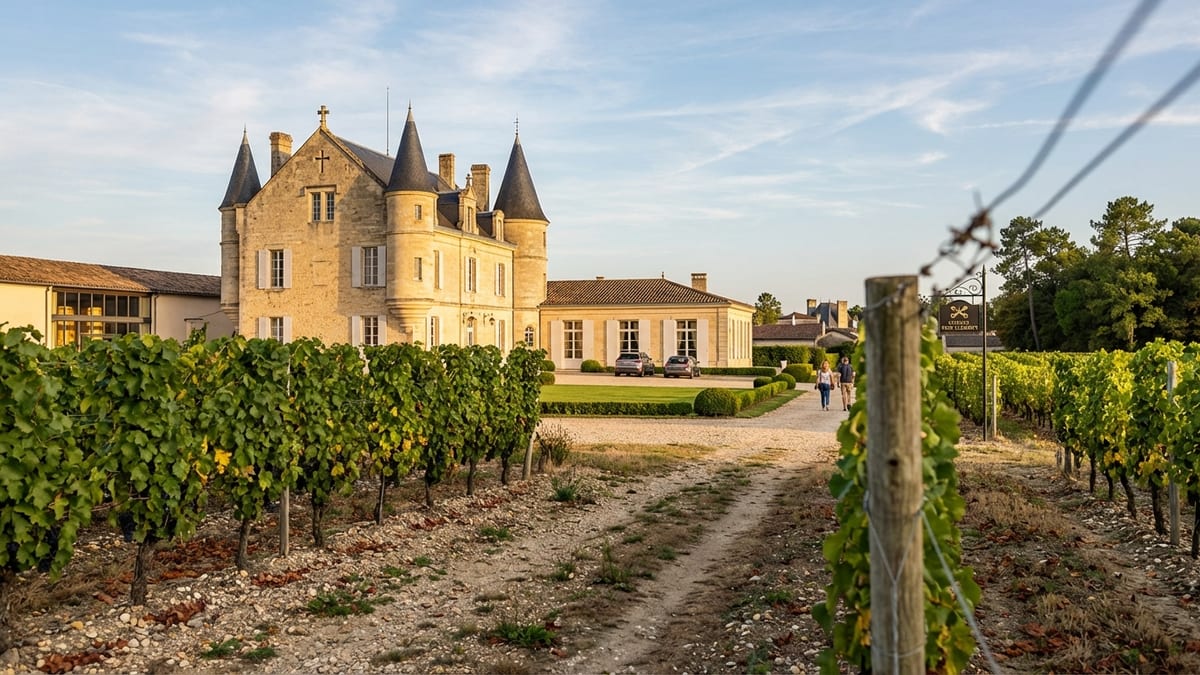
Château Pape Clément is one of those Bordeaux names that manages to feel both deeply historic and surprisingly contemporary. Just a short drive from central Bordeaux in the suburb of Pessac, this Grand Cru Classé de Graves offers visitors a rare combination of seven centuries of winegrowing heritage, cutting edge cellar techniques and polished hospitality. Whether you come for a cellar tour, a park-like stroll among the vines or to taste its powerful, perfumed reds and distinctive whites, Pape Clément provides a complete immersion in the character of Pessac Léognan.
The Story Behind the Pope’s Vineyard
The modern identity of Château Pape Clément is inseparable from its medieval origins. The estate traces its first recorded harvest to 1252, when the land was known as Domaine de la Mothe and already prized for its gravelly soils. Its most famous early owner was Bertrand de Goth, born into a local noble family and appointed Archbishop of Bordeaux in the early 14th century. In 1305 he was elected pope and took the name Clement V, giving rise to the property’s current name and its enduring association with ecclesiastical history.
As Pope Clement V, Bertrand de Goth continued to manage and improve the Bordeaux vineyard from afar, entrusting it to stewards but maintaining close oversight. For centuries after his death the estate remained in the hands of the Archbishopric of Bordeaux, and its wines were largely reserved for religious ceremonies and the church hierarchy rather than commercial trade. This long clerical guardianship helped cement a reputation for quality at a time when few estates had such continuity.
The French Revolution brought a decisive break. Church lands across France were seized and sold as national property, and in this upheaval Pape Clément passed into private hands. Through the 19th and early 20th centuries a succession of owners expanded the vineyards, modernized winemaking practices of the day and rebuilt parts of the château, particularly in the 16th century wing that now greets visitors. The estate weathered phylloxera, war and economic crises, but like many Bordeaux vineyards its quality and visibility fluctuated.
A crucial modern milestone arrived in 1959, when the wines of Graves were formally classified and Château Pape Clément was recognized as a Grand Cru Classé. That official recognition codified what many merchants and connoisseurs already believed: that Pape Clément belonged among the elite of the Left Bank, distinct in style from the Médoc yet of comparable pedigree.
Bernard Magrez and the Modern Renaissance
The contemporary chapter of Château Pape Clément begins in the 1980s, when Bordeaux entrepreneur and wine magnate Bernard Magrez acquired the estate as his flagship property. At the time Pape Clément was respected but not always consistent. Magrez set out to change that through significant investment in the vineyard and cellar, a relentless focus on detail and a clear objective of placing the wine at the summit of Pessac Léognan.
Under his ownership the estate adopted a philosophy that marries traditional respect for terroir with modern precision. Vineyard mapping, denser plantings, parcel by parcel management and rigorous selection have all become hallmarks of the approach here. Magrez also enlisted the services of leading consultant oenologist Michel Rolland for the red wines, deepening the focus on texture, ripeness and tannin polish while preserving the classic Graves signatures of graphite and smoky minerality.
Today Pape Clément is surrounded by roughly 60 to 67 hectares of vines, depending on whether you consider only the parcels used for the Grand Vin or the broader estate surface. The property remains at the heart of Magrez’s wider wine portfolio, which now includes dozens of estates in Bordeaux and beyond. Yet Pape Clément retains a special status. It is where the emblematic “keys” symbol that appears on Magrez bottles was first associated with his quest for excellence, and it functions as the showcase for his vision of top tier Bordeaux hospitality.
For visitors, this modern renaissance is palpable. Restored salons, contemporary art pieces, manicured gardens and a meticulously kept barrel cellar sit alongside historic architectural elements, signaling that the château is both guardian of an important past and firmly anchored in the present.
Understanding the Terroir of Pessac Léognan
Château Pape Clément belongs to the Pessac Léognan appellation, created in 1987 within the wider Graves region to highlight the finest terroirs on the left bank of the Garonne south of Bordeaux. Unlike the contiguous vineyards of the Médoc, Pessac Léognan’s parcels are often sprinkled among residential neighborhoods and woodlands, especially around Pessac itself. The result is a landscape where imposing châteaux share the skyline with suburban homes and pine trees.
The key to Pape Clément’s quality lies beneath the surface. The estate sits on one of the oldest alluvial terraces of the Graves, often referred to as the “nappe des graves pyrénéennes,” a geological formation dating from the late Pliocene and early Quaternary periods. Here, a relatively thin skin of more recent Garonne gravels overlays much older, deep deposits of pebbles, sand and clay enriched by material washed down from the Pyrenees.
This mosaic of gravel on clay underpins the character of the red wines. The gravel ensures excellent drainage and heat retention, helping Cabernet Sauvignon and Merlot achieve full ripeness even in challenging years. Beneath, the clay provides water reserves that vines can tap into during dry spells, sustaining vine health and promoting even maturation. Many tasters attribute the estate’s combination of ripe black fruit, tobacco and truffle notes, along with its fine-grained tannins, directly to this interplay of gravel and clay.
For the white wines, planted on slightly cooler and sometimes sandier plots, the terroir brings a different expression. Sémillon and Sauvignon Blanc, along with smaller amounts of Sauvignon Gris and Muscadelle, deliver wines marked by smoky and flinty minerality, tension and a distinctive, almost waxy texture when aged. The same gravel that radiates warmth to the reds helps whites reach aromatic maturity, while the subsoils protect their acidity and structural backbone.
From Cabernet to Sémillon: Vines and Viticulture
In the vineyard, Château Pape Clément focuses on a classic Bordeaux palette of grape varieties, adjusted to the specific requirements of Pessac Léognan. For the reds, Cabernet Sauvignon and Merlot dominate, typically supported by smaller shares of Petit Verdot and Cabernet Franc. Proportions can vary slightly depending on vintage conditions, but a representative planting might include close to half Cabernet Sauvignon, slightly under half Merlot and a few percent each of Petit Verdot and Cabernet Franc.
The white plantings are more unusual in a Left Bank context, reflecting Pessac Léognan’s dual heritage as a source of both top red and white wines. Sémillon and Sauvignon Blanc form the backbone, with Sauvignon Gris and a small amount of Muscadelle adding aromatic complexity. This blend allows the estate to craft whites that can rival the reds in structure and longevity, a defining feature of the Graves style.
Vine density is typically high, around 7,700 vines per hectare, encouraging deep root penetration and competition that naturally limits yields. The average vine age for the Grand Vin parcels is often stated in the high twenties to mid-thirties in years, with some older blocks contributing further concentration. Vineyard work is intensive, with green harvesting, leaf thinning and meticulous plot selection used to fine-tune ripeness and tannin quality.
In keeping with the estate’s drive for precision, harvests are conducted parcel by parcel, sometimes in multiple passes through the same block to pick only perfectly ripe bunches. Hand harvesting is standard for the grapes destined for the Grand Vin. In cooler or more challenging years the team leans on strict selection at the sorting table to maintain the house standard, while in great vintages they focus on capturing freshness and balance to complement the natural generosity of the fruit.
Inside the Cellar: Winemaking at Château Pape Clément
The winemaking approach at Château Pape Clément combines traditional Bordeaux methods with modern technology and a clear stylistic vision. In the red cellar, grapes are sorted and often undergo cold pre-fermentation maceration to extract color and aroma with minimal tannic harshness. Fermentation takes place in temperature-controlled vats, with maceration commonly lasting around four weeks to build depth and structure.
The estate is known for careful extraction practices, aiming for richness without heaviness. Pump-overs and, in some cases, manual punch-downs are adapted to each parcel’s characteristics. Consultant Michel Rolland’s influence is evident in the silky textures and finely calibrated tannins that many vintages display. Malolactic fermentation typically takes place in barrel, further integrating oak and fruit at an early stage.
Ageing for the red Grand Vin usually runs to around 18 months, predominantly in French oak barrels with a significant portion new each vintage. Some lots may also be matured in larger wooden vats to moderate oak impact while preserving freshness. The result is a wine that marries ripe cassis and plum fruit with notes of cedar, cigar box, dark chocolate and the signature smoky, truffle-like nuance often associated with top Pessac Léognan.
The white wines see equally careful handling. Whole-bunch pressing, fermentation in barrel and extended lees contact with regular stirring help build texture and aromatic complexity. New oak is used, but generally with a lighter touch than for the reds, preserving the tension and mineral line that give Pape Clément Blanc its reputation for ageworthiness. In strong vintages the white wine can be every bit as impressive as its red counterpart, displaying layers of citrus, stone fruit, beeswax, flint and a subtle grilled note over time.
Signature Wines: What to Expect in the Glass
The flagship of Château Pape Clément is its red Grand Cru Classé Pessac Léognan. In youth it typically shows a deep, saturated color and an expressive bouquet of dark berries, ripe plum, violet and spice, with undertones of graphite, tobacco and cocoa. Texture is one of its calling cards: full-bodied and concentrated yet noticeably polished, with tannins that are abundant but velvety, giving a sense of power wrapped in refinement.
With bottle age, the red wine evolves toward more savory and tertiary aromatics. Blackcurrant and blackberry often give way to dried fig, leather, cigar box, forest floor and the truffle character that critics frequently highlight. In strong vintages, such as 2010 or 2015, the wine can easily sustain two or more decades in a good cellar, rewarding patience with complexity and a long, harmoniously tapered finish.
The white Grand Vin of Château Pape Clément has developed a near cult following among lovers of structured, ageworthy Bordeaux Blanc. Young bottles are typically intense and tightly coiled, with aromas of citrus zest, white peach and tropical fruits framed by smoky, flinty notes and well-integrated oak. On the palate, richness and freshness coexist, supported by vibrant acidity and a subtly creamy texture from lees ageing.
As it ages, Pape Clément Blanc gains honeyed, waxy and nutty nuances, often compared to top white Burgundy in their interplay of weight and precision. The distinctive “fumé” character associated with Graves whites emerges more clearly, and the finish lengthens, carrying saline and mineral tones. For many enthusiasts, tasting both red and white side by side offers the clearest window into the complete personality of the estate.
Visiting Château Pape Clément: Experiences and Practical Tips
For travelers in Bordeaux, Château Pape Clément is one of the most accessible top estates to visit. Located in Pessac, within the Bordeaux urban area, it can be reached by car or taxi from the city center in a matter of minutes, making it feasible as a half day or even late afternoon excursion. The property welcomes visitors throughout the year with a range of tours, tastings and tailored experiences.
Standard visits typically include a guided walk through the gardens and a portion of the vineyards, followed by a tour of the vat room and barrel cellars. Guides explain the history of the estate from its medieval origins to its modern revival and outline the key principles of viticulture and winemaking here. Tastings often include both the Grand Vin and the second wine, Le Clémentin de Pape Clément, and in some formats may showcase both red and white wines.
Beyond classic cellar tours, the estate also offers more immersive experiences. These can range from blending workshops, where guests try their hand at creating their own Bordeaux blend from component varieties, to food and wine pairing sessions and gourmet meals staged in one of the château’s historic salons. For travelers seeking a deeper stay, a limited number of luxurious guest rooms and suites within the château allow for a full overnight immersion among the vines.
Booking in advance is highly recommended, especially during peak travel seasons and around major Bordeaux wine events. While last minute slots may sometimes be available, pre-arranging a visit ensures access to English language tours and any specific tasting options you may prefer. As with most Bordeaux estates, comfortable footwear is advisable for walking the grounds, and a light jacket can be useful in the cool, humid environment of the barrel cellars even in summer.
Planning Your Tasting: Vintages, Styles and Buying Advice
When planning a tasting or making a purchase, it is useful to have a broad sense of recent vintages and styles at Château Pape Clément. Warmer years such as 2009, 2010, 2015 and 2018 tend to produce particularly opulent reds here, with abundant ripe fruit, higher alcohol and plush tannins. These vintages often attract high critical scores and are sought after by collectors, yet they benefit from significant bottle age to fully integrate their components.
More temperate or challenging years, like 2014 or 2021, can highlight another side of the estate’s character: slightly fresher fruit profiles, higher relative acidity and a more pronounced mineral and savory dimension. Thanks to rigorous selection and modern winemaking, Pape Clément has maintained a high benchmark even in such vintages, and some drinkers actually prefer the added tension and classicism they deliver.
If you are visiting, consider tasting across a small range of vintages if possible. Comparing a younger, more fruit-driven recent release with a bottle that has seen a decade or more in the cellar offers an instructive perspective on how the wine evolves. For whites, be aware that the wines can require several years after bottling to show their full aromatic complexity; a slightly older vintage may be more revealing than the latest release if you enjoy layered, evolved flavors.
For travelers looking to bring bottles home, note that many international retailers carry Château Pape Clément, and the estate’s wines are widely distributed in the United States. Buying directly at the château, however, often allows you to access a slightly broader range of formats and back vintages, as well as limited edition releases. If transporting wine, factor in airline baggage restrictions or explore local shipping options to your home country, which staff can typically help arrange within regulatory limits.
The Takeaway
Château Pape Clément stands out in Bordeaux not only for its age and its classification but for the clarity with which it expresses the character of Pessac Léognan. Its gravel and clay soils, carefully tended vines and meticulous cellar work combine to produce reds that are both powerful and refined, and whites that rival the best in France for their structure and complexity. The estate’s layered history, from papal vineyard to modern luxury destination, adds further resonance to any visit or tasting.
For travelers, the property offers an ideal introduction to the Left Bank’s southern reaches. Proximity to Bordeaux city, polished hospitality and a spectrum of tasting and tour options make it straightforward to weave into a broader itinerary. Whether you are a seasoned collector, an interested beginner or simply a curious visitor tasting Bordeaux at the source, time at Pape Clément deepens your understanding of how place, history and human ambition converge in the glass.
In the end, what lingers from a day at Château Pape Clément is not just the memory of smoked-tinged reds or flinty whites but the sense of continuity. Vines first harvested in the 13th century now share their fruit with a global audience, yet they remain rooted in the same gravel terraces, under the same Atlantic sky. That enduring link between past and present is the true signature of this remarkable estate.
FAQ
Q1. Where is Château Pape Clément located?
Pape Clément is located in Pessac, within the Graves region on the Left Bank of Bordeaux, France, just southwest of Bordeaux’s city center.
Q2. What does “Grand Cru Classé de Graves” mean for Pape Clément?
It means the estate was officially recognized in the 1959 Graves classification as one of the top properties in the region, reflecting long-standing quality rather than a single vintage.
Q3. What grape varieties are used in the red wines?
The red Grand Vin is based primarily on Cabernet Sauvignon and Merlot, with smaller proportions of Petit Verdot and Cabernet Franc adding structure and aromatic nuance.
Q4. Does Château Pape Clément produce white wine as well?
Yes. The estate produces a highly regarded white Pessac Léognan based on Sémillon and Sauvignon Blanc, with additions of Sauvignon Gris and Muscadelle for complexity.
Q5. How long can I age a bottle of Château Pape Clément red?
In strong vintages, the red Grand Vin can comfortably age 15 to 25 years or more, with tannins softening and complex tertiary aromas developing over time.
Q6. Do I need to book a visit in advance?
Advance reservations are strongly recommended, especially from spring through autumn, to ensure availability of English language tours and specific tasting formats.
Q7. What is the second wine of Château Pape Clément?
The second wine is called Le Clémentin de Pape Clément. It is made from younger vines or lots not selected for the Grand Vin and is generally more approachable in youth.
Q8. What tasting style should I expect from the red wines?
Expect full-bodied, concentrated wines with ripe dark fruit, polished tannins and notes of tobacco, cocoa and smoky minerality typical of top Pessac Léognan.
Q9. Are the wines of Château Pape Clément widely available in the United States?
Yes. The estate’s wines are distributed internationally and can be found through many wine merchants and restaurants across the United States, though specific vintages and formats vary.
Q10. Is Château Pape Clément a good visit for someone new to Bordeaux wine?
It is an excellent choice for beginners, offering clear explanations of terroir and winemaking, polished tours, accessible second wines and the chance to compare both red and white Bordeaux at a single historic estate.