

More news on this day
Overnight cancellations, conflicting airline statements, and a fast‑moving security crisis around Iran are turning the once routine Istanbul–Tehran hop into one of the world’s most volatile air corridors, forcing travelers to double‑ and triple‑check their flight status before they even set out for Istanbul.
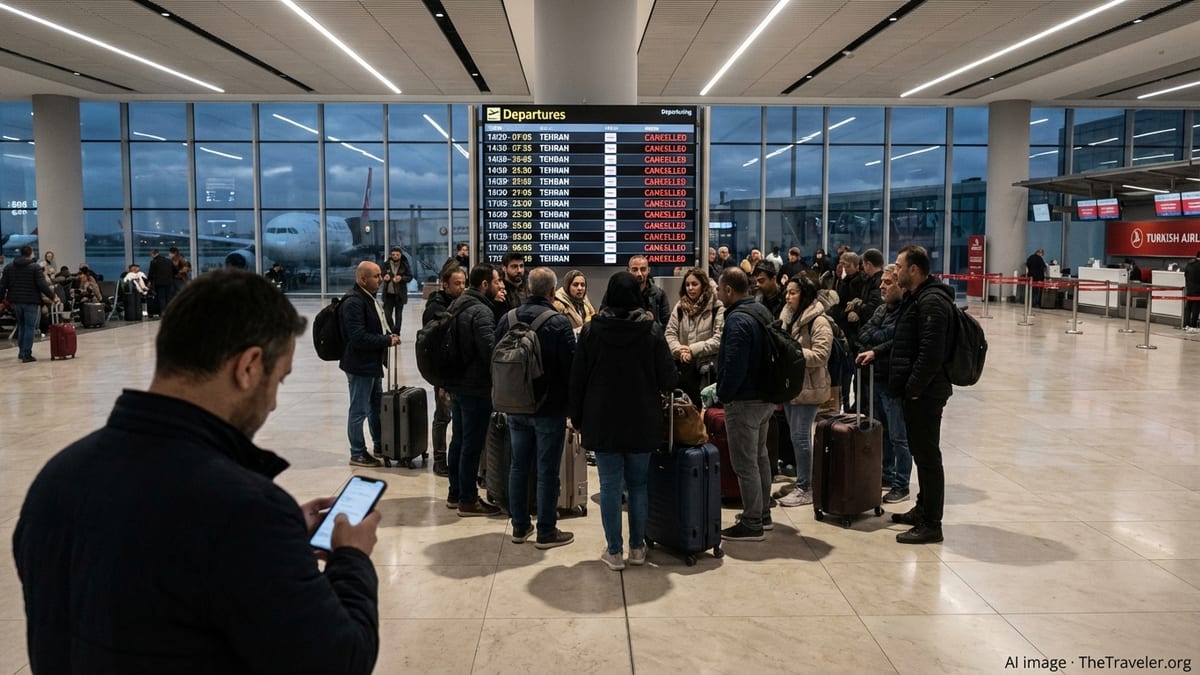
Night Cancellations Turn a Busy Route Unpredictable
Flights between Istanbul and Tehran, a key link between Europe and Iran, have been repeatedly disrupted over the past 24 hours as tensions spike in the region. Istanbul Airport data and regional media reports show several Friday night departures to Tehran abruptly cancelled, with additional Saturday services scrubbed from the board at short notice. Passengers who had already begun their journeys are finding themselves stranded in transit, or forced into last‑minute re‑routing via other hubs.
Airport officials in Istanbul have confirmed that multiple flights to the Iranian capital, including services operated by Turkish Airlines and Iranian carriers, did not depart as planned. In some cases, a handful of later rotations remain scheduled, creating a patchwork of operations that is proving difficult for travelers to interpret in real time. With the situation shifting hour by hour, the Istanbul–Tehran route has become a prime example of why checking live status is now essential, not optional.
The cancellations come as the United States signals the possibility of military action against Iran and foreign ministries, including Australia’s, warn that airspace closures around key hubs could ripple across global networks. For passengers bound ultimately for Tehran but connecting via Istanbul from Europe, North America or Asia, this means that a long‑haul segment might still operate while the final short leg is pulled at the last moment.
Travel analysts say the pattern emerging this week mirrors earlier waves of disruption seen in January, when protests and security incidents inside Iran prompted scattered cancellations from Turkish Airlines and other major carriers. What is new is the intensity and speed of the latest adjustments, underlining how quickly operational decisions are being made as events on the ground evolve.
Turkish Airlines Issues Assurances While Schedules Shift
Against this backdrop, Turkish Airlines has struck a notably defensive tone, publicly rejecting suggestions that it has enacted a blanket suspension of Tehran services. Senior company executives have used social media to insist that the flag carrier’s flights “operated in daytime conditions” are continuing as scheduled, describing widespread reports of mass cancellations as inaccurate or misleading.
At the same time, airport departure boards and independent aviation trackers have recorded specific Turkish Airlines flights between Istanbul and Tehran being cancelled, alongside services by Iranian airlines on the same route. Industry observers say there is no obvious contradiction: the airline may still be running some rotations while axing others, particularly overnight departures viewed as higher risk in a deteriorating security environment.
This nuanced reality is crucial for travelers to understand. Turkish Airlines is not, as of Saturday, announcing a full shutdown of its Iran network. Instead, it appears to be making rolling operational decisions, sometimes within hours of departure. That leaves a narrow window in which a flight can move from “on time” to “cancelled,” even after passengers have completed check‑in for their preceding leg into Istanbul.
For passengers, the mixed messaging underscores why airline press statements cannot substitute for individual flight checks. While the carrier’s communications team stresses continuity, the combination of airport data and regional news reports reveals a much messier picture in practice, particularly for night‑time departures.
Escalating Security Risks Drive Operational Decisions
The upheaval on the Istanbul–Tehran route is rooted in a wider security crisis that has engulfed Iran and its neighborhood in recent weeks. Anti‑government protests, a deepening economic downturn and the lingering fallout from last year’s conflict with Israel have already stretched Iranian domestic stability. Layered on top of that are explicit US warnings of possible limited strikes if nuclear and human rights talks fail, raising the specter of sudden military escalation.
International aviation authorities and security analysts have flagged Iranian airspace as increasingly high risk, particularly for flights that would cross at night or at times when tensions are expected to spike. Carriers must weigh the safety of passengers and crew, the availability of reliable air traffic control information and the possibility of miscalculation if air defense systems are on heightened alert.
These considerations are not unique to Turkish Airlines. In January, multiple global airlines, including several Gulf and European carriers, temporarily scaled back or rerouted flights to Iranian cities amid communications blackouts and protests. On Friday and into Saturday, Istanbul’s cancellations once again illustrate how quickly commercial air services can be adjusted when risk calculations shift, even in the absence of formal government‑ordered airspace closures.
For aviation planners, the Istanbul–Tehran corridor is especially sensitive. Istanbul serves as one of the world’s busiest international transfer hubs, meaning any disruption to a single spoke can cascade through connecting banks of flights. A decision to cancel just one or two Tehran rotations can trigger missed onward connections for travelers bound for Europe, Africa or the Americas, amplifying the impact far beyond the Middle East.
What Travelers Need to Do Before Leaving for Istanbul
For passengers whose itineraries involve a Tehran leg via Istanbul, the new reality is clear: do not assume that a booking confirmation or even an on‑time status printed the night before guarantees that the flight will operate. The first step is to monitor the live status of every segment, especially the Istanbul–Tehran portion, on the day of departure and again before checking in for any feeder flight.
Experts recommend using multiple channels to verify status, including the airline’s own flight‑status tools and the latest information published by the departure airport. Because Iran has experienced intermittent digital blackouts, travelers departing from Tehran toward Istanbul should print boarding passes and hold written copies of key details whenever possible, in case mobile apps stop functioning on the ground or at the airport.
Passengers already ticketed to Tehran from distant origins may want to contact Turkish Airlines or their travel agent to discuss alternative routings or flexible rebooking options if their final leg is at risk. Some travelers are opting to delay nonessential trips to Iran or to rebook to alternate destinations until the security picture becomes clearer and flight patterns stabilize.
Crucially, even travelers not intending to set foot in Iran but connecting through Istanbul to other cities could feel indirect effects. If crews or aircraft are reassigned at short notice due to Iran‑related cancellations, knock‑on delays may ripple across the network. That is another reason to keep a close eye on real‑time updates, build extra buffer time into tight connections and ensure contact details are correctly registered with the airline.
A Route That Reflects a Region on Edge
The volatility now defining flights between Istanbul and Tehran captures the broader unease gripping the Middle East as Iran’s standoff with the United States and regional rivals deepens. What was once a predictable corridor for business travelers, students and visiting families has become a barometer for risk, with every fresh advisory or headline potentially reshaping the next day’s schedule.
Diplomatic efforts continue in the background, with nuclear talks and shuttle diplomacy in European capitals aimed at defusing the crisis. But until there is a tangible easing of tensions, airlines are likely to err on the side of caution, especially on night‑time routes and services skirting the most sensitive airspace.
For now, the message to passengers is blunt but simple: if Tehran is on your boarding pass and Istanbul is your gateway, your travel plans are more exposed to fast‑moving events than they have been in years. The only way to stay ahead is to treat live flight status checks as an integral part of the journey, right up to the moment you leave for the airport.
In a region where geopolitical developments can change overnight, the Istanbul–Tehran route serves as a reminder that air travel does not exist in a vacuum. Each cancellation notice or updated schedule is not just a logistical footnote, but a reflection of the shifting realities on the ground, and a signal to travelers that vigilance has become an essential part of flying.