

More news on this day
Chiang Mai International Airport has smashed its post-pandemic traffic records as this year’s Lunar New Year peak sent passenger volumes surging to their highest levels since 2019, underscoring the strength of Thailand’s tourism rebound and a shifting regional travel map led by demand from South Korea and neighboring Asian markets.
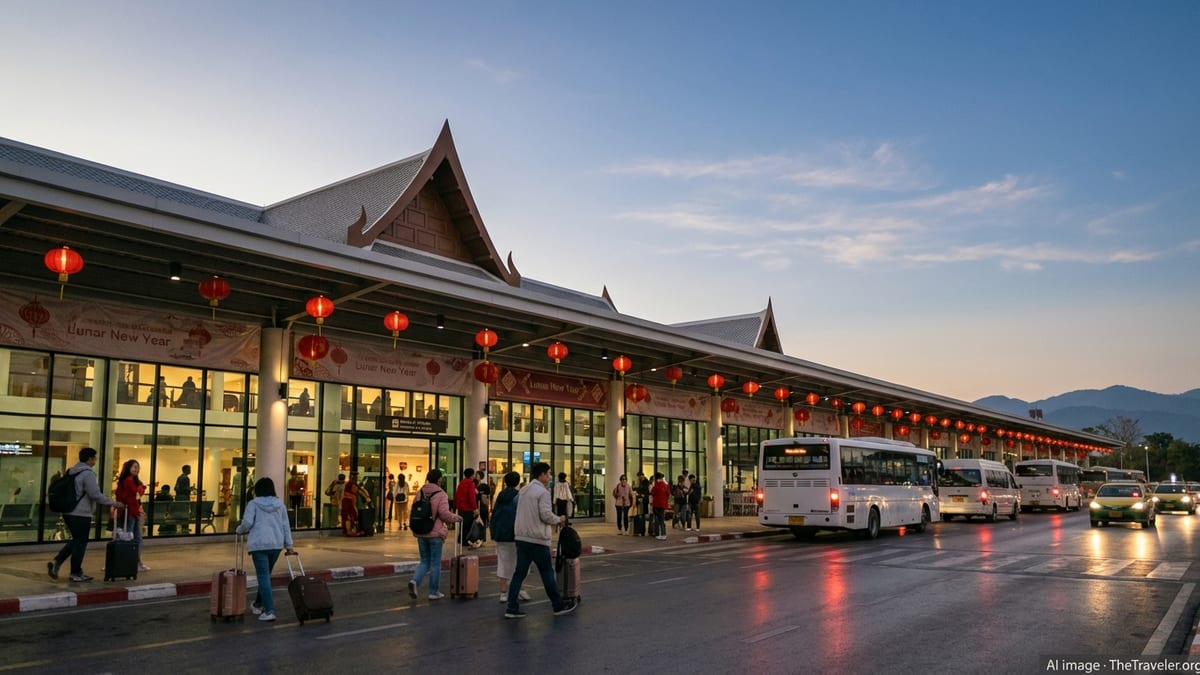
Lunar New Year Lifts Chiang Mai to Post-Pandemic Peak
According to the latest data compiled by Airports of Thailand and regional transport authorities, Chiang Mai International Airport has continued the steep recovery trajectory that began in 2022, pushing well beyond its early post-pandemic benchmarks as the Year of the Horse holiday period drew millions of travelers back into the skies across Asia. The airport handled more than 9 million passengers in 2024, up sharply from 5.46 million in 2022 and approaching its pre-pandemic peak of 11.3 million recorded in 2019. That momentum set the stage for a record-breaking Lunar New Year rush in early 2026, when airlines ramped up frequencies and reintroduced seasonal charter flights targeting Chiang Mai’s cool-season appeal.
Airport managers say the combination of relaxed visa rules, new promotional campaigns from the Tourism Authority of Thailand and the shift in Chinese travel patterns away from Japan and back toward Southeast Asia helped fill flights into northern Thailand. With domestic networks largely restored and international capacity steadily expanding, Chiang Mai’s terminals have seen peak-day volumes that now rival, and in some cases exceed, those recorded before the pandemic halted global travel in 2020. Check-in halls and arrival zones were crowded throughout the festival window as inbound tourists mixed with Thai travelers using the break to visit family in the north.
Although official tallies for the full Lunar New Year period are still being finalized, preliminary counts from airport operations point to multiple consecutive days of traffic surpassing the averages recorded even in 2019. Industry analysts note that the airport’s rebound has been somewhat quieter than the recovery at Thailand’s primary international gateways, yet the latest holiday surge confirms that the country’s northern hub is once again a key beneficiary of Asia’s revived travel appetite.
Regional Tourism Rewires: From China to Korea and Beyond
The Lunar New Year surge into Chiang Mai reflects broader shifts across Asia’s tourism landscape. While Chinese travelers remain vital to Thailand’s inbound market, safety concerns and changing consumer preferences have slowed the pace of China’s outbound recovery, prompting Thai tourism planners to cultivate a more diversified mix of visitors. In recent peak seasons, South Korea has emerged as one of the standout growth markets, helped by strong air connectivity and a cultural affinity for Thailand’s food, nightlife and warm climate during the Korean winter.
South Korean airports themselves reported more than 4.3 million passengers passing through during the 2025 Lunar New Year period, highlighting the rapid normalization of air travel after pandemic-era restrictions. With carriers increasingly deploying capacity on regional routes rather than long-haul services, Thailand has been a major beneficiary of this rebound. Routes linking Seoul, Busan and other Korean cities with Chiang Mai and other Thai destinations have seen higher load factors, feeding a steady stream of visitors into northern Thailand’s hotels, cafes and cultural attractions.
Japan, once the dominant magnet for Chinese Lunar New Year travel, has faced a sharp drop in Chinese arrivals this year amid geopolitical strains, according to reporting from regional outlets. That has redirected some demand toward Southeast Asia, including Thailand, Singapore and Vietnam. For Chiang Mai, this means more space to cultivate returning Chinese guests while also capturing travelers from secondary markets such as Taiwan, Hong Kong and emerging segments in Southeast Asia who are seeking festival getaways with a different cultural flavor.
Thailand’s Nationwide Holiday Rush Sets Context
The traffic spike at Chiang Mai is part of a nationwide wave. Thai tourism authorities projected that around 1 million foreign tourists would arrive in the country during the 2024 Lunar New Year window, with expectations of even higher numbers during the extended 2026 festivities after Thailand lengthened visa-free stays for several key markets and signed reciprocal exemptions with China. More recently, officials have reported that from January 1 to mid-February 2026 alone, more than 770,000 visitors from mainland China entered Thailand, with daily arrivals reaching roughly 30,000 as the holiday period approached.
Those flows are layered on top of robust regional demand. Airlines serving Bangkok’s Suvarnabhumi and Don Mueang airports have restored or exceeded pre-pandemic frequencies on popular intra-Asian routes, sending holidaymakers onward to secondary hubs such as Chiang Mai and Phuket. Statista data for 2024 show Thailand’s major airports collectively handling tens of millions of international passengers as carriers rebuilt networks and leisure travelers grew more confident in booking overseas trips.
Phuket International Airport offers a parallel illustration of this broader boom. The island gateway logged more than 17.4 million passengers in 2025 and has continued to set new daily records in early 2026, with an average of over 71,000 travelers passing through per day at the start of the year. For Thai tourism planners, these numbers demonstrate that the recovery is no longer limited to a handful of flagship destinations but is instead reaching deep into the country’s regional airports, positioning Chiang Mai to compete aggressively for holiday traffic.
Chiang Mai’s Cool-Season Appeal and Cultural Draw
Chiang Mai’s position in northern Thailand gives it a seasonal advantage during Lunar New Year. The holiday roughly coincides with the cool, dry months from December through February, when daytime temperatures are typically milder than in Bangkok or Phuket and evenings can be refreshingly crisp. For visitors arriving from South Korea, where winter temperatures can regularly fall below freezing, the city offers a comfortable escape that still feels seasonally appropriate, without the intense heat often associated with tropical destinations.
At the same time, the former Lanna capital offers its own roster of cultural experiences that dovetail with Lunar New Year traditions. Visitors can join merit-making ceremonies at centuries-old temples, stroll through lantern-lit night markets and sample dishes that blend Thai, Lanna and Chinese influences. Hoteliers and local businesses have leaned into the holiday atmosphere with themed decorations, red-and-gold color schemes, lion dance performances and special dining menus that nod to prosperity, longevity and good fortune.
These elements help differentiate Chiang Mai from Thailand’s beach-centric resorts while still delivering the festive ambiance many travelers seek at this time of year. Travel agents in Seoul, Taipei and Singapore report heightened interest in itineraries that combine a few nights in Chiang Mai with side trips to nearby mountain towns or elephant sanctuaries, as visitors look to pair city comforts with nature excursions during the relatively dry season.
Infrastructure Strain and Expansion Plans in the North
The surge in Lunar New Year traffic has also highlighted the pressure on Chiang Mai’s existing airport infrastructure. Designed to handle around 8 million passengers annually, the facility has edged past that threshold as the recovery has gathered pace, forcing operators to juggle gate allocations, ramp up staff and expand use of temporary check-in and security lanes during peak periods. Travelers arriving over the holiday window reported longer lines at immigration and baggage claim, even as authorities deployed additional personnel and digital kiosks to speed processing.
These bottlenecks have reinforced the strategic case for the long-discussed Lanna Airport project, a planned new international facility near Chiang Mai that would significantly expand capacity in northern Thailand. Airports of Thailand has outlined a broader investment program that includes the future Lanna gateway, upgrades at Phuket and a new Andaman International Airport in Phang Nga, with the aim of enabling Thai airports to handle up to 250 million passengers annually over the coming decade. The new northern hub, expected to move forward from 2027, would help redistribute traffic from Chiang Mai’s city airport and provide room for new long-haul and regional routes.
In the meantime, Chiang Mai International Airport is pushing incremental improvements. Recent years have seen upgrades to passenger screening areas, boarding lounges and retail concessions, along with the gradual rollout of biometric systems similar to those deployed at Mae Fah Luang Chiang Rai International Airport. During the Lunar New Year period, authorities urged travelers to arrive two to three hours before departure to prevent congestion at checkpoints, a message that resonated particularly with first-time visitors unfamiliar with the airport’s compact layout.
South Korean Routes Lead Airline Recovery
Airlines connecting Thailand and South Korea have been among the most aggressive in rebuilding capacity, reflecting strong pent-up demand on both sides. Low-cost carriers have reinstated multiple daily services linking Seoul’s Incheon and Gimpo airports to Chiang Mai, while full-service operators have targeted premium segments with timed connections to Europe and North America. Travel agents say Korean families, couples and young independent travelers have embraced Chiang Mai as a short-haul holiday option that combines Instagram-ready scenery with comparatively affordable prices.
The timing of Lunar New Year, which often overlaps with winter school holidays in South Korea, further amplifies demand. Korean tourists have been particularly drawn to Chiang Mai’s coffee culture, boutique hotels and growing reputation as a “slow travel” destination, complementing the more nightlife-oriented draw of Bangkok or the beach party scene of Phuket. For carriers, the route offers favorable economics: aircraft that might otherwise sit idle between long-haul rotations can be deployed on three- to five-hour hops into northern Thailand, capturing high-yield holiday traffic.
Industry experts expect capacity between Thailand and South Korea to keep rising through 2026, even as airlines remain cautious about overextending in the still-recovering China market. That gives Chiang Mai a window of opportunity to cement its status as a default winter escape for Korean travelers and to position itself as part of multi-stop itineraries that include Bangkok, Phuket or emerging coastal destinations along the Andaman Sea.
Chinese New Year Shifts and Thailand’s Strategic Pivot
For years, Thailand was the unchallenged top overseas destination for Chinese tourists at Lunar New Year, but that dominance has been tested as Japan, South Korea and other markets rolled out aggressive visa relaxations and benefited from favorable exchange rates. Reports from early 2025 indicated that Japan had overtaken Thailand as the leading destination for Chinese holidaymakers based on booking data, a symbolic loss of a title that Thai officials had long touted as proof of the kingdom’s draw.
Since then, the picture has grown more nuanced. Political tensions between China and Japan and concerns about travel boycotts have dampened some of the enthusiasm that lifted Japan to the top of Chinese outbound rankings. At the same time, Thailand has moved to remove barriers, offering mutual visa waivers with China, ramping up safety messaging and promoting new campaigns such as “Nihao Month” and China-focused marketing runs across major cities. Early figures for 2026 suggest that Chinese arrivals during the Lunar New Year period are again climbing, although they have yet to match the peaks seen before 2020.
Chiang Mai stands to benefit directly from this recalibration. Before the pandemic, the city had a growing menu of direct connections to Chinese secondary cities, bringing in package tour groups and independent travelers alike. Industry executives expect many of those links to return over the next two high seasons, especially if Chinese demand continues to shift away from Japan and back toward Southeast Asia. In the current environment, even a partial restoration of those flows, layered atop the new strength from South Korea and intra-ASEAN markets, could push Chiang Mai’s airport beyond its 2019 passenger peak far earlier than previously forecast.
Outlook: Northern Hub Poised for a New Era
The record-breaking Lunar New Year period at Chiang Mai International Airport offers a glimpse of what the next phase of Thailand’s tourism recovery may look like: more diversified source markets, more evenly distributed traffic across regional airports and a higher premium on infrastructure that can flex to accommodate peak-season surges. With Phuket already surpassing its pre-pandemic daily flight averages and Bangkok planning major terminal expansions, the focus is turning toward ensuring that northern Thailand’s main gateway does not become a bottleneck.
Local tourism operators remain cautiously optimistic. Hotel bookings across Chiang Mai and nearby destinations held at high levels throughout the holiday window, and forward reservations for March and April suggest that many visitors are extending their travels beyond the festival period. If that pattern holds, Chiang Mai could transition from a largely seasonal spike to a more sustained year-round flow, with Lunar New Year remaining the most visible symbol of its post-pandemic renaissance.
For now, the images of jam-packed arrival halls, dragon dancers greeting passengers and airline staff handing out festive gifts at Chiang Mai International Airport capture a turning point for both the city and Thailand’s wider tourism sector. After years of shuttered terminals and uncertain timetables, the roar of jet engines over the northern capital during the Year of the Horse points firmly toward growth, even as the region’s travel map continues to be redrawn.