

More news on this day
Mae Fah Luang–Chiang Rai International Airport has launched a spectacular Chinese New Year 2026 welcome experience, unveiling a wave of cultural installations, live performances and traveler services designed to capture surging demand from Chinese visitors and position northern Thailand at the heart of the country’s booming aviation and tourism rebound.
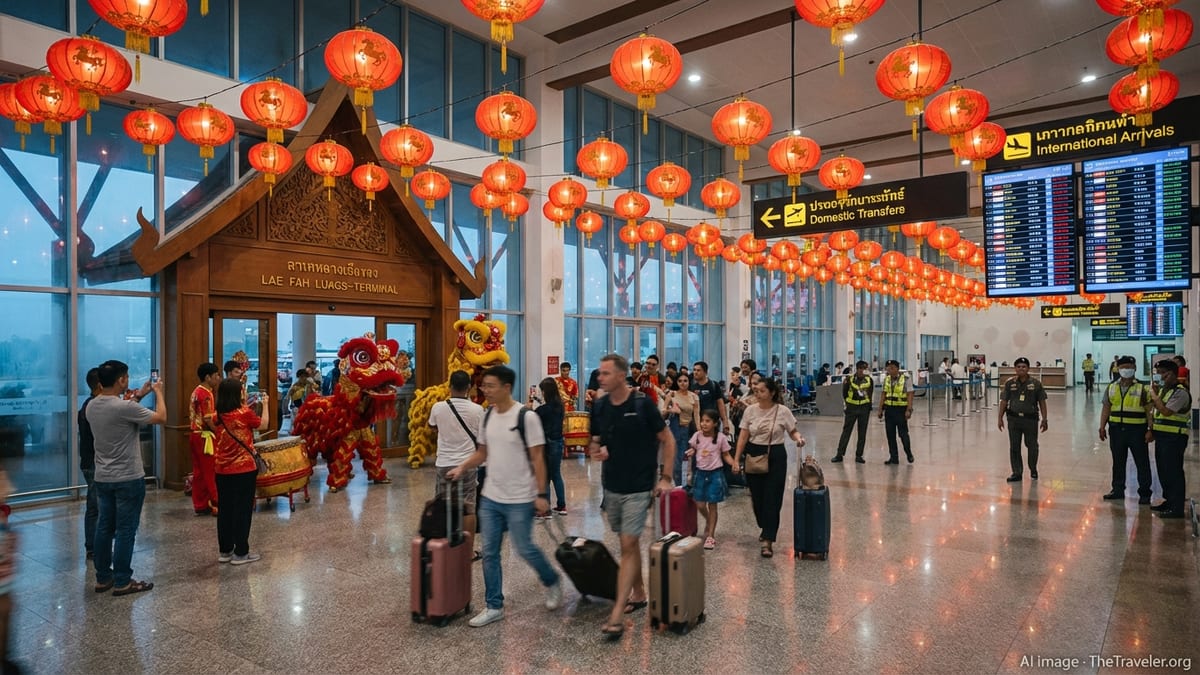
Lantern-Lit Arrival Hall Sets Festive Tone for Millions of Flyers
Arriving passengers at Mae Fah Luang–Chiang Rai International Airport this week are being greeted by a sea of red lanterns, illuminated calligraphy banners and sculpted dragons celebrating the Year of the Fire Horse, transforming the compact northern gateway into one of Thailand’s most photogenic festive terminals. The airport’s management, working with the Tourism Authority of Thailand and local cultural groups, has reimagined the arrivals concourse as a temporary Chinatown, complete with auspicious floral displays and traditional music played softly over the public address system.
The new look comes as Thailand’s airports brace for more than four million passengers over the Chinese New Year holiday period from February 13 to 22, 2026, with international flyers expected to account for the bulk of traffic. While Bangkok’s Suvarnabhumi and Don Mueang airports will handle the largest share of movements, Mae Fah Luang–Chiang Rai has emerged as a critical regional node for tourists combining Chiang Rai and neighboring provinces into multi-stop itineraries.
Airport officials say the aim is twofold: to offer a warm, unmistakably Thai-Chinese welcome that encourages visitors to stay longer and spend more, and to ease the stress of peak-season travel by turning the terminal into an immersive, Instagram-ready cultural experience. The emphasis on atmosphere and service aligns with national efforts to compete with regional rivals by enhancing airport quality rather than relying solely on price-driven tour packages.
“We want travelers’ first impressions of northern Thailand to be vibrant, welcoming and deeply connected to local heritage,” one senior airport manager said during a media briefing, noting that the design deliberately uses craftwork and motifs sourced from Chiang Rai’s communities.
From Lion Dances to Lanna Drums: A Curated Cultural Showcase
Beyond decorations, the airport’s Chinese New Year program features a daily schedule of performances that blend Chinese and Lanna culture, illustrating the region’s long-standing cross-border ties. Lion and dragon dance troupes perform short routines in the public departures hall during off-peak hours, while small stages host classical Chinese instrument recitals paired with traditional northern Thai khlui and drum ensembles.
Curators from Chiang Rai’s museums and art collectives have installed rotating photo and textile exhibitions along passenger walkways, highlighting everything from the city’s historic Chinese merchant communities to its modern role as a gateway to the Golden Triangle. Information panels in Thai, English and simplified Chinese explain the significance of each motif, inviting visitors to explore the city’s temples, markets and riverside promenades once they leave the airport.
To minimize congestion, performances are timed carefully around major departure and arrival waves, with airport staff directing spectators and keeping thoroughfares clear. Short, five to ten-minute shows are announced in advance on digital screens and the airport’s social channels, giving travelers the option to plan a quick photo stop or simply enjoy the spectacles from nearby seating areas.
Importantly, the cultural program also has a commercial dimension. Several curated pop-up stalls sell locally made snacks, teas, ceramics and handicrafts themed around the New Year, with part of the proceeds channeled back into community cultural groups. Officials say these micro-outlets are already generating strong interest from transit passengers and domestic travelers heading onward to Bangkok or the southern islands.
Targeting a Resurgent Chinese Market in a Competitive Region
The elaborate welcome at Chiang Rai is being rolled out against the backdrop of a complex but improving picture for Thailand’s Chinese tourism market. After a subdued 2025, sector analysts and Thai aviation authorities expect Chinese visitor numbers to rise again in 2026, helped by relaxed travel restrictions, more direct routes and aggressive joint campaigns between airlines and tourism bodies. Chinese passenger volumes over the Chinese New Year window alone are projected to climb by more than eight percent year-on-year, with hundreds of thousands flying in on routes across Thailand’s six major international gateways.
Chiang Rai’s airport, although smaller than its counterparts in Bangkok and Phuket, is positioning itself as a nimble beneficiary of this recovery. Scheduled and charter services from secondary Chinese cities have increased in recent months, mirroring a national strategy that emphasizes more point-to-point connections beyond the mega hubs. For Chinese visitors seeking cooler temperatures, mountain landscapes and café culture, northern Thailand holds particular appeal during the dry season.
Industry observers note that Chinese visitors remain among Thailand’s highest-spending tourists, particularly on accommodation, shopping and experiences. By investing in a strong cultural welcome at the airport level, Chiang Rai’s authorities hope to convert transit and short-stay traffic into longer itineraries that include temple tours, tea plantation visits and eco-excursions along the Mekong and Kok rivers.
The initiative is also designed to differentiate Thailand from regional competitors chasing the same market. With Vietnam, Malaysia and Japan mounting large-scale Chinese New Year campaigns, Thai airports are under pressure to signal safety, quality and cultural richness from the moment travelers step off the plane. Chiang Rai’s program, with its combination of heritage installations and practical service upgrades, is seen as a test case that could be replicated at other secondary airports.
Airport Upgrades Align With Thailand’s Aviation Boom
The cultural rollout at Mae Fah Luang–Chiang Rai coincides with a broader upswing in Thailand’s aviation sector. The Civil Aviation Authority of Thailand reports that nationwide passenger volumes reached around 145 million in 2025, reflecting steady year-on-year growth and shrinking the gap to pre-pandemic levels. International seats in particular have rebounded strongly, thanks to new routes from Europe, Central Asia and the Middle East that help offset remaining shortfalls from China.
In this context, Chiang Rai’s airport is undergoing subtle but important upgrades. Additional check-in counters have been opened for key Chinese carriers, while automated kiosks in Thai, English and simplified Chinese now handle bag tag printing and boarding pass reissues. Security screening lanes have been reconfigured to reduce bottlenecks during peak international arrivals, and immigration desks have been reinforced with Mandarin-speaking officers during the holiday period.
On the airside, apron management has been tightened to accommodate a denser schedule of narrow-body aircraft during the festival window. While the airport is not yet operating at the scale of Chiang Mai or Phuket, officials say its ability to handle more charter and seasonal flights is critical to regional connectivity. The Department of Airports has coordinated closely with airlines to stagger departures and arrivals, aiming to avoid the long queues and missed connections that marred some holiday peaks in previous years.
Thailand’s broader airport ecosystem is also in expansion mode. Major investments at Suvarnabhumi, Don Mueang and Chiang Mai are underway to increase capacity over the next decade, and secondary airports like Chiang Rai are expected to capture a growing slice of traffic as international travelers seek more diversified itineraries beyond the capital.
Boosting Local Economies Across Northern Thailand
For Chiang Rai and surrounding provinces, the airport’s Chinese New Year transformation is more than a branding exercise; it is a targeted economic stimulus. Local tourism operators say that advance bookings for February 2026 have risen, with many Chinese and regional visitors planning combined trips that include Chiang Rai, Chiang Mai and smaller towns along the route to the Laos border.
Hotel associations report higher occupancy rates for the holiday period, particularly among boutique properties and riverside resorts that cater to family groups and small tour clusters. Travel agents indicate that demand is strongest for two- to four-night stays, with itineraries centered on temple visits, night markets and coffee farm tours. The airport’s cultural welcome, widely shared on social media platforms popular in China, is helping to drive last-minute interest and reinforce perceptions of northern Thailand as safe, welcoming and well-prepared.
At the same time, the focus on community involvement is designed to spread the benefits of the tourism surge. Many of the performers and artisans participating in the airport program come from local schools, cultural foundations and rural villages, which receive appearance fees and sales revenue. Officials hope this will encourage more young people to see cultural heritage as a viable livelihood, supporting the long-term preservation of traditional crafts and performances.
City planners and economists are watching closely to see how much incremental revenue can be attributed to the airport campaign. Early estimates from tourism officials suggest that Chinese New Year 2026 could generate hundreds of millions of baht in direct and indirect spending across northern Thailand, particularly if visitors can be persuaded to extend their stays beyond the typical long-weekend break.
Seamless Passenger Experience Becomes a Strategic Priority
Recognizing that crowded airports can quickly erode traveler goodwill, Mae Fah Luang–Chiang Rai has coupled its festive makeover with a series of passenger-experience upgrades. Bilingual and trilingual signage has been expanded across the terminal, including clearer wayfinding to taxis, buses and ride-hailing pick-up zones. Digital displays now feature flight information in Chinese, Thai and English, along with real-time advisories on security wait times and recommended check-in windows.
Inside the terminal, additional seating and charging points have been installed near boarding gates that serve China-bound routes. Free Wi-Fi capacity has been boosted to accommodate the spike in simultaneous connections from travelers streaming, messaging and navigating on their mobile devices. Food and beverage outlets, many of them local brands, have extended opening hours and introduced Chinese-language menus, catering to passengers on late-night and early-morning flights.
On the landside, authorities have coordinated with local transport providers to increase airport bus and shuttle frequencies linking the terminal to central Chiang Rai and major hotel clusters. Taxi queues are monitored more closely during peak arrivals, with staff on hand to assist travelers unfamiliar with the area. Travel desks operated by licensed agents offer last-minute hotel bookings and tour packages, allowing visitors arriving without fixed plans to organize their stays on the spot.
The emphasis on operational readiness reflects lessons learned nationwide after episodes of congestion at major Thai airports during earlier holiday peaks. With Chinese New Year 2026 shaping up to be one of the busiest periods since borders reopened, Chiang Rai’s efforts to streamline the journey from plane door to city center are seen as integral to protecting Thailand’s reputation as a hassle-free destination.
Collaborative Push From Airlines, Tourism Bodies and Local Partners
The scale of Chiang Rai’s Chinese New Year initiative underscores the growing collaboration between airport operators, airlines, tourism agencies and local government. The Tourism Authority of Thailand has spent the past year deepening partnerships with more than 50 carriers worldwide, with a particular focus on building capacity and joint marketing campaigns into the country’s secondary cities. Chiang Rai’s airport has been one of the beneficiaries of this approach, with new seasonal services and charters from mainland China, Taiwan and regional hubs.
Airlines have responded by tailoring in-flight announcements, menus and entertainment to highlight Chiang Rai’s attractions, while ground staff at origin airports distribute promotional materials emphasizing the city’s temples, cafes and cultural events. Some carriers have coordinated themed flights for the holiday period, including cabin decorations and costumes aligned with the Year of the Fire Horse, creating a seamless narrative that begins at boarding and continues through arrival at the decorated terminal.
Local authorities, meanwhile, have synchronized their own event calendars with the airport’s campaign. Lantern festivals, walking-street markets and riverside light shows across Chiang Rai city are timed to coincide with the peak influx of Chinese New Year visitors. Travel packages sold through tour operators often include airport meet-and-greet services, expedited transfers and guided visits to key landmarks, ensuring that the festive energy inside the terminal carries over into the city’s streets.
Observers in Thailand’s aviation and tourism sectors say Chiang Rai’s example highlights how even smaller airports can play an outsized role in national recovery strategies when they integrate culture, service and commercial planning. If the numbers over the ten-day holiday period meet or exceed expectations, similar cultural welcome programs could soon become a fixture at other regional gateways across the kingdom.