

More news on this day
Thunderstorms and air traffic constraints around Chicago O’Hare International Airport have triggered a fresh wave of disruption for US air travelers, with tracking data showing 148 flight cancellations and 1,318 delays affecting major carriers including American Airlines, United Airlines, Republic Airways, SkyWest Airlines and Envoy Air, and rippling across key routes to New York, Toronto, Detroit, Atlanta and other hubs.
Get the latest news straight to your inbox!
Chicago O’Hare Emerges as the Day’s Disruption Epicenter
Publicly available operational data identify Chicago O’Hare as the central pinch point in the latest round of disruptions, with the airport registering the bulk of cancellations and extensive departure and arrival delays. The combined impact of unstable weather cells in the upper Midwest and a series of traffic management measures has slowed movements into and out of one of the country’s busiest hubs.
Figures compiled from flight-tracking and aviation data providers indicate that 148 flights linked to Chicago operations were canceled while about 1,318 were delayed, affecting both domestic and cross-border services. These numbers place O’Hare among the most impacted airports in the United States for the current travel period, despite a broader industry push to improve on-time performance.
Regional carriers operating on behalf of the big networks, including Republic Airways, SkyWest Airlines and Envoy Air, feature prominently in the disruption tallies. Their schedules, heavily concentrated on feeder routes into Chicago, mean that any slowdown at O’Hare rapidly cascades through dozens of smaller cities across the Midwest and beyond.
While the headline figures remain below the most extreme weather events seen in recent years, the concentration of disruption at a single mega-hub has amplified its visibility to travelers and created widespread knock-on effects throughout the day.
Major Airlines Hit as Hub-and-Spoke Networks Strain
American Airlines and United Airlines, the two largest operators at O’Hare, have experienced significant schedule pressure as their hub-and-spoke networks absorb the delays. Reports from flight-status dashboards show both carriers logging numerous late departures and arrivals on Chicago-originating and Chicago-bound services, even when the flights themselves ultimately operated.
Regional affiliates Republic, SkyWest and Envoy, which operate a large share of American and United’s shorter flights under their respective brand umbrellas, have been particularly exposed. Their aircraft and crews typically rotate multiple times per day through O’Hare, so an initial delay in the morning often leads to a rolling series of missed departure times that are difficult to recover without substantial schedule trimming.
Analysts note that the relatively modest headline cancellation figure, compared with the much larger delay count, suggests a strategic effort by airlines to preserve as many flights as possible, even at the cost of lengthy waits at gates and on tarmacs. In previous disruption episodes, carriers have sometimes opted for earlier and more aggressive cancellations to reset their operations, but current patterns indicate a preference for keeping itineraries intact wherever feasible.
The imbalance between cancellations and delays also reflects operational constraints such as aircraft availability, crew duty-time limits and the need to maintain connections at other hubs. By holding flights rather than canceling, airlines can still move passengers into the network, even if many miss their original onward connections.
Ripple Effects from New York to Toronto and Atlanta
The impact of Chicago’s slowdown has extended far beyond Illinois, disrupting traffic across some of the busiest corridors in North America. According to aggregated flight-status information, routes connecting O’Hare with New York–area airports have reported a mix of late departures, extended arrival holding patterns and scattered cancellations, particularly during peak bank times.
Toronto services have also seen measurable disruption, with cross-border flights between O’Hare and Canada’s largest city encountering weather-related flow restrictions and gate congestion. Even relatively short sectors into Detroit and other Great Lakes markets have been affected, as aircraft and crews arriving late from Chicago force subsequent rotations to depart behind schedule.
Farther south, routes linking Chicago with Atlanta and other Southeastern hubs have reported secondary delays as aircraft originating from O’Hare arrive late and compress turn times. This pattern mirrors earlier incidents in which localized weather around a single major hub has triggered a broader regional slowdown, despite clear skies at many affected destination airports.
Travel industry coverage notes that today’s pattern fits a familiar template in the modern US aviation system: an operational shock at one or two large hubs radiates outward along highly interconnected networks, leaving travelers in seemingly unaffected cities facing disruptions whose origins lie hundreds of miles away.
Weather, Airspace Management and Structural Vulnerabilities
Meteorological reports for the Chicago region point to thunderstorms and unsettled conditions as a primary trigger for the slowdown, with convective activity periodically closing or constraining arrival and departure corridors. In response, air traffic managers have deployed ground delay programs and other flow-control measures that reduce the rate at which flights can land and depart, forcing airlines to adjust schedules on short notice.
Industry data and historical performance records show that weather remains the single largest driver of US flight disruptions, particularly at hub airports situated in storm-prone regions. Chicago’s location at the intersection of major east–west and north–south traffic flows makes it especially sensitive to rapidly changing conditions, whether snow in winter, thunderstorms in summer or low-visibility events at any time of year.
Structural factors within the airline system amplify these weather shocks. High gate utilization, tight connection banks and extensive reliance on regional affiliates all increase the difficulty of absorbing delays. Even relatively short ground stops or runway capacity reductions can quickly overwhelm buffer times built into schedules, creating congestion on taxiways and in terminal areas.
Recent federal data on causes of delay underline the interplay between extreme weather, national airspace constraints and airline-controlled factors such as crew and maintenance. While the exact mix varies from day to day, the Chicago disruption illustrates how these categories often overlap, with thunderstorms triggering traffic-flow limits that then expose operational vulnerabilities within carrier networks.
What Travelers Are Experiencing and How They Are Adapting
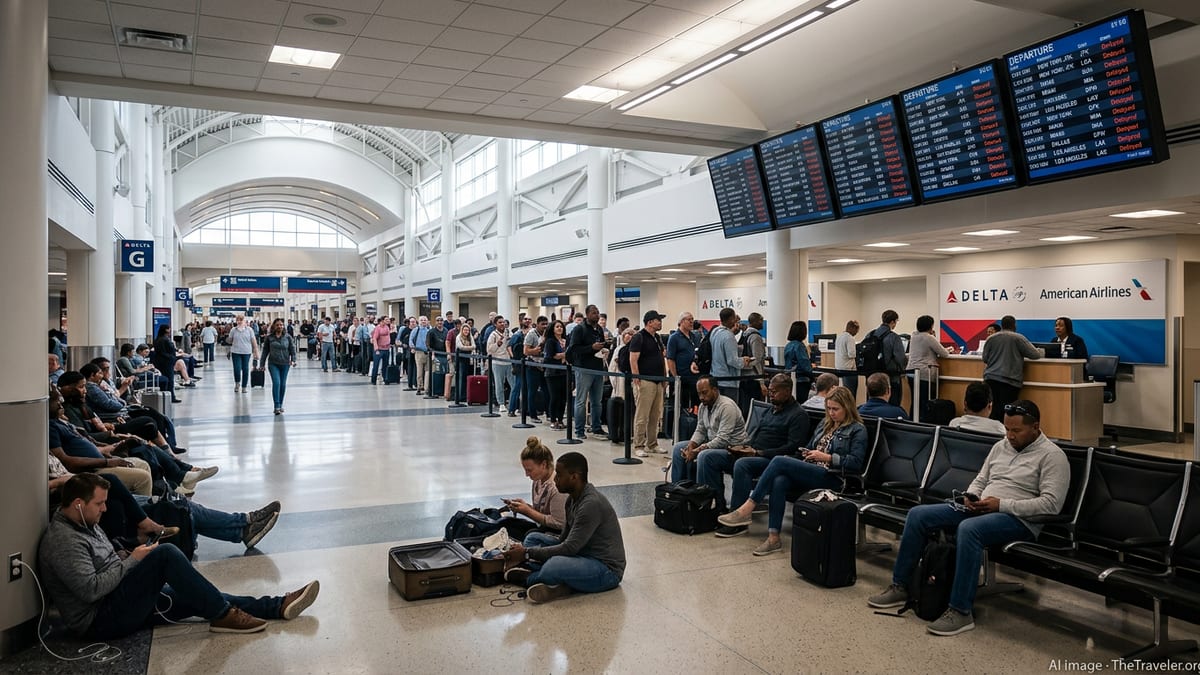
For passengers, the statistics translate into long lines, missed connections and improvised overnight stays. Social media posts and firsthand accounts from recent Chicago disruption days describe crowded gate areas, rapidly shifting departure times on display boards and growing uncertainty about onward travel, particularly for those relying on tight connections.
Travel news outlets and consumer advocates emphasize several recurring strategies that appear to help mitigate the impact of such events. Passengers booked through Chicago are increasingly advised to monitor flight-status tools frequently, consider same-day rebooking to less congested hubs when available, and build additional buffer time into itineraries involving critical connections or international departures.
Some travelers are also reevaluating their routing choices, especially during seasons with higher storm risk. Booking patterns show rising interest in point-to-point options that bypass vulnerable hubs where feasible, although such alternatives remain limited outside the largest domestic markets.
For now, the latest wave of disruptions at Chicago underscores the fragility of a system that depends heavily on a few key airports. As airlines and regulators continue to refine scheduling, airspace management and infrastructure planning, episodes like today’s highlight the ongoing challenge of balancing efficiency with resilience in North American air travel.