

More news on this day
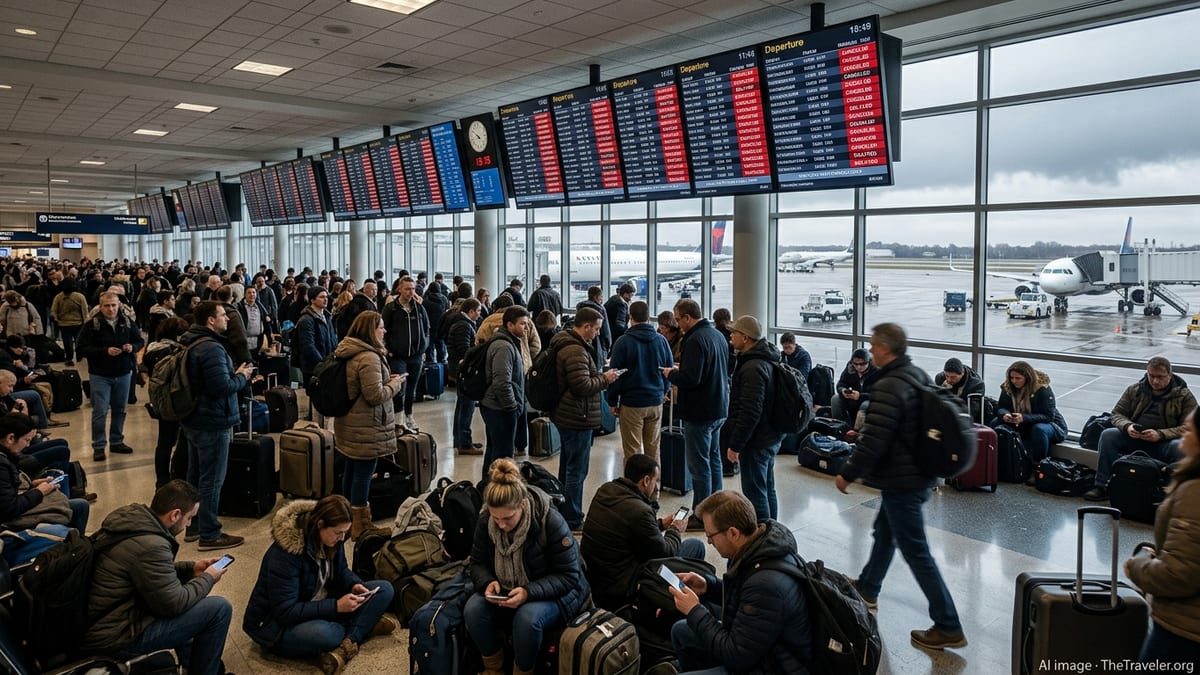
Chicago Midway International Airport is grappling with major disruption as hundreds of flights are canceled or delayed in the wake of powerful spring storms sweeping across the Midwest and broader eastern United States, compounding pressures already building from a partial federal government shutdown and the busy spring break travel period.
Get the latest news straight to your inbox!
Storm System Slams a Key Midwestern Hub
The latest wave of cancellations at Chicago Midway comes as a large storm system, described in meteorological coverage as a sprawling extratropical cyclone, moves across the central United States and toward the East Coast. The system has produced heavy snow over parts of the Upper Midwest, high winds across the Great Lakes region and severe thunderstorms farther south, disrupting air travel along some of the nation’s busiest corridors.
Chicago sits at the heart of these weather patterns, and both of the city’s major airports have seen operations upended. Published flight-tracking data show that hundreds of flights into, out of or within the United States have been canceled each day since the storm intensified over the weekend, with Chicago repeatedly listed among the hardest-hit cities. For Midway, which serves primarily domestic traffic, even a short period of high winds, low visibility or lightning can ripple through tightly scheduled turnarounds.
Weather-related disruptions are not new to Chicago’s airports, but the timing of the current storm complex is particularly challenging. It arrives during a peak travel window for spring break and college basketball tournaments, when planes are heavily booked and spare seats on alternative flights are scarce. That leaves travelers at Midway with fewer options when cancellations cascade through the schedule.
Layered Strain From Government Shutdown and Security Bottlenecks
Compounding the weather shock is a broader strain on the aviation system from a partial federal government shutdown that began in mid-February. Publicly available reporting indicates that Transportation Security Administration staffing has been under pressure at several airports, with some checkpoints experiencing longer lines and occasional closures as the shutdown drags on.
For a compact airport like Midway, where terminal space is limited and security lanes operate near capacity during peak hours, even modest staffing shortfalls can create bottlenecks. When storms force airlines to bunch departures into narrow weather windows, surges of passengers converge on security checkpoints at the same time, increasing the risk of missed flights, gate changes and crowding in the concourses.
Operationally, the interaction between security constraints and weather is significant. Airlines may need to hold some departures to accommodate late-arriving passengers from lengthy checkpoint queues, only to see those flights pushed into periods of worsening weather or tighter air-traffic control restrictions. The result is a feedback loop in which each delay makes the schedule more fragile.
Why Midway Is Feeling the Impact So Sharply
Chicago Midway is not the nation’s single busiest airport by passenger volume, but it is one of the busiest in terms of aircraft movements relative to its compact footprint. The airport functions as a crucial hub for low-cost and point-to-point carriers, with an emphasis on frequent short-haul flights rather than a traditional banked hub structure. This operating model leaves little slack when severe weather compresses the usable flying day.
High-frequency schedules mean that one canceled flight can quickly disrupt multiple subsequent rotations for the same aircraft and crew. If a morning departure from Midway cannot operate because of lightning or crosswinds, the aircraft may miss planned turns to secondary markets and back, multiplying the number of passengers affected. With aircraft and crews already tightly utilized, airlines operating at Midway have limited ability to substitute spare planes or fresh crews at short notice.
Infrastructure also plays a role. Midway’s intersecting runways and dense surrounding neighborhoods constrain options when winds shift or visibility drops. Published airport data show that the field handles a substantial number of operations compared with its physical size, which increases the complexity of recovering the schedule once conditions improve. Air-traffic control programs designed to keep the system safe can require additional spacing between takeoffs and landings, slowing the rate at which delayed flights can depart or arrive.
Travelers Confront Long Lines, Rebookings and Uncertainty
For passengers, the operational stress translates into crowded terminals, long waits at customer service desks and a scramble to secure new itineraries. Social media posts and local commentary from Chicago in recent days describe extensive lines at airline counters and security checkpoints, as well as departure boards filled with cancellations at both Midway and O’Hare. Many travelers are attempting to reroute through other cities, only to encounter disruptions there as the same storm system affects multiple regions.
Some travelers have reported turning to nearby airports in Milwaukee, Indianapolis or smaller regional fields as alternatives when Midway flights disappear from the schedule. However, strong demand tied to spring break means that those airports are also under pressure, with limited last-minute seat availability. Hotel bookings near Chicago’s airports and in the downtown area appear to be tightening as stranded passengers look for overnight accommodation.
Consumer advocates are reminding passengers to check airline policies on rebooking, meal vouchers and hotel assistance during weather-related disruptions, as carriers generally treat storms as circumstances beyond their control. Travel insurance and credit card benefits may offer additional coverage, but eligibility varies widely. In the meantime, many travelers at Midway are facing extended waits in crowded gate areas as they monitor their rebooked flights for further changes.
What This Chaos Reveals About Systemic Vulnerabilities
The current difficulties at Chicago Midway highlight broader vulnerabilities in the U.S. air travel system when extreme weather coincides with staffing and infrastructure constraints. Airlines across the country have scheduled more flights to meet strong demand, but that growth has not always been matched by equivalent increases in staffing resilience or buffer time between rotations.
Analysts note that complex storm systems, such as the one now affecting parts of the Midwest and East, can expose how interconnected the network has become. A ground stop in Chicago can disrupt flights in the Southeast, while blizzard conditions in the Plains can echo through schedules in the Northeast. Midway’s role as a dense, short-haul hub makes it particularly sensitive to these chain reactions, because aircraft that cannot complete their short segments early in the day may not return to the airport in time for evening departures.
As storms continue to track across the region and the government shutdown remains unresolved, travelers using Chicago Midway in the coming days are likely to face continued uncertainty. Industry observers suggest that conditions may stabilize only when the current weather pattern moves offshore and federal aviation and security staffing return to a more predictable footing, allowing airlines to rebuild their schedules and reduce the risk of another wave of mass cancellations.