

More news on this day
A volatile mix of spring thunderstorms and an already stretched airline network triggered a fresh wave of disruptions at Chicago Midway International Airport, where data from flight-tracking services showed 88 severe delays and 16 Southwest Airlines cancellations during a single peak travel window.
Get the latest news straight to your inbox!
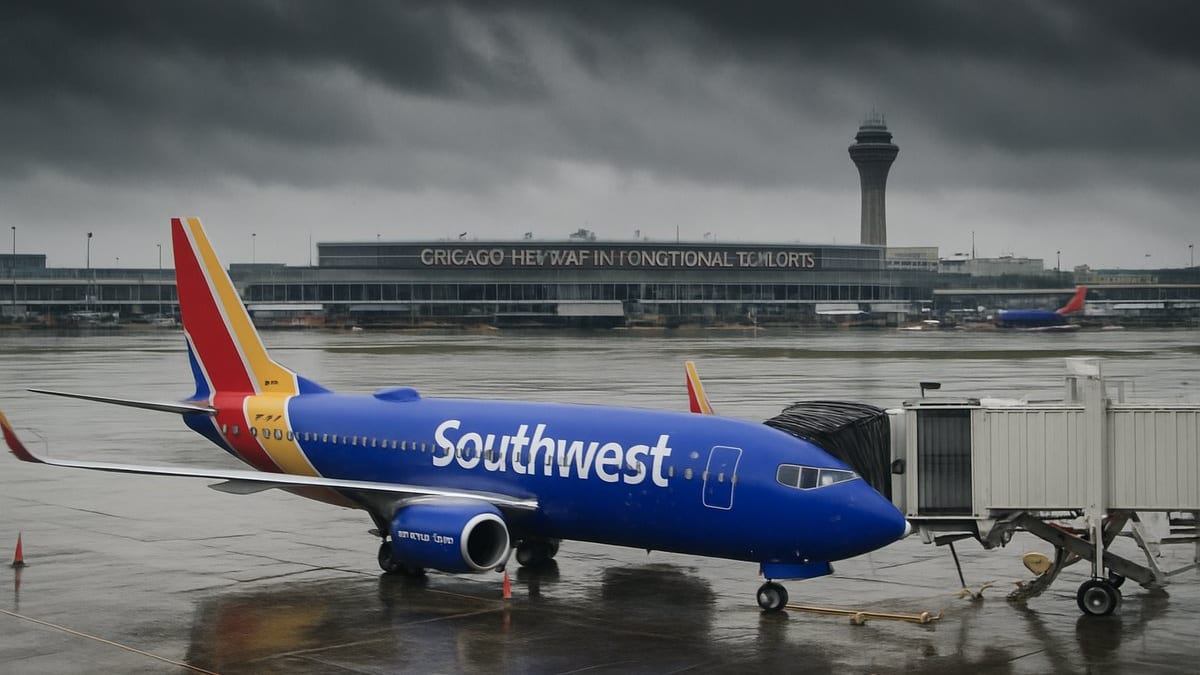
Stormy Skies Turn Midway Into a Chokepoint
The disruption at Chicago Midway emerged as a sharp local flashpoint in a broader pattern of weather related snarls affecting the national air system in late March and early April. A series of potent storm systems crossed the Midwest and Great Lakes region, spawning ground stops and ground delay programs at Chicago area airports and forcing airlines to compress or reshuffle already busy schedules.
Publicly available information from the Federal Aviation Administration and airport tracking dashboards indicated that Midway, a key Southwest stronghold, was placed under intermittent flow restrictions as thunderstorms moved through the metropolitan area. These measures limited the number of arrivals permitted each hour and pushed departure queues higher, creating long gaps between scheduled and actual departure times.
By the height of the disruption, data compiled from flight status aggregators showed 88 Southwest operated flights at Midway falling into severe delay territory, often stretching well beyond 60 minutes behind schedule. While most eventually departed, the prolonged hold times backed up aircraft on the ground and narrowed the margin for recovering later in the day.
Alongside the delays, at least 16 Southwest flights tied to Midway were canceled outright during the same operating window, according to travel industry tallies. Although those cancellations represented a modest share of the carrier’s daily schedule from the airport, they compounded the congestion by removing aircraft and crews from subsequent rotations across the network.
Southwest’s Network Model Magnifies Local Disruptions
Chicago Midway functions as one of Southwest’s most important operational bases, with dense point to point flying that funnels aircraft and crews through the airport at frequent intervals. Industry analyses note that this structure can be efficient in normal conditions but is especially vulnerable when a single node experiences repeated weather or air traffic bottlenecks.
During the Midway disruption, publicly available flight statistics suggested that Southwest bore a disproportionate share of the delays among carriers using the airport. Unlike a traditional hub and spoke system, where airlines can often pool backup aircraft and crews in a central hub, Southwest’s pattern of short, tightly timed segments leaves fewer buffers when thunderstorms, low visibility, or air traffic control constraints reduce capacity at one of its busiest stations.
Travel operations summaries published in recent weeks have already highlighted Southwest’s elevated delay volumes across major U.S. airports in early 2026, including Chicago, Dallas, Denver, Phoenix, and Las Vegas. The Midway episode fit squarely into that broader narrative, with local weather acting as the spark that exposed underlying pressure points in crew scheduling and aircraft routing.
Southwest’s own public filings and postdisruption action plans in prior years have acknowledged the challenge of quickly restoring the network after severe weather. While the carrier has invested in added deicing capacity, winter readiness, and improved operational coordination at locations including Chicago Midway, the latest storm driven meltdown demonstrated how difficult it remains to prevent cascading knock on effects once flights begin accumulating long delays.
Passengers Face Missed Connections and Limited Alternatives
For travelers inside Midway’s terminals, the numerical tally of 88 severe delays and 16 cancellations translated into hours of uncertainty, rebooked itineraries, and in some cases overnight stays. Reports from consumer travel outlets described long lines at gate podiums and customer service desks as passengers sought alternate routings or refunds once it became clear that some flights would not depart as planned.
The predominance of Southwest at Midway limited same day alternatives for many customers. With relatively few other carriers operating robust schedules from the airport, passengers often had to choose between waiting for a later Southwest departure or attempting to reposition by ground to Chicago O’Hare, where seats on competing airlines were already constrained by their own weather related delays.
Published advice pieces from travel analysts in the wake of the disruption emphasized that the point to point network can leave passengers exposed when an airport such as Midway becomes a chokepoint. Missed onward flights on separate tickets, lost hotel nights, and disrupted family plans around the Easter travel period featured prominently in online accounts, underscoring the real world cost of what appears on paper as a handful of cancellations and a cluster of late departures.
Some passengers with flexibility were able to shift travel to less affected dates or reroute through other Southwest focus cities, but for many, the sudden capacity crunch at Midway left few appealing options. Same day walk up fares on alternative airlines from O’Hare were often significantly higher than typical advance purchase prices, adding a financial sting to the operational headache.
Chicago’s Weather and Infrastructure Under Scrutiny
The Midway meltdown also renewed attention on Chicago’s vulnerability to fast changing weather patterns, particularly during the transition seasons. In the days surrounding the disruption, regional media highlighted repeated episodes of severe thunderstorms, strong wind gusts, and localized flooding that affected both Midway and O’Hare, at times prompting ground stops and extended ground delay programs.
Officials have long characterized Chicago as one of the most weather sensitive aviation regions in the country, given its location near major storm tracks and its heavy role in national air traffic flows. When convective storms form over or near the city, air traffic controllers must reduce arrival rates for safety reasons, which quickly ripples into longer taxi times and airborne holding patterns.
While Midway is smaller than O’Hare in terms of runway count and passenger volume, its shorter runways and dense scheduling profile leave limited slack when thunderstorms or low visibility cut operational capacity. Publicly available performance data from past years has shown that delay percentages at Midway can spike sharply during stormy periods, particularly for carriers with back to back turns on the same aircraft.
Infrastructure improvements and procedural refinements can only partially mitigate these issues. As the latest storm cluster demonstrated, even modest convective activity at the wrong time of day can force airlines and passengers into a waiting game, especially at airports where a single carrier dominates the schedule and therefore bears the brunt of any disruption.
What the Midway Disruption Signals for Spring and Summer Travel
The scale of the latest Midway disruption, while limited to one airport and one carrier, is being interpreted by travel commentators as a warning sign for the months ahead. Demand projections for spring and summer 2026 remain robust, and airlines are operating with leaner scheduling buffers after several years of cost cutting and efficiency drives.
Industry observers point out that weather variability is expected to remain high across much of the United States, increasing the likelihood that more airports will experience short notice ground stops or flow control measures similar to those that affected Chicago in recent days. In such an environment, carriers with concentrated operations at a handful of key airports may find it especially challenging to protect their schedules when storms or air traffic constraints develop.
For Southwest travelers who rely on Midway, the episode serves as a reminder to build additional slack into itineraries, particularly for trips involving important connections, events, or cruises. Published guidance from consumer advocates recommends booking earlier flights on critical travel days, monitoring conditions closely, and considering travel insurance products that offer some compensation for lengthy delays or cancellations.
As airlines, airports, and regulators sift through the latest data, Chicago Midway’s 88 severe delays and 16 cancellations stand out as both a localized headache and a case study in how a combination of volatile weather and network fragility can quickly cascade into a systemwide challenge for carriers such as Southwest.