

More news on this day
Hundreds of passengers faced prolonged waits and missed connections today as Chicago O’Hare International Airport reported extensive flight disruptions, with dozens of cancellations and hundreds of delays rippling across major U.S. cities including New York and Los Angeles.
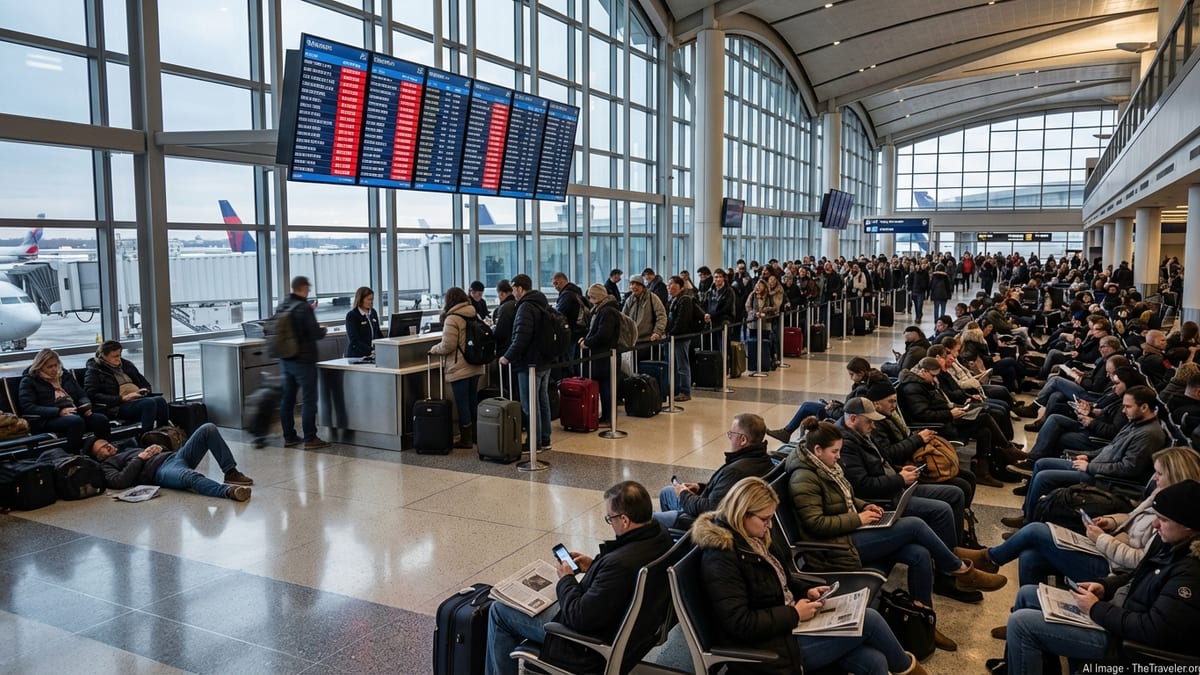
Major Delays and Cancellations at a Critical National Hub
Chicago O’Hare, one of the busiest aviation hubs in the United States, once again found itself at the center of nationwide travel disruption as flight delays climbed into the hundreds and more than a dozen departures and arrivals were canceled. Tracking data showed that operations on key domestic and international routes were affected, forcing airlines to trim schedules, reroute aircraft and rebook frustrated travelers.
At the heart of the disruption were flights operated by large network carriers and their regional partners, with American Airlines, United Airlines and Delta Air Lines experiencing widespread schedule impacts. O’Hare’s central role in their networks meant that relatively modest operational challenges in Chicago quickly cascaded into missed connections and late arrivals at airports across the country.
Passengers heading to or returning from major markets such as New York, Los Angeles, Miami, Minneapolis and Detroit reported holding patterns, gate changes and rolling departure times. Many travelers described a familiar pattern of uncertainty, as updates from airlines remained fluid and estimated departure times were repeatedly pushed back throughout the day.
While the number of flights affected at Chicago O’Hare was small compared with the total daily schedule, the concentration of problems at a key connecting hub meant the knock-on effects were significant. Even a cluster of a few hundred delays and a small number of cancellations was enough to create broad network bottlenecks felt from coast to coast.
New York, Los Angeles and Other U.S. Cities Feel the Impact
The operational turbulence in Chicago quickly radiated outward to major destination and origin airports, particularly in New York and Los Angeles, two of the most heavily trafficked domestic markets served from O’Hare. Flights between Chicago and New York’s LaGuardia and John F. Kennedy airports saw elevated levels of delayed departures, with knock-on consequences for aircraft and crews scheduled to continue from New York to secondary markets.
On the West Coast, Los Angeles International Airport experienced its share of operational strain as late-arriving aircraft from Chicago compressed already busy afternoon and evening schedules. With tight turnarounds on popular transcontinental and international routes, even relatively short delays on Chicago originating flights created scheduling headaches for airlines trying to keep aircraft utilization on track.
Beyond New York and Los Angeles, disruptions extended to a wide network of cities including Minneapolis, Detroit, Miami and other key domestic destinations linked to O’Hare by high-frequency routes. Travelers connecting through Chicago on multi-leg itineraries were particularly vulnerable, as delayed arrivals left them with little margin to make onward flights. In many cases, missed connections meant unexpected overnight stays or rebooked journeys that stretched into the following day.
The broader U.S. air travel system, already under pressure from previous days of weather, staffing constraints and government-related air traffic limitations, had little slack to absorb another wave of disruptions centered on such a pivotal hub. As a result, relatively localized problems at O’Hare quickly became a national story, illustrating how dependent modern air travel remains on a handful of major connecting airports.
American, United and Delta Confront Operational Strain
American Airlines and United Airlines, both of which maintain large hub operations at Chicago O’Hare, bore much of the brunt of the day’s troubles. United, in particular, has expanded aggressively at O’Hare in recent seasons, adding new domestic and international routes and operating what it describes as its busiest schedule ever at the airport. That growth brings benefits to travelers in the form of more choices, but also increases the stakes on days when weather or air traffic constraints reduce capacity.
American, while operating a somewhat smaller footprint at O’Hare than United, remains a key player in Chicago and an essential carrier for connections across the Midwest and to major business markets on both coasts. When delays and cancellations mount at O’Hare, American’s customers often face a combination of aircraft swaps, rolling departure times and rebooked itineraries as the airline works to reposition planes and crews.
Delta Air Lines, which does not operate a full-scale hub at O’Hare but runs a substantial schedule serving its own hubs and focus cities, also saw its flights affected as traffic flow management measures and weather-related constraints limited operational flexibility. Delta’s Chicago services form part of a larger network linking the Midwest to Atlanta, Minneapolis, Detroit and coastal gateways, meaning that any prolonged ground delays in Chicago can reverberate far beyond Illinois.
For all three legacy carriers, irregular operations at O’Hare add to a growing list of challenges in recent travel seasons. Winter storms, thunderstorms in peak summer months, lingering staffing and maintenance constraints, and periodic government shutdowns affecting air traffic operations have left airlines operating closer to the edge, with less room to recover quickly when problems arise.
Weather, Airspace Limits and Systemic Pressures
While the precise blend of causes for the latest disruption at Chicago O’Hare varied throughout the day, the pattern aligned with a broader theme that has defined recent travel cycles across the United States. Periods of unsettled weather, including winter storms and fast-moving thunderstorms, have repeatedly intersected with an overstretched air traffic system and tight airline schedules, creating conditions where delays can build rapidly.
Even when local snowfall or rainfall totals fall short of the most severe forecasts, as has happened in some recent storms, the knock-on effect on flight operations can still be significant. Reduced visibility, strong winds, icing conditions and the need to de-ice aircraft all slow operations, while air traffic controllers may be required to space aircraft farther apart for safety, reducing the number of arrivals and departures an airport can handle in a given hour.
Overlaying weather and air traffic constraints are ongoing systemic pressures. Government budget disputes and staffing shortages have, at times, limited the ability of the Federal Aviation Administration to keep the system running at full capacity, especially at high-volume markets like Chicago, New York and Atlanta. When traffic flow programs and ground stops are imposed, airlines must prioritize certain routes and cut back others, amplifying the reach of localized storms.
For passengers, the reasons behind a delay may feel academic compared with its consequences. However, the combination of environmental and structural factors shaping today’s disruptions at O’Hare offers a glimpse into why, even outside obvious extreme weather events, the U.S. aviation system can experience cascading problems that are difficult to unwind over the course of a single day.
Travelers Face Long Lines, Missed Connections and Limited Options
Inside Chicago O’Hare’s terminals, the human cost of the operational disruption was fully visible. Passengers queued at customer service counters seeking rebooking options, while others juggled airline apps and text alerts in search of better alternatives. For many, the challenge was not just a delayed departure, but the fear of missing a crucial connection to New York, Los Angeles or another onward destination.
Families traveling with children and older passengers with limited mobility were among those most affected, often finding it difficult to move quickly between concourses as gates changed or new departure times were posted. With many flights heavily booked, especially on routes to major coastal cities, a single missed connection could mean waiting hours for a new seat or, in some cases, an unplanned overnight stay.
Hotel availability near the airport became tight as the day wore on, and rebooking options grew more limited. While some airlines waived change fees and offered flexible rebooking policies for affected travelers, passengers still faced the challenge of finding itineraries that fit their needs. For those connecting from international flights into Chicago, immigration and customs processing added another layer of timing risk, particularly when onward departures to cities like New York and Los Angeles were already operating on delay.
Despite the frustration, many travelers expressed understanding that safety must come first, particularly when weather and airspace congestion intersect. Yet the experience underscored the importance of communication and transparency from airlines and airports, as passengers sought timely and accurate information in a fast-changing situation.
Network Ripples Across the United States
The operational difficulties at Chicago O’Hare did not remain confined to the Midwest. Because O’Hare functions as a central node in the national aviation network, problems there can rapidly extend into secondary markets that, on the surface, seem far removed from the day’s local weather or airspace issues.
Aircraft scheduled to operate Chicago to New York or Chicago to Los Angeles flights often continue later in the day to serve regional routes out of those coastal hubs. When early legs run late or are canceled, it can disrupt follow-on services to smaller cities, even if conditions at those airports are entirely normal. This pattern repeated across numerous routes, with passengers in unaffected weather regions experiencing delays that traced back to O’Hare.
Airlines attempted to mitigate the disruption by swapping aircraft, adjusting crews and consolidating lightly booked flights. In some cases, carriers prioritized maintaining long-haul international departures while adjusting domestic frequencies, a strategy designed to minimize the impact on the highest-value and least flexible parts of their networks. For travelers, this sometimes translated into improved odds of departing on a transcontinental or overseas flight, albeit possibly on a different schedule than originally booked.
However, such tactical moves only go so far in the face of widespread delays. Once an airport like O’Hare accumulates a critical mass of late departures and arrivals, gate space becomes constrained, crews reach their legally mandated duty time limits and maintenance windows begin to compress, making it increasingly difficult for airlines to recover before the day’s end.
How Airlines and Passengers Are Adapting
In response to recurring episodes of large-scale disruption, airlines operating at Chicago O’Hare and other major hubs have been steadily refining their playbooks. Carriers have invested in improved real-time data tools to track weather, traffic flow programs and aircraft positioning, allowing them to make earlier decisions on schedule adjustments and give passengers more notice when flights are likely to be delayed or canceled.
Many airlines now proactively issue travel waivers when forecasts suggest substantial disruption at key hubs, allowing customers booked on affected dates to rebook to earlier or later flights without additional fees. While these measures cannot prevent operational issues altogether, they can help spread demand more evenly across the schedule and reduce the number of passengers stranded at peak disruption times.
Passengers, too, are learning to adapt. Frequent travelers increasingly build extra connection time into itineraries that run through weather-prone hubs or during peak storm seasons, even if it means sacrificing some efficiency for reliability. Others opt for early-morning departures, which have a better chance of operating on time before delays accumulate throughout the day.
As today’s events at Chicago O’Hare demonstrate, however, even the best preparation cannot fully insulate travelers from the realities of a complex and tightly coupled aviation system. When a key hub experiences a cluster of delays and cancellations, the effects can spread quickly, reminding passengers and airlines alike of how interconnected the modern travel network has become.