

More news on this day
Chicago O’Hare International Airport endured one of its most chaotic spring travel days in recent memory on Good Friday, with 1,666 flight disruptions snarling holiday journeys and amplifying wider strains across the U.S. aviation system.
Get the latest news straight to your inbox!
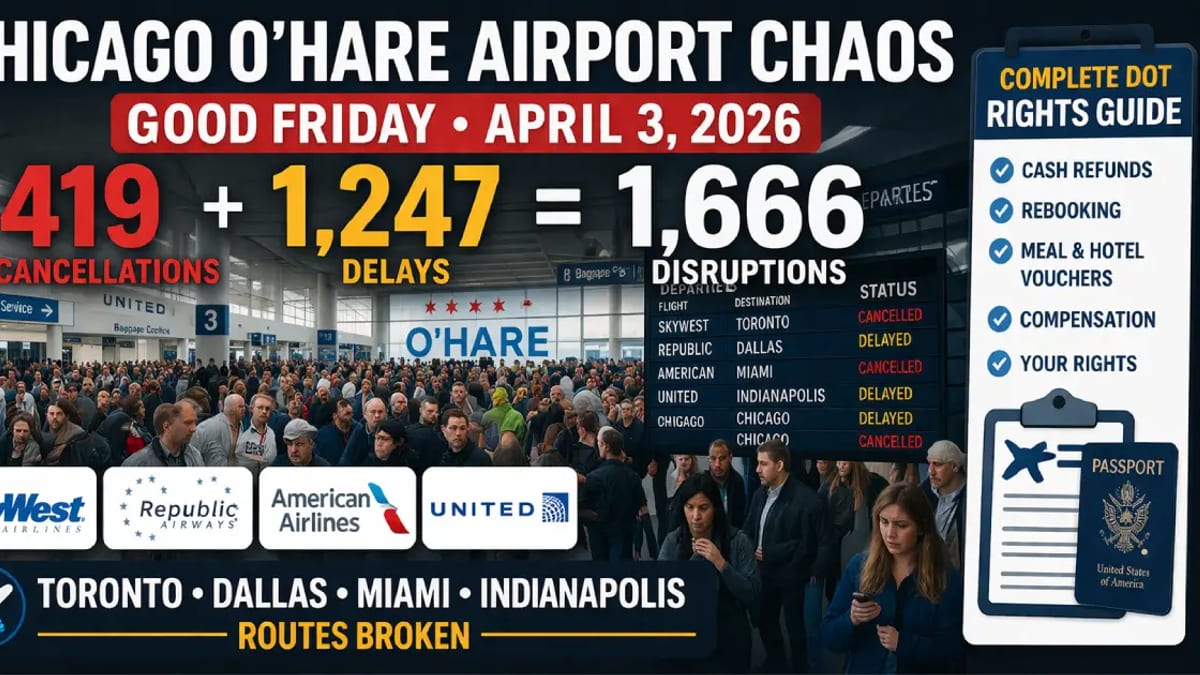
Good Friday Gridlock at the Nation’s Busiest Hub
Flight tracking data and aviation industry coverage indicate that O’Hare led the nation in Good Friday disruptions, with a combined 1,666 cancellations and delays logged as spring storms and system bottlenecks converged on March 29. The figures placed Chicago at the center of a turbulent holiday weekend for U.S. air travel, with ripple effects spreading quickly to hubs across the Midwest and East Coast.
The disruption tally reflects both flights that never left the gate and those that departed hours behind schedule, leaving thousands of passengers sleeping in terminals, scrambling for rebooking options or abandoning trips altogether. Publicly available data show that several major carriers at O’Hare saw large portions of their schedules affected, particularly on domestic routes feeding smaller regional airports.
While Good Friday is traditionally one of the kickoff days for spring break and Easter travel, this year’s volume collided with fragile airline and airport operations already tested by March storms and federal funding uncertainty. Aviation analysts note that O’Hare’s role as a primary connecting hub for the upper Midwest meant any slowdown in Chicago quickly cascaded nationwide.
By late evening, social media posts and traveler accounts described concourses filled with standby lines, full-service counters overwhelmed by rebooking requests and long queues at customer service desks as operations struggled to absorb the day’s schedule shock.
Stormy Skies and a Fragile Spring Operation
The Good Friday meltdown did not emerge in isolation. In the weeks leading up to Easter weekend, O’Hare repeatedly featured among the top U.S. airports for weather related disruptions, including a mid March winter storm that generated more than 1,000 cancellations at Chicago’s two major airports in a single day. Travel industry reports for March also highlight multiple storm systems that triggered ground stops and flow control programs over the Great Lakes and upper Midwest.
Those earlier storms forced airlines to reposition crews and aircraft, narrowing the margin for error heading into a peak holiday period. Good Friday brought a fresh round of unsettled conditions, with low clouds, thunderstorms and gusty winds combining to reduce arrival rates and stretch already tight schedules at O’Hare. Flight delay programs at the national air traffic control level further compressed hourly capacity at the airport during key parts of the day.
Observers note that Chicago’s geographic position makes it particularly vulnerable in March, a month that often swings rapidly between late season snow, severe thunderstorms and strong frontal passages. When those systems pass directly over a hub of O’Hare’s size, the combination of weather constraints and packed flight banks can transform modest delays into large scale meltdowns in a matter of hours.
Several recent aviation analyses have pointed out that the growing intensity of spring storms in the Midwest, plus dense hub schedules, are pushing airports like O’Hare closer to their operational thresholds, leaving little slack to absorb unexpected disruptions.
Staffing Shortfalls and Federal Turbulence Add Pressure
Beyond the weather, underlying staffing and policy strains played a significant role in turning Good Friday into a flashpoint. Coverage of national aviation operations throughout early 2026 points to ongoing shortages of air traffic controllers at key facilities, including the centers and approach controls that manage flows into Chicago. These gaps have prompted the Federal Aviation Administration in recent months to ask airlines to trim schedules at some major airports to preserve safety margins.
Reports focused on Chicago note that O’Hare had already been subject to reduced capacity and sporadic ground delay programs due to controller availability, even on relatively clear weather days. When the Good Friday storms and low ceilings arrived, those pre existing constraints magnified the impact, forcing longer spacing between arrivals and departures and slowing the pace of recovery when flights began stacking up.
Separate coverage has highlighted pressures on security screening and ground handling teams, tied to broader federal funding uncertainty and high turnover in front line airport roles. Longer than usual wait times at checkpoints and baggage belts can delay boarding and turnarounds, a factor that becomes especially acute on days with very tight aircraft utilization like holiday Fridays.
The combined effect on March 29 was a system in which each small delay had outsized consequences. Late arriving crews reached legal duty time limits, aircraft missed their next rotations and even minor maintenance checks became schedule breaking events, all feeding into the 1,666 disruption count.
Passengers Face Tough Choices on a Signature Travel Weekend
For travelers, the numbers translated into missed family gatherings, lost vacation days and stretched budgets. Social media posts and passenger advocacy reporting from Good Friday describe rows of cots in gate areas, families camping near charging stations and business travelers attempting to rework itineraries from crowded lounges.
Publicly available guidance from consumer advocates emphasizes that passengers whose flights are canceled are entitled to refunds if they choose not to travel, regardless of whether the disruption stems from weather, staffing issues or broader system turbulence. However, compensation for hotels, meals or rebooking varies significantly by airline and by whether the root cause is considered within the carrier’s control.
On Good Friday, many stranded travelers faced limited rerouting options because alternative flights were already heavily booked for the Easter weekend. In some cases, published accounts indicate that same day or next day seats from O’Hare to major destinations such as New York, Los Angeles and Florida leisure markets were sold out or only available in premium cabins at high last minute prices.
The situation also created headaches for connecting passengers who were only passing through Chicago. A missed inbound connection at O’Hare often meant no practical way to reach smaller regional airports until well into Easter Sunday or beyond, as airlines prioritized restoring core trunk routes first.
What the O’Hare Meltdown Signals for the Rest of 2026
The Good Friday episode is being read by many aviation observers as an early warning for the rest of the peak travel year. Industry forecasts project record passenger volumes through summer 2026, with carriers adding capacity from major hubs such as O’Hare while still wrestling with pilot and controller pipelines that have not fully caught up with demand.
Analysts note that March had already produced several headline making disruption days at Chicago, including weather driven cancellations in the mid month winter storm pattern and a series of storm related ground stops that affected hubs from Atlanta to the upper Midwest. Against that backdrop, the 1,666 Good Friday disruptions underscore how quickly the system can seize up when multiple stressors align.
Some aviation policy experts have argued that large connecting hubs need more conservative spring scheduling and stronger buffers to cope with increasingly volatile weather. Proposed ideas include shifting more marginal flights to off peak hours, investing in additional de icing and ramp capacity, and accelerating hiring and training for controllers and ground staff based near Chicago.
For now, travel planners are advising passengers to treat O’Hare and other major hubs with extra caution on peak Fridays in March and April. Recommendations commonly include booking earlier departures, allowing longer connection times, and building flexibility into hotel and ground transport plans in case another meltdown similar to Good Friday’s 1,666 flight disruptions hits later in the year.