

More news on this day
China’s fast-growing cruise industry has taken another decisive step as its second domestically built large cruise ship moves closer to completion, reinforcing national ambitions to expand a globally competitive, internationally focused fleet.
Get the latest news straight to your inbox!
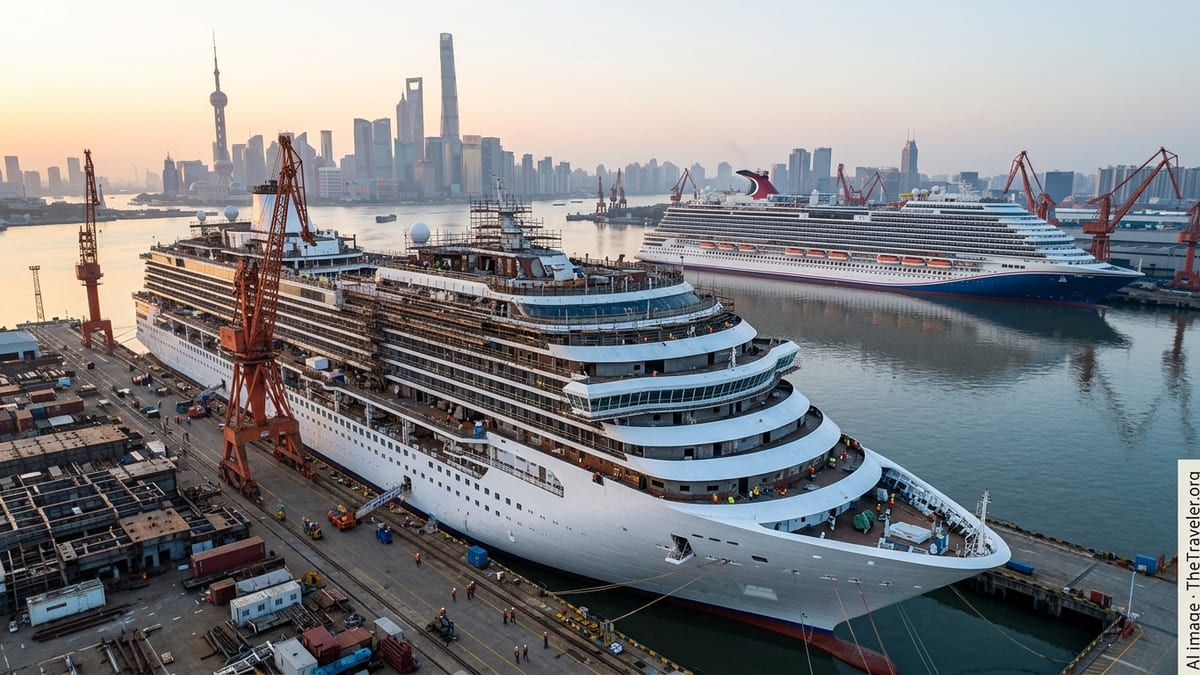
Second Homegrown Giant Nears Delivery
China’s second large domestically built cruise ship, the Adora Flora City, has passed several major construction milestones and is now on track for delivery by the end of 2026. Publicly available information indicates that the vessel’s main structure is complete and that the ship has progressed through float-out and dockside outfitting stages in Shanghai, placing it firmly in the final phases of construction.
The ship is being built at Shanghai Waigaoqiao Shipbuilding, part of China State Shipbuilding Corporation, the same yard that delivered Adora Magic City, China’s first large homegrown cruise ship. Reports describe Adora Flora City as similar in size and capacity to its sister ship, with thousands of lower berths and facilities tailored to multiday itineraries in East Asia, underscoring China’s determination to master the complex design and engineering involved in large cruise construction.
Industry coverage notes that the construction schedule for Adora Flora City has been significantly shortened compared with the first vessel, with improvements in modular construction, digital planning tools and supply chain localization. The ship is expected to undergo sea trials in 2026 ahead of handover and commercial deployment, which would give China two domestically built cruise ships in active service before the end of the decade.
Adora Magic City Sets the Pace at Sea
The second ship’s progress builds directly on the commercial performance of Adora Magic City, which entered service in early 2024 as China’s first large cruise vessel designed and built domestically. Since then, publicly available data and media coverage indicate that Adora Magic City has completed numerous voyages from Chinese homeports, carrying hundreds of thousands of passengers on itineraries that include destinations in Japan and Southeast Asia.
These operations have helped Chinese shipbuilders and operators accumulate practical experience in running a large, modern cruise ship to international standards, from hotel operations and entertainment programming to technical maintenance and turnaround logistics. Adora Magic City’s performance at sea is often cited by analysts as a proof-of-concept for China’s broader cruise strategy, showing that a domestically built vessel can compete regionally with established international brands.
The ship has also played a symbolic role, becoming a visible sign of China’s push to move up the value chain in shipbuilding and tourism. Its deployment on international routes, serving both domestic tourists and foreign guests, has underscored Beijing’s ambition to position Chinese-built ships not only for the local market but for a wider slice of the global cruise business.
Efficiency Gains and a Growing Industrial Ecosystem
Construction of Adora Flora City has been widely presented as evidence that China is moving from a one-off achievement to repeatable, scaled production in the cruise segment. Reports from Chinese media and industry outlets state that man-hours on the second ship have been reduced by more than 20 percent, with some estimates placing overall efficiency gains at 20 to 30 percent compared with the first vessel.
These gains are attributed to more refined design integration, earlier involvement of suppliers and a maturing ecosystem of domestic component manufacturers. Public information indicates that the localization rate of equipment and systems on the second ship is higher than on Adora Magic City, covering areas such as cabin modules, public area outfitting and certain technical subsystems. This shift reduces reliance on imported components and supports the development of specialized maritime suppliers within China.
Analysts note that cruise ships sit at the top of the civilian shipbuilding value chain, combining complex hotel, entertainment, safety and propulsion systems in a single platform. By demonstrating that it can repeat and improve on its first design, China is signaling that its shipyards are moving closer to the capabilities long dominated by European builders, particularly in high-complexity passenger vessels.
Plans for a Larger, More International Fleet
Alongside the construction of its second homegrown cruise ship, China is reshaping its cruise operations around a more international and scalable model. Recent coverage in regional business media describes a consolidation of several state-owned cruise interests into a single platform intended to manage a larger fleet serving both domestic and overseas markets. This emerging structure is expected to operate multiple ships, including the two China-built Adora vessels and additional tonnage sourced from international shipyards.
Industry reports also point to active tendering for new cruise newbuilds at several Chinese shipyards, indicating that planners are looking beyond the initial pair of Adora ships. While detailed specifications vary, the projects under discussion reportedly target vessels capable of international deployment, with designs that align with global safety and environmental regulations and can be marketed to foreign as well as Chinese travelers.
At the same time, Chinese coastal cities are upgrading terminals and port infrastructure to handle larger and more frequent cruise calls. Investments in berths, passenger processing facilities and customs capacity aim to position ports such as Shanghai, Tianjin and Hainan as homeport and turnaround hubs for sailings that link China with Northeast Asia, Southeast Asia and, eventually, longer-haul routes.
Implications for Regional Cruise Competition
The combination of homegrown shipbuilding capability and an expanding fleet strategy is reshaping the competitive landscape for cruising in Asia. For years, international brands have dominated the region using vessels built in Europe and operated under foreign flags. As China adds more domestically built ships into service and supports them with dedicated port and marketing infrastructure, observers expect a more multipolar market in which Chinese operators take on a larger share of capacity.
Industry commentary suggests that this development could lead to increased competition on popular itineraries from East Asian ports, with more choices in pricing, onboard products and source markets. In parallel, China’s ability to design and construct its own large cruise vessels may eventually position its shipyards as alternative suppliers for foreign operators, particularly those seeking lower-cost builds that still meet international standards.
For the wider travel sector, the progress of Adora Flora City and the broader Chinese cruise program points to rising passenger volumes and a diversification of source markets across Asia. As more internationally capable vessels enter service under Chinese ownership, regional destinations are likely to court calls from Chinese-built ships, further integrating China’s fast-growing outbound tourism market with the global cruise network.