

More news on this day
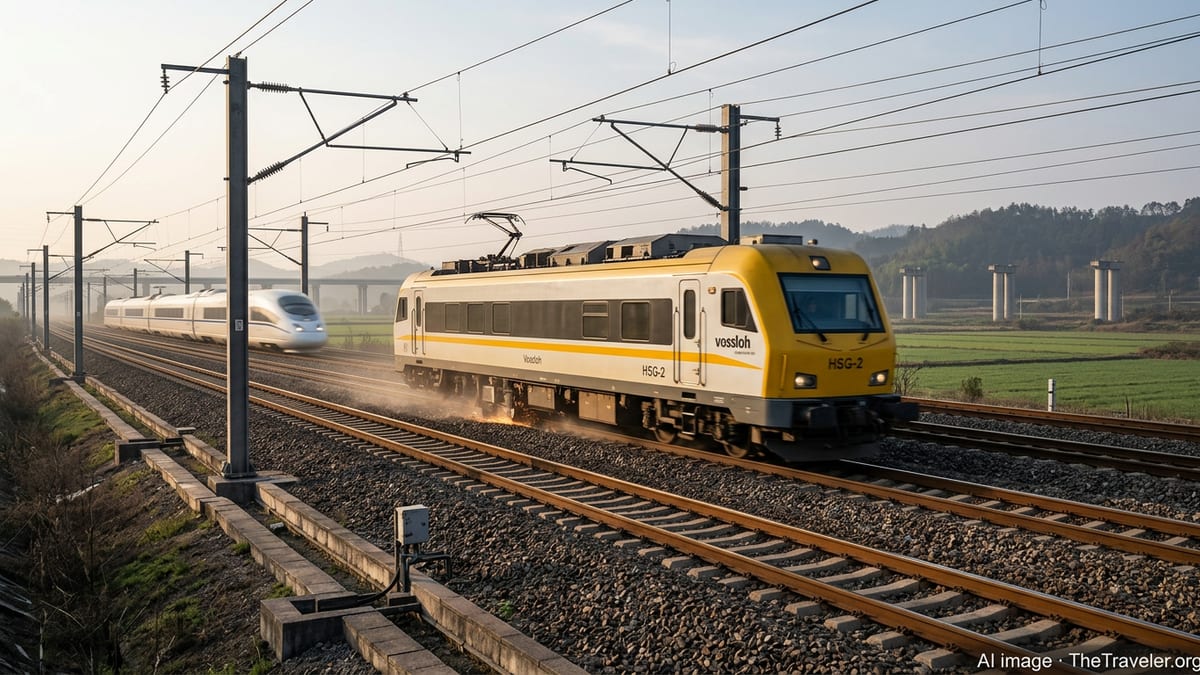
China’s high-speed rail network, already the largest in the world, is expected to gain an additional layer of safety and reliability from 2027 as Vossloh’s HSG-2 high-speed grinding train is introduced to support more advanced, data-driven track maintenance across key passenger corridors.
Get the latest news straight to your inbox!
High-Speed Grinding Technology Targets Preventive Maintenance
The HSG-2 grinding train developed by Germany-based Vossloh is designed to perform preventive rail maintenance at speeds of up to 80 km/h while regular services continue to run. Publicly available technical descriptions indicate that the train removes only around a tenth of a millimeter of material from the rail surface, addressing early-stage defects before they grow into cracks or corrugations that can affect ride quality and safety.
By focusing on light, frequent interventions rather than heavy, disruptive work, the system aims to extend the service life of rails on main and high-speed lines by as much as 100 percent. The concept aligns with a wider industry shift from corrective to preventive maintenance, where infrastructure owners try to address wear and fatigue long before it reaches critical thresholds.
The HSG-2 uses rows of specially arranged grinding stones that rotate as the vehicle moves, forming what product literature describes as a “grinding ruler” that smooths out irregularities in the rail head. Because the stones operate passively and the contact pressure is continuously monitored, the risk of overheating or leaving periodic grinding marks is reduced, helping preserve the precise geometry required for high-speed operation.
China, which operates thousands of kilometers of lines at commercial speeds between 250 and 350 km/h, is seen as a natural setting for this kind of technology. The planned deployment of HSG-2 equipment in 2027 is framed as part of a broader effort to keep pace with growth by refining maintenance regimes rather than simply adding more hardware.
Continuous Grinding Without Disrupting Train Schedules
One of the main challenges for maintaining a dense high-speed rail network is gaining access to track without disrupting busy passenger timetables. Conventional grinding trains often require complete line closures or long nighttime windows. The HSG-2 has been engineered to fit into existing operations, allowing rail grinding to be carried out while other rail traffic continues to run on the same corridor.
Technical data published by Vossloh indicate that the HSG-2 can grind non-stop over distances of up to 60 kilometers per pass and achieve shift performances approaching 240 kilometers without the crew needing to leave the train. Quick-change grinding magazines and automated stone indexing are intended to minimize setup and stoppage times between sections of track.
The train’s configuration also allows it to move through turnouts and other complex track elements without removing signaling or switching equipment in advance. Once the grinding pass is completed, the line can be used immediately, which is a critical factor for heavily used high-speed corridors where even short interruptions can impact thousands of passengers.
For a network on the scale of China’s, where new long-distance high-speed links continue to open while older routes accumulate years of wear, such operational flexibility is expected to be significant. Planners are positioning high-speed grinding as one tool among several to manage both aging infrastructure and new construction under increasingly tight maintenance windows.
Onboard Diagnostics Bring Data to the Trackside
Beyond the grinding hardware itself, recent iterations of the HSG-2 platform are equipped with an expanded suite of diagnostic tools. According to product updates, the “smart” version of the train integrates sensors to measure longitudinal and transverse rail profiles and can be complemented by eddy current testing equipment to detect surface and near-surface defects.
The data collected during each grinding run is intended to feed into a cloud-based platform, where it can be visualized on a digital map of the network. This supports condition-based maintenance strategies in which rail sections are prioritized for treatment according to measured wear, noise performance, or defect development rather than fixed time intervals alone.
For China’s high-speed routes, where axle loads, traffic density, and climatic variation all influence degradation, the introduction of such data-driven tools is expected to refine how and where maintenance resources are deployed. It moves the maintenance model closer to continuous monitoring, in which each pass of the grinding train not only restores the rail surface but also updates a detailed health record of the track.
Industry observers note that this type of integrated grinding and measurement capability reflects a wider trend in rail technology, where rolling stock and infrastructure maintenance are increasingly supported by digital platforms. For a network as geographically extensive and operationally demanding as China’s, incremental improvements in data quality can translate into noticeable gains in reliability and passenger comfort.
Aligning With China’s Long-Term Rail Expansion
China has spent more than a decade expanding its high-speed rail system, with public planning targets calling for tens of thousands of kilometers of high-speed lines. As new routes open and earlier lines mature, authorities and operators are placing greater emphasis on lifecycle costs, noise control, and resilience under heavy traffic rather than on headline construction numbers alone.
In this context, the introduction of additional HSG-2 capacity in 2027 is presented as a complementary measure to earlier initiatives, which have included conventional grinding, rail milling, and renewed interest in monitoring technologies along viaducts and tunnels. Reports on previous projects show that Vossloh high-speed grinding equipment has already been used on prominent European infrastructure, including long base tunnels, providing reference experience for operations on high-speed corridors.
China’s environment presents its own set of challenges, from wide temperature ranges across the country to the need to maintain consistent performance on lines carrying both high-speed and mixed traffic. Advocates of the HSG-2 argue that high operating speeds, reduced dust and spark emissions, and the potential for rail noise reduction of several decibels can be valuable attributes where high-speed lines traverse densely populated regions.
The 2027 introduction timeline suggests that planning work is underway to integrate the new grinding and diagnostic capacity into existing maintenance depots and operating plans. While detailed route allocations have not been publicly outlined, sector commentary points to heavily used intercity corridors as likely early beneficiaries, where incremental improvements in rail condition can have an outsized impact on punctuality and ride quality.
What This Means for Passengers and the Travel Experience
For passengers, the arrival of HSG-2 operations on Chinese high-speed lines is unlikely to be directly visible. Grinding runs are typically scheduled at off-peak hours, and the trains themselves may look more like industrial equipment than passenger rolling stock. Yet the effects of smoother, more consistently maintained rails can be felt in quieter cabins, fewer vibration-related disturbances, and greater comfort over long distances.
Reduced rail roughness and better profile control are also linked to lower rolling noise, which can improve the experience for communities located near high-speed alignments. When combined with sound barriers and optimized wheel profiles, high-speed grinding is one element in a broader toolkit aimed at limiting the acoustic footprint of fast intercity services.
From a safety perspective, the technology is designed to help prevent the formation of surface defects that can evolve into more serious rail flaws if left unchecked. While China’s high-speed rail system has built a record of generally reliable operation, the scale of the network means that even rare events can have wide consequences. Preventive tools such as the HSG-2 are therefore positioned as part of a layered strategy that includes inspections, monitoring systems, and rolling stock maintenance.
As the 2027 deployment horizon approaches, attention within the rail sector is focused on how effectively high-speed grinding and its associated data platforms can be integrated into China’s established maintenance frameworks. For travelers, the most tangible outcome may simply be the continued ability to move quickly and quietly between major cities, supported by a track system that is being managed with increasingly sophisticated technology.