

More news on this day
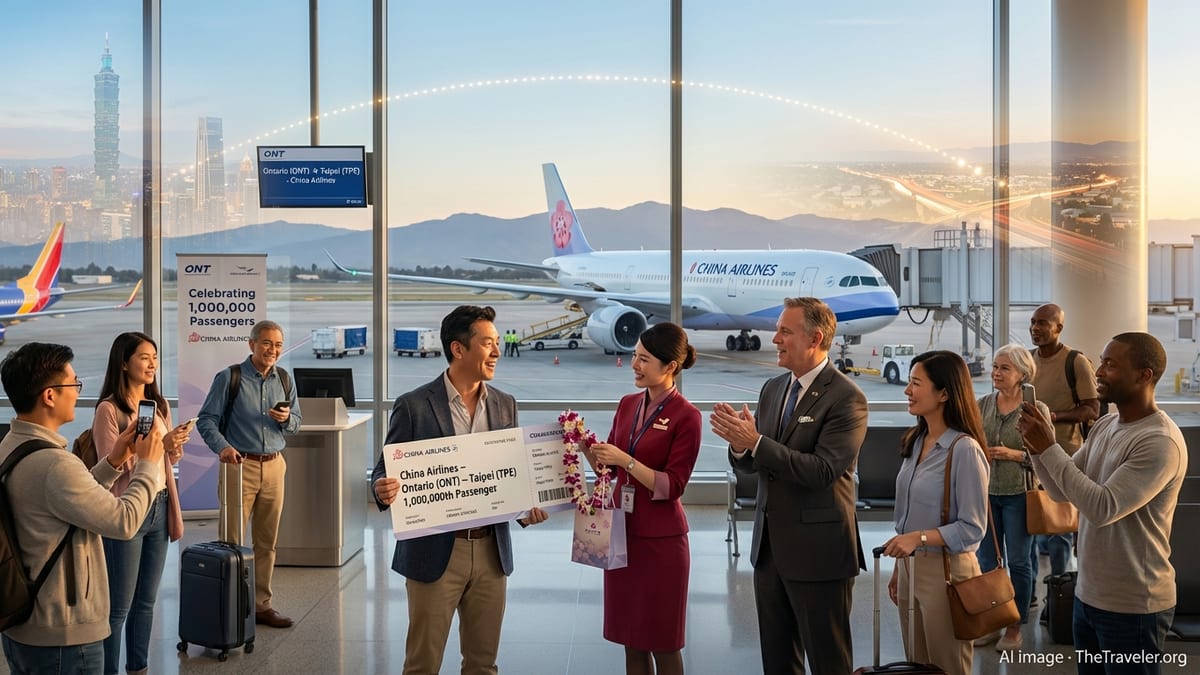
Ontario International Airport in Southern California and the city-region of Taipei are marking a major milestone for transpacific travel, as China Airlines celebrates carrying its one millionth passenger on the Ontario–Taipei route since service began in 2018.
The achievement, formally recognized at a ceremony on February 2, 2026, underscores how a once-niche gateway has rapidly grown into a favored launchpad to Asia for Inland Empire and Greater Los Angeles travelers, while giving Taiwan a stronger tourism and business foothold in the western United States.
More News
- TSA Rolls Out $45 ConfirmID Fee for Travelers Without REAL ID at Security
- Flying Blue Launches February 25% Promo Rewards on Transatlantic and Regional Routes
- United Fast-Tracks Starlink Wi‑Fi Across Fleet, Free for MileagePlus Members
What Happened at Ontario and Why It Matters
The celebration at Ontario International Airport centered on Mr. Cheng, the one millionth passenger to fly between Ontario and Taipei with China Airlines. He was honored during a gate-side ceremony before boarding a China Airlines flight to Taiwan, symbolizing not only a lucky traveler’s windfall but also the maturation of a route that has steadily gained traction over nearly eight years of operation.
China Airlines launched nonstop service between Ontario and Taiwan Taoyuan International Airport in March 2018, becoming the first carrier to operate direct transoceanic passenger flights from Ontario after the airport’s transition to local ownership. Airport officials say the airline carried almost 195,000 passengers through Ontario in 2025 alone, a strong result that pushed the cumulative total over the million-passenger threshold.
For Ontario, located about 35 miles east of downtown Los Angeles, the milestone is being held up as proof that Southern California travelers are increasingly willing to bypass the region’s coastal mega-hubs when convenient alternatives exist. For Taipei and Taiwan’s tourism authorities, it confirms that direct links into the Inland Empire and eastern Los Angeles County can be as strategic as serving traditional gateways on the Pacific coast.
As international passenger volumes at Ontario continue to rise, the route’s performance is reinforcing the airport’s pitch to airlines and travelers alike: that a growing share of Southern California’s long-haul demand can and should be served locally, rather than routed through distant hubs.
How the Ontario–Taipei Route Evolved
When China Airlines inaugurated the Ontario–Taipei route in 2018, it did so with Boeing 777-300ER aircraft, introducing the first nonstop service from Asia to Ontario and giving the Inland Empire a direct link into one of Asia’s busiest hubs. Early results were promising, with strong load factors despite the typical seasonality of long-haul demand.
The pandemic brought a temporary halt in March 2020, as it did across much of global aviation. China Airlines resumed the route in June 2021 and gradually rebuilt frequencies. In the post-pandemic rebound, Ontario’s domestic traffic surged first, followed by a steady recovery in international travel as restrictions eased and travelers regained confidence.
By 2025 China Airlines had ramped up to strong, consistent traffic volumes, carried largely on Airbus A350-900 aircraft featuring three-cabin service. In early 2026, with demand still climbing, the airline and airport announced a restoration of daily service accompanied by a planned upgauge from the A350-900 back to the larger Boeing 777-300ER, boosting seat capacity and signaling confidence in the long-term prospects of the route.
That trajectory from inaugural flight to daily service and now a million cumulative passengers underscores how quickly Ontario has moved from being an experiment in decentralizing Southern California air traffic to a permanent part of many travelers’ Asia travel plans.
Boost to Tourism and Business on Both Sides of the Pacific
The million-passenger milestone is being framed as more than a statistical achievement. For regional tourism bodies and economic development officials in both California and Taiwan, it is tangible evidence that air connectivity is reshaping travel, trade and cultural exchange patterns across the Pacific.
On the U.S. side, Ontario’s catchment area includes more than 10 million residents across San Bernardino, Riverside, northern Orange and eastern Los Angeles counties. For these communities, a nonstop flight to Taipei offers a shorter drive to the airport, less congestion at check-in and security, and simpler post-flight logistics than many coastal alternatives. That convenience becomes a powerful incentive for leisure travelers planning trips to Taiwan, Japan, Korea and Southeast Asia via Taipei, as well as for visiting friends and relatives in the large Asian and Asian American communities spread across inland Southern California.
On the Taiwan side, the route offers direct access to a region of California that is home to a mix of logistics hubs, manufacturing bases, distribution centers, universities and fast-growing suburbs. Business travelers can reach warehouses, industrial parks and corporate offices in the Inland Empire more efficiently, reducing surface travel time while still benefiting from the comprehensive connecting network offered at Taiwan Taoyuan International Airport.
As travel patterns normalize and diversify following the pandemic, airports such as Ontario are increasingly seen as complementary rather than competing gateways. For Taiwan’s tourism and trade strategists, that means the Ontario–Taipei route is not simply siphoning traffic from Los Angeles International Airport; it is unlocking new demand from travelers who might otherwise have deferred or avoided long-haul journeys altogether.
Network Growth, Partnerships and New Travel Options
China Airlines is pairing the million-passenger celebration with a broader North America push, including seasonal promotional fares and closer coordination with domestic partners. Early 2026 has seen the carrier roll out Valentine’s-themed promotional fares for travelers departing from several North American cities, including Ontario, with discounted rates to destinations across Asia during a three-week booking window.
At the same time, the airline has launched an interline partnership with Southwest Airlines, one of the dominant domestic carriers in the United States. The arrangement, finalized in January 2026, allows travelers to book single-ticket itineraries that combine Southwest’s domestic flights with China Airlines’ transpacific services, simplifying connections through Ontario and other gateways for passengers who might previously have stitched their journeys together segment by segment.
For Ontario-based travelers, the new coordination means that a customer from, for example, Phoenix or Sacramento can fly Southwest into Ontario, then transfer directly to a China Airlines departure for Taipei on a linked itinerary. For Asian travelers, it creates new one-stop options from Taipei into secondary and tertiary American cities served by Southwest that previously required multiple tickets or long surface transfers from major hubs.
This incremental connectivity is critical to sustaining and expanding the passenger base that enabled the million-passenger milestone in the first place. As more travelers discover Ontario as a viable alternative for transpacific journeys, the pressure grows to maintain high-quality schedules, competitive fares and smooth transfers if the airport and airline hope to keep loyalty high.
What the Milestone Means for Southern California Travelers
For residents of Southern California, the celebrations at Ontario translate into practical improvements in how and where they can travel. The restoration of daily Ontario–Taipei service gives travelers more flexibility in planning trips to Asia, reducing the need to route through Los Angeles or San Francisco simply to access a wider range of departure days or times.
Daily operations also make it easier for corporate travel managers and tour operators to design packages and itineraries built around Ontario departures. That stability can encourage more frequent business trips and more complex leisure journeys that involve multiple stops across Asia, all linked through Taipei as a connecting hub.
In the near term, travelers can expect competitive pricing as China Airlines works to fill the additional seats created by the aircraft upgauge and daily frequency. Promotional campaigns tied to holidays such as Lunar New Year, Valentine’s Day and summer peak travel are likely to highlight Ontario departures, both to reward local loyalty and to further embed the airport in travelers’ mental maps of international options.
For frequent flyers, the route’s continued growth could eventually attract additional services, such as enhanced premium cabin offerings, integrated ground transportation packages, or even complementary routes by other Asian carriers exploring Ontario as a secondary Southern California gateway.
Impact on Taiwan’s Tourism Strategy and Taipei’s Role
From Taipei’s perspective, the success of the Ontario route helps reinforce Taiwan Taoyuan International Airport’s status as a central transfer point for North America to Asia traffic. Each new wave of passengers coming in from Ontario feeds into a network of onward flights to destinations including Tokyo, Osaka, Seoul, Hong Kong, Bangkok, Singapore and major cities across mainland China and Southeast Asia, subject to prevailing air service agreements and regulatory conditions.
Taiwan’s tourism authorities have spent recent years promoting the island as both a stand-alone destination and an attractive stopover for travelers headed elsewhere in Asia. The millionth-passenger celebration creates a fresh opportunity to spotlight Taiwan’s culinary, cultural and natural attractions to Southern California residents who might initially have chosen Taipei for convenience, connections or fares.
Campaigns that combine stopover incentives with long-haul tickets, city-pass promotions or co-branded marketing between California and Taiwanese tourism agencies are likely to receive a boost from the publicity generated in both markets. The existence of a strong, high-traffic route from Ontario can also bolster Taipei’s case as a key gateway in discussions with other carriers evaluating their own transpacific strategies.
For travelers, the net effect is a richer menu of ways to structure a trip that combines Taiwan with neighboring destinations, using Taipei not only as a transfer point but as a highlight of the journey.
What You Need to Know if You Plan to Fly Ontario–Taipei
For travelers considering the Ontario–Taipei link, a few practical points stand out in light of the latest developments. First, China Airlines now operates daily nonstop service between Ontario International Airport and Taiwan Taoyuan International Airport, offering consistent departure and arrival patterns that simplify trip planning. Schedules and aircraft types can change over time, so passengers should always verify exact timings and equipment when booking.
Second, with the route’s planned shift to larger Boeing 777-300ER aircraft, seat availability is expected to increase across all cabins. The 777 configuration typically includes premium business, premium economy and economy seating, with lie-flat seats in the business cabin appealing to long-haul corporate travelers and frequent flyers.
Third, travelers connecting beyond Taipei will find a wide range of onward flights across Asia. Many itineraries can be booked on a single ticket with checked baggage transferred through to the final destination, although specific rules depend on the ticket type, fare conditions and any partner airline involved in the journey.
Finally, demand on the route is influenced by seasonal peaks such as Lunar New Year, summer holidays, and major festivals in both California and Taiwan. While the million-passenger milestone highlights robust year-round demand, it also serves as a reminder that peak dates can sell out quickly or command higher fares, making early booking advisable for travelers with fixed schedules.
FAQ
Q1. What exactly is the millionth passenger milestone being celebrated by Ontario International Airport and Taipei?
Ontario International Airport and China Airlines are marking the point at which one million passengers have traveled on China Airlines flights through Ontario since the carrier launched nonstop service between Ontario and Taipei in 2018, highlighting the sustained growth of the route and its importance in linking Southern California with Taiwan and the wider Asia region.
Q2. When did the Ontario–Taipei route first begin operating?
China Airlines inaugurated nonstop flights between Ontario International Airport and Taiwan Taoyuan International Airport in March 2018, introducing the first direct passenger service between Asia and Ontario and expanding the airline’s United States network beyond traditional coastal gateways.
Q3. How often does China Airlines now fly between Ontario and Taipei?
As of early 2026, China Airlines is operating daily nonstop service between Ontario and Taipei, giving travelers seven flights per week in each direction and more flexibility in planning business and leisure trips across the Pacific.
Q4. What type of aircraft does China Airlines use on the Ontario–Taipei route?
The route has been operated by both Airbus A350-900 and Boeing 777-300ER aircraft, and the airline has announced plans to deploy the larger 777-300ER on daily Ontario–Taipei flights to increase total seat capacity across premium business, premium economy and economy cabins.
Q5. How does this milestone benefit travelers in Southern California’s Inland Empire?
For Inland Empire and eastern Los Angeles County residents, the milestone confirms that demand is strong enough to support frequent, large-aircraft service from a closer, less congested airport, making it easier to reach Taipei and connect onward to other Asian destinations without driving to coastal hubs or enduring longer airport processing times.
Q6. What does the million-passenger achievement mean for tourism between California and Taiwan?
The achievement suggests that tourism flows in both directions have deepened, with more Californians using Taipei as a gateway to Asia and more Taiwanese visitors and business travelers choosing Ontario as a convenient entry point to Southern California, which in turn encourages further marketing efforts, tour packages and cultural exchange programs.
Q7. Are there special promotions tied to the Ontario–Taipei route right now?
China Airlines has aligned the milestone with seasonal promotional campaigns in North America, including limited-time fare sales around Valentine’s period and other peak travel windows, offering discounted tickets from Ontario and other gateways to select destinations in Asia, subject to availability and fare conditions.
Q8. How does the new partnership with Southwest Airlines affect passengers using Ontario?
The interline partnership with Southwest Airlines allows travelers to book combined itineraries that link Southwest’s domestic flights with China Airlines’ long-haul services, enabling passengers from other U.S. cities to connect through Ontario to Taipei more seamlessly, often on a single ticket with coordinated baggage handling.
Q9. Is Ontario International Airport trying to position itself as an alternative to Los Angeles International for Asia travel?
Ontario is not replacing Los Angeles International Airport but is positioning itself as a complementary international gateway, particularly for residents of the Inland Empire and nearby regions who prefer a closer airport; the success of the China Airlines route strengthens that positioning and may attract additional long-haul services over time.
Q10. What should travelers keep in mind when booking flights on the Ontario–Taipei route?
Travelers should check current schedules, aircraft type and fare rules at the time of booking, consider seasonal demand spikes that may affect prices and availability, verify visa and entry requirements for Taiwan and any onward destinations, and factor in the benefits of daily service and growing partnership networks when comparing Ontario departures with other regional airports.