

More news on this day
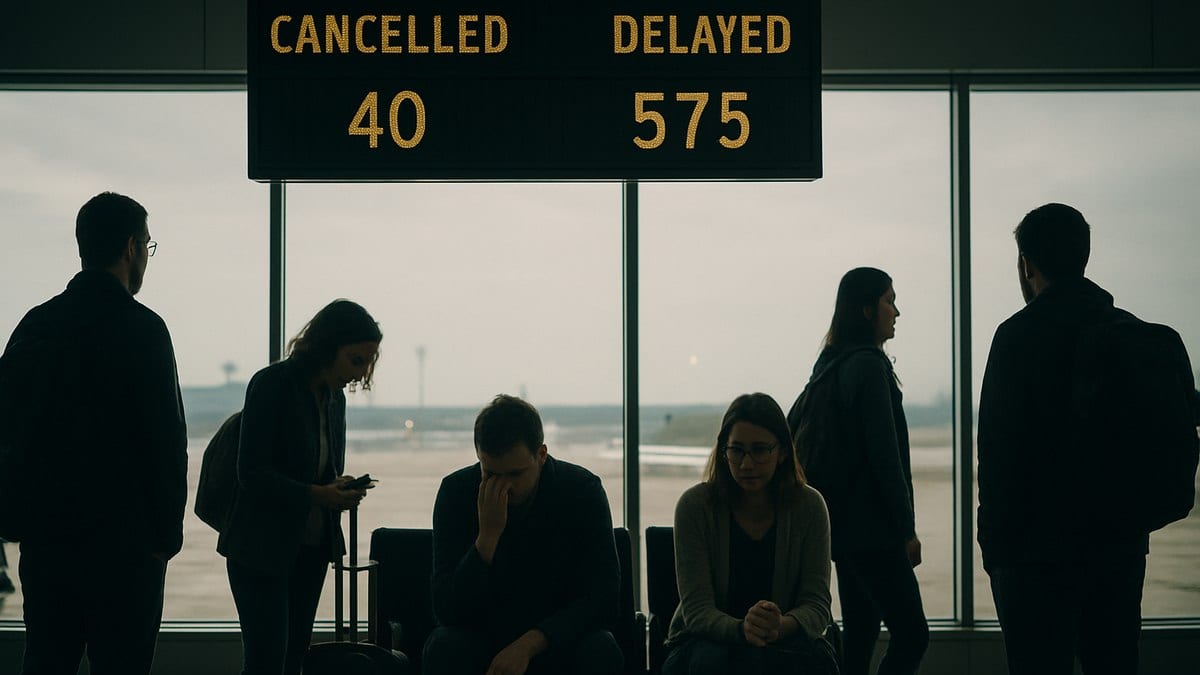
Flight disruption across Asia in early April 2026 is increasingly concentrated at China’s two largest carriers, with publicly available tracking data indicating around 40 cancellations and more than 575 delays tied to China Eastern Airlines and China Southern Airlines over the opening days of the month.
Get the latest news straight to your inbox!
Early April Snapshot: Persistent Strain on Chinese Hubs
Industry summaries and operational dashboards for the first days of April 2026 show flight operations at major Chinese hubs still under significant strain. Aggregated data covering airports in Beijing, Shanghai, Guangzhou, Shenzhen, Chengdu and other large cities point to several hundred delays and dozens of cancellations each day across the country’s leading airlines.
Within that broader pattern, China Eastern and China Southern continue to feature prominently. Compiled tallies for the opening days of April indicate roughly 40 cancellations and more than 575 delayed flights involving the two carriers combined, reflecting an environment where even routine banked departures are vulnerable to relatively small shifts in weather or air traffic control flow.
The snapshot follows a late March period in which Chinese airports already reported heavy disruption. One recent industry roundup of March 31 activity cited more than 5,400 delayed flights and over 460 cancellations nationwide, with China Southern and China Eastern among the most affected airlines, highlighting how pressures evident at the end of March are carrying into April.
For travelers, the numbers translate into crowded gate areas, rolling departure-time revisions, and tight connections at already busy hubs. While most flights still depart, the elevated rate of delays increases the likelihood that itineraries involving domestic connections or onward long haul segments will need to be reworked on short notice.
China Eastern: Knock-on Effects From Network Adjustments
Operational data for China Eastern in early April aligns with a period of broader adjustment in the airline’s 2026 schedule. Recent timetable filings show the carrier trimming parts of its Oceania network for the second quarter of the year, including reductions in frequencies on selected routes. While those changes are primarily structural, they also reduce the level of slack in the system when irregular operations occur.
Tracking services for individual China Eastern flights during March and early April point to elevated average delay times on selected domestic sectors. On some Kunming and Hefei rotations, for example, historical performance records show a notable share of flights operating late, with average delays for certain services exceeding one and a half hours. These route-level patterns hint at how congestion can ripple outward from a few overburdened city pairs.
The result in early April is that China Eastern’s share of the 40 cancellations and 575 delays is being driven less by a single event and more by accumulated pressures: high utilization of narrowbody fleets, storm-related disruption in southern China, and a still-normalizing international schedule. Public guidance from the airline’s own conditions of carriage and customer documents continues to emphasize that delay certificates and limited compensation apply only from specific thresholds, which can leave passengers on shorter hold-ups primarily relying on rebooking rather than monetary remedies.
Travel forums in recent weeks have also reflected this environment, with posts describing itinerary changes, long connection gaps and, in some cases, uncertainty around late-notified schedule shifts for April departures. While anecdotal, that chatter mirrors what the operational data suggests: punctuality is improving compared with the most turbulent pandemic-era seasons, but remains fragile on busy domestic and regional routes.
China Southern: Weather Exposure Across Southern China
China Southern’s early April performance is similarly shaped by conditions at its core southern China hubs. Guangzhou Baiyun and Shenzhen Bao’an, two of the airline’s primary bases, have both experienced repeated bursts of disruption since late March, linked in part to thunderstorms and heavy rain over the Pearl River Delta. Aviation-focused coverage of Shenzhen’s first April weekend, for instance, notes a dense cluster of cancellations and delays concentrated into a relatively short window.
Summaries of Asia-wide disruption published at the turn of the month repeatedly identify China Southern as one of the airlines with the highest volume of delayed flights. Tallies for March 31 and April 1 list the carrier among the top contributors to regional delay counts, suggesting that much of the stress now visible in April’s statistics for China Southern is a continuation of patterns already present in the closing days of March.
As one of the largest operators of domestic sectors across southern and central China, China Southern’s network structure leaves it highly exposed to local weather volatility. When Guangzhou or Shenzhen impose temporary ground stops or reduced arrival rates, a large number of short- and medium-haul rotations are affected in rapid succession, and those knock-on effects can take days to unwind fully.
That exposure is now reflected in the early April snapshot, where China Southern accounts for a substantial share of the hundreds of delayed services attributed to China’s two biggest airlines. Passengers transiting the airline’s hubs this month face an environment where flights are largely operating, but not always at their scheduled times.
Regional Context: Asia-Wide Disruptions Feed Into April
The numbers associated with China Eastern and China Southern in early April 2026 form part of a wider pattern of operational stress across Asia. In recent days, several regional aviation digests have documented thousands of delays and hundreds of cancellations in a single 24-hour period spanning Thailand, Japan, Singapore, Hong Kong, mainland China, Malaysia and the Gulf states.
Some of this disruption is linked to continuing airspace restrictions over parts of West Asia, which have forced certain long haul routes to operate on longer detours or at constrained times. Although the Chinese majors have kept their intercontinental schedules largely intact, shifts in flow patterns can still affect aircraft and crew availability, introducing additional complexity when bad weather or slot constraints hit high-density hubs.
Other factors are more localized, such as seasonal storms in southern China and Southeast Asia and congestion at major Tokyo and Bangkok airports during popular travel periods. In this environment, large network carriers like China Eastern and China Southern are more likely to see their operational buffers eroded, making it harder to recover quickly once irregular operations start to build.
For passengers, that means the headline figure of 40 cancellations and 575 delays tied to China Eastern and China Southern in early April is less an isolated anomaly and more a reflection of how interconnected the region’s aviation system has become. Disruptions originating in one part of Asia can, and often do, propagate across multiple markets within a single operating day.
What Travelers Should Expect Through April 2026
Looking ahead to the rest of April, publicly available scheduling data suggests that both China Eastern and China Southern intend to operate dense domestic and regional programs alongside gradually expanding long haul services. With no major capacity cuts flagged beyond selective route adjustments, the overall risk of disruption is likely to remain elevated whenever weather or airspace constraints emerge.
Travelers planning journeys with either carrier in April 2026 should therefore anticipate the possibility of extended ground times, late-arriving aircraft and, in a smaller share of cases, outright cancellations. The early April figures already indicate that even a few days of adverse conditions can translate into dozens of cancellations and several hundred delayed flights at these scale of operations.
Passenger experiences described in recent weeks, from missed connections in Shanghai to revised transit times in Guangzhou, underscore the importance of allowing generous buffers between separate tickets and avoiding last-possible departures when onward commitments are inflexible. While most itineraries still operate successfully, the margin for error remains thin.
For now, the evolving tally of 40 cancellations and more than 575 delays across China Eastern and China Southern in the opening stretch of April stands as a reminder that Asia’s post-pandemic aviation recovery, though advanced, is still subject to disruption from both predictable seasonal patterns and sudden external shocks.