

More news on this day
China Eastern Airlines will resume nonstop flights between Stockholm Arlanda and Shanghai Pudong in June 2026, a move hailed by Swedish and Chinese officials as a major boost to business, tourism and political ties between the two countries.
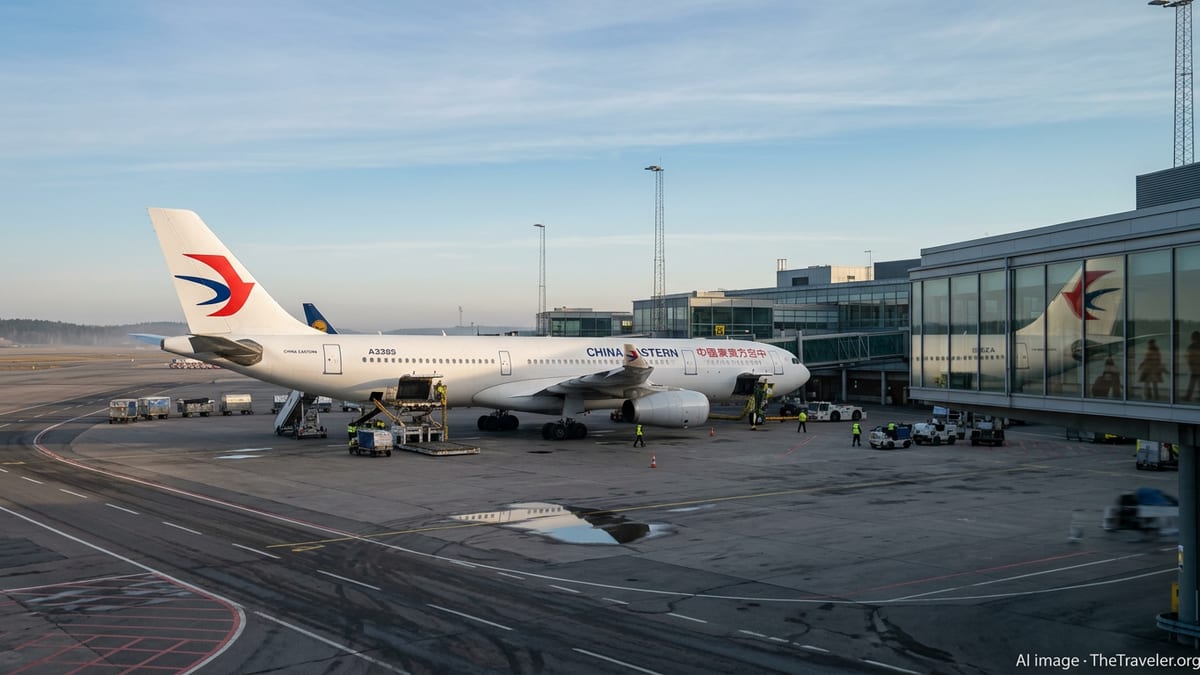
Thrice-weekly A330 Service Returns to Arlanda
Scheduled to start on June 22, 2026, the relaunch will see China Eastern operate three weekly rotations between Stockholm Arlanda Airport and Shanghai Pudong International Airport using Airbus A330 widebody aircraft. The service restores a direct air bridge that has been absent from Sweden’s long-haul network since before the pandemic and repositions Stockholm as a gateway for Nordic travel to one of Asia’s most important hubs.
Flight schedules filed with aviation data providers show the route operating under flight numbers MU289 and MU290, timed to connect into China Eastern’s extensive domestic and regional network at Shanghai. The A330-200 aircraft selected for the route typically offers a two-class configuration, with lie-flat or deeply reclining business-class seats and standard economy, catering to both corporate and leisure demand on the roughly 10-hour sector.
Swedavia, the Swedish airport operator, described the decision as a clear sign of confidence in the country’s air travel market and an important milestone in rebuilding long-haul capacity at Arlanda. Airport officials note that the Stockholm–Shanghai link will be one of only a handful of direct routes connecting Scandinavia with mainland China, underlining its strategic importance.
For China Eastern, Stockholm becomes one of several European destinations to be reinforced or reintroduced as the airline rebuilds its long-haul program. The carrier has been steadily restoring capacity to key markets across Europe and Oceania, and the return to Sweden fits into a broader push to expand its footprint beyond traditional hubs in Western Europe.
New Momentum in Sweden–China Relations
The return of nonstop flights comes at a moment when Sweden and China are seeking to stabilize and cautiously deepen economic and political engagement after several challenging years. Diplomats on both sides have signaled that more predictable travel and logistics links are essential to supporting dialogue, trade and people-to-people exchanges.
Swedish government representatives have welcomed the announcement as a practical sign that bilateral relations are moving into a more constructive phase. Direct air connectivity is frequently cited by policymakers as a foundation for long-term cooperation, enabling regular high-level visits, technical exchanges and participation in trade fairs and innovation forums in both countries.
For China, the restored route aligns with efforts to strengthen ties with northern Europe, where Swedish companies play an outsized role in sectors such as green technology, telecommunications, pharmaceuticals and advanced manufacturing. More convenient access to Stockholm is expected to encourage Chinese investors and corporate delegations to engage more actively with Swedish partners and research institutions.
Observers note that the route also has symbolic value. Sweden has long marketed itself as an innovation leader and sustainable society, themes that resonate strongly with Chinese policymakers as they pursue their own climate and technology agendas. A direct connection between Shanghai, a powerhouse of Chinese finance and innovation, and Stockholm, a leading Nordic capital, underscores that shared focus.
Business Travel and Trade Set for Rebound
Swedish export industries are likely to be among the main beneficiaries of the resumed flights. Before the pandemic, China ranked among Sweden’s most important non-European trading partners, with strong flows of machinery, vehicles, pharmaceuticals, design products and services moving between the two markets. Many of those relationships have continued, but company executives have relied heavily on virtual meetings and multi-stop itineraries.
A nonstop Stockholm–Shanghai option shortens travel times for Swedish executives visiting Chinese factories, suppliers and customers across the Yangtze River Delta region, one of the country’s industrial heartlands. It also improves access for Chinese buyers and partners looking to visit Swedish headquarters, research centers and production sites, reducing the friction that often accompanies multi-connection journeys.
Travel managers say that the new service could also support regional business hubs around Stockholm, as companies in Norway, Finland and the Baltic states tap into the route via short feeder flights or rail connections to Arlanda. For multinational firms with Nordic headquarters in Sweden, the reinstated link offers an additional selling point when planning regional investment and staffing decisions.
Freight and belly cargo are expected to play a supporting role. While the route is primarily passenger-focused, the A330’s hold capacity will provide additional lift for high-value, time-sensitive goods such as pharmaceuticals, electronics and specialized components, particularly during peak seasons when traditional freighter capacity can be tight.
Tourism Flows Poised to Grow in Both Directions
Tourism officials in Sweden and China expect the direct route to stimulate new visitor flows in both directions. For Swedish travelers, Shanghai’s role as a major Asian gateway opens up more convenient one-stop connections to destinations across China, Southeast Asia and the Pacific, often at competitive fares compared with routings via Western European hubs.
Chinese leisure travelers, meanwhile, will gain a straightforward route to Sweden’s capital and, by extension, to the country’s broader tourism offering. From Stockholm’s historic old town and museum district to the forests and lakes of central Sweden and the northern lights in Lapland, the country has been working to position itself as a premium, nature-focused destination for long-haul visitors.
Visit Sweden and regional tourism boards have in recent years tailored campaigns to the Chinese market, highlighting sustainable experiences, design-driven city breaks and family-friendly itineraries. A nonstop route from Shanghai is expected to make it easier for tour operators to build Sweden-focused packages and for independent travelers to consider Stockholm as a first European stop.
The relaunch may also spur more cultural exchanges and educational links. Swedish universities already attract students from China, and institutions report growing interest in joint programs and research partnerships. Easier travel could encourage more short-term exchanges, summer schools and cultural festivals that bring together artists, academics and young professionals from both nations.
Strategic Win for Stockholm in Competitive European Market
For Stockholm Arlanda Airport, securing the return of China Eastern is a strategic win in an increasingly competitive European landscape, where hubs in cities such as Copenhagen, Helsinki and Frankfurt vie for limited long-haul capacity. The new Shanghai service helps diversify Arlanda’s intercontinental portfolio and reinforces Sweden’s role as a Nordic air gateway.
Airport executives have emphasized that attracting and retaining long-haul carriers requires a compelling mix of local demand, efficient operations and coordinated support from tourism, business and government stakeholders. The China Eastern announcement follows ongoing investments at Arlanda to improve terminal capacity, passenger flows and ground transport connections to downtown Stockholm and regional cities.
Industry analysts point out that airlines are being selective about where they deploy widebody aircraft such as the A330, given higher fuel costs and evolving demand patterns. The decision to commit a scarce long-haul asset to Stockholm suggests that China Eastern sees durable potential in the Sweden–China market, even as it balances growth across Europe, North America and the Asia-Pacific region.
If the route performs well, there is potential for additional frequencies or seasonal adjustments in the future, particularly during peak summer and winter holiday periods. For now, the thrice-weekly schedule marks a significant step forward, reconnecting two innovation-driven economies and opening fresh possibilities for travelers, companies and communities at both ends of the revived air corridor.