

More news on this day
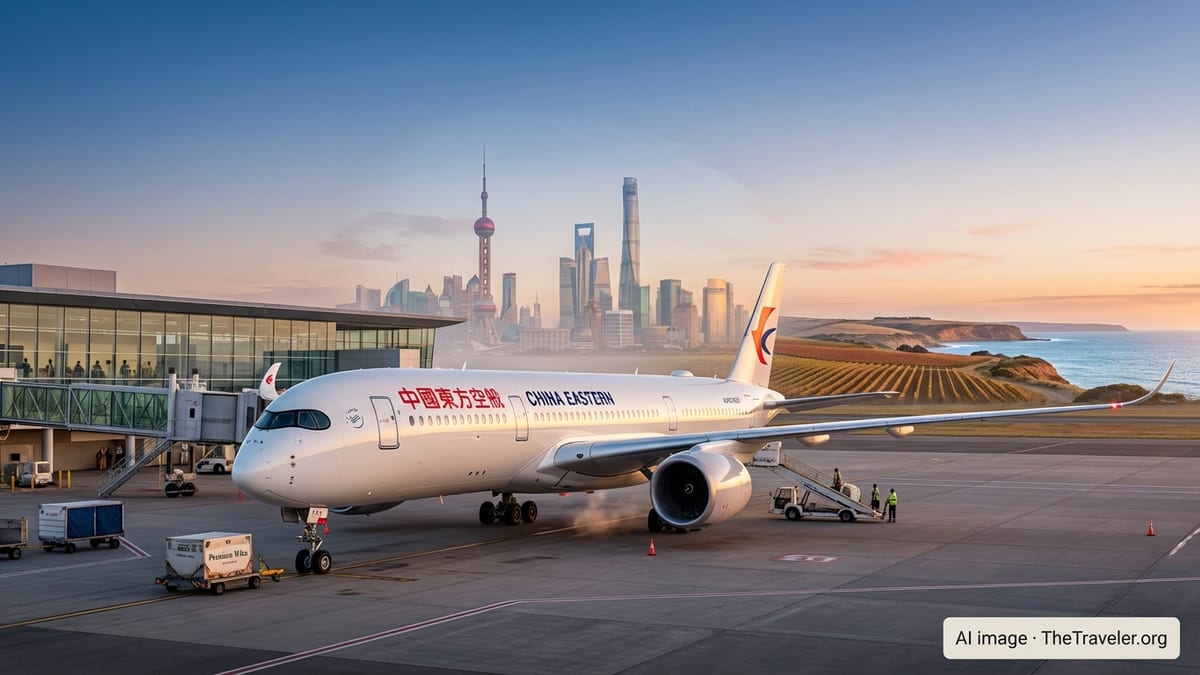
China Eastern Airlines is set to launch seasonal Airbus A350 flights between Shanghai and Adelaide from June 2026, in a move widely seen as a symbolic and practical reconnection between Australia and China.
The new route will restore South Australia’s only direct passenger link to mainland China, support a fast-recovering tourism sector, and provide high-value freight capacity for exporters looking to rebuild after years of pandemic disruption and geopolitical tension.
More News
- TSA Rolls Out $45 ConfirmID Fee for Travelers Without REAL ID at Security
- Flying Blue Launches February 25% Promo Rewards on Transatlantic and Regional Routes
- United Fast-Tracks Starlink Wi‑Fi Across Fleet, Free for MileagePlus Members
Seasonal A350 Service Puts Adelaide Back on China’s Map
China Eastern will begin non-stop services between Shanghai Pudong International Airport and Adelaide Airport in June 2026, operating three times a week with Airbus A350-900 aircraft. Current schedules indicate the first inbound flight from Shanghai will arrive on Sunday 21 June at around 7:30 in the morning, with a return departure from Adelaide at 9:30. The initial season is planned to run until 2 August, capturing China’s northern summer holiday period and demand for visiting friends and relatives travel.
The flights will operate on a seasonal basis, with the airline expected to return in early 2027 to complete its first full program. This measured approach allows China Eastern to test and build demand on a long-haul route that has been absent for several years, while retaining flexibility in its broader network planning. For South Australia, it means a reliable seasonal bridge to one of the world’s most important commercial and tourism markets, without shouldering the risk of a year-round launch from day one.
Adelaide will become the latest Australian city to secure direct links to China’s largest metropolis after the pandemic era saw most long-haul Chinese capacity concentrate on Sydney, Melbourne and Brisbane. The decision to deploy a next-generation widebody such as the A350 underscores the strategic value of the South Australian market, both for point-to-point travel and for onward connectivity through China Eastern’s Shanghai hub.
Rebuilding Australia–China Air Links After a Turbulent Period
The announcement comes as aviation and tourism ties between Australia and China continue a cautious but steady recovery. Before 2020, Chinese carriers were among the most active foreign airlines in the Australian market, with multiple daily services from major Chinese cities to the country’s east-coast gateways. The pandemic collapsed that network, and the broader diplomatic chill between Canberra and Beijing further complicated efforts to restore traffic.
Over the last 18 months, however, a visible thaw has taken place. High-level political visits have resumed, key trade restrictions on Australian products have been wound back, and airlines on both sides have gradually rebuilt their schedules. China Eastern’s move into Adelaide fits this broader pattern: a commercially driven decision that also carries clear diplomatic and economic overtones. It signals confidence in the sustainability of the bilateral relationship and in underlying demand between South Australia and mainland China.
For Chinese travelers, the service offers a new, direct gateway into regional Australia at a time when interest in nature, wine tourism and less-crowded destinations is rising. For Australians, it returns a same-day, single-hop connection into Shanghai and beyond, avoiding the need to connect via Sydney, Melbourne or third-country hubs. Industry analysts note that the route is likely to attract a mix of leisure travelers, business passengers, students and diaspora visiting family, reflecting the diversified nature of post-pandemic demand.
Economic Windfall for South Australian Tourism and Education
China is already South Australia’s most valuable international visitor market, with recent government data estimating Chinese visitors injected more than 300 million Australian dollars into the state’s visitor economy in the year to September 2025. These figures were achieved without a direct Shanghai service in place, relying instead on connections through other Australian cities. Tourism agencies and operators expect that a dedicated A350 route will both grow visitor numbers and increase average spend per trip.
The route is timed to support high-yield segments such as premium leisure travelers and families who prefer non-stop itineraries. Direct access also enhances South Australia’s appeal to international students and their families, a group that typically stays longer and spends more than short-stay tourists. Universities and vocational institutions in Adelaide have been working to rebuild their Chinese student cohorts, and better air connectivity is seen as a critical ingredient in that recovery.
Regional tourism bodies anticipate flow-on benefits well beyond metropolitan Adelaide. Easier access is expected to funnel visitors into wine regions such as the Barossa Valley and McLaren Vale, as well as nature destinations on Kangaroo Island and along the Limestone Coast. Tour operators say that having a non-stop flight to Shanghai makes it easier to market South Australia as a standalone destination in Chinese cities, rather than as a side trip bolted onto an itinerary built around Sydney or Melbourne.
Cargo Capacity and Trade: Lobster, Wine and High-Value Exports
Beyond passengers, a central feature of the new service is its belly-hold cargo capacity. Each Airbus A350 flight is expected to carry around 15 tonnes of freight, giving South Australian producers a direct pipeline into China’s vast consumer market. Seafood exporters, particularly those dealing in live Southern Rock Lobster and abalone, stand to benefit from shorter transit times and reduced handling compared with routings via other Australian hubs.
China has historically been South Australia’s largest export market, taking billions of dollars’ worth of goods annually, including wine, nuts, grain and resources. While some categories were affected by recent trade restrictions, exporters have been quick to re-engage as market access improves. The new Shanghai flights offer a nimble logistics option for high-value, time-sensitive products such as premium wine, chilled meat and pharmaceuticals, complementing existing sea freight channels.
Industry groups note that direct widebody capacity can help stabilise freight pricing during peak periods and provide flexibility in response to demand spikes, for instance around Chinese New Year or major trade fairs. Government trade agencies are expected to align promotional missions and business delegations with the flight schedule, highlighting the connection as a tangible symbol of renewed commercial engagement between South Australia and China.
What the Airbus A350 Brings to Passengers
The choice of the Airbus A350-900 is significant in its own right. China Eastern introduced the type to its fleet in 2018 and has increasingly used it on long-haul routes where fuel efficiency, cabin comfort and environmental performance are critical selling points. The aircraft assigned to the Adelaide route will carry around 286 to 287 passengers, configured across multiple cabins including business class and economy, with some services also expected to feature premium offerings depending on final configuration.
For travelers accustomed to older-generation aircraft on long sectors, the A350 offers several upgrades. The airframe is built from advanced composite materials and features improved pressurisation and higher cabin humidity compared with many previous widebodies. This typically results in reduced jet lag and a more comfortable experience on flights of around ten hours, the approximate duration of the Shanghai–Adelaide sector.
The aircraft’s advanced aerodynamics and modern engines also contribute to lower fuel burn and reduced noise footprints, aligning with increasingly stringent environmental and community standards at both ends of the route. Adelaide Airport and regulators in China have highlighted the role of newer, quieter aircraft types in enabling growth in long-haul networks while maintaining commitments on emissions and local noise impacts around airports.
Adelaide’s Growing International Network
China Eastern’s arrival comes at a time when Adelaide is steadily expanding its international network. In recent months the city has secured new or upgraded services from several carriers, including long-haul connections from the Middle East and expanded links to key Asian hubs. By mid-2026, China Eastern is expected to become the thirteenth airline operating international routes into Adelaide, a milestone for an airport that historically struggled to attract long-haul capacity.
The addition of Shanghai strengthens Adelaide’s position as a secondary Australian gateway with a diverse mix of international destinations rather than a reliance on a single anchor carrier or route. It also gives South Australian passengers more choice when planning itineraries into Europe, North Asia and even North America via China Eastern’s broader network. Travel agents anticipate that competitive pricing on the new route could place downward pressure on fares via other hubs, to the benefit of consumers.
The seasonal design of the service is being closely watched by aviation planners. If forward bookings, load factors and yields perform strongly, there is scope over time for China Eastern to extend the operating window, increase frequency, or upgrade the mix of cabins offered. Equally, the seasonal model allows the airline to consolidate operations during lower-demand periods, which is especially useful in the still-evolving post-pandemic travel environment.
Symbolism and Soft Diplomacy in the Skies
Direct flights often carry a symbolic weight that goes beyond aviation economics, and the Shanghai–Adelaide route is no exception. For policymakers in both countries, the resumption and expansion of air links is a visible sign that relations have stabilised after a period of sharp rhetoric and trade friction. While airlines ultimately make decisions based on commercial viability, they do so within a framework of market access, policy support and regulatory cooperation.
State and federal officials in Australia have publicly welcomed China Eastern’s decision, framing it as a vote of confidence in South Australia’s economic prospects and in the resilience of the Australia–China relationship. In China, the move aligns with a broader push to restore outbound tourism and business travel, as well as to showcase the international reach of the country’s major airlines and airports.
Soft diplomacy also plays out at the community level. Cultural exchanges, sister-city relationships and education partnerships all become easier to sustain when a single overnight flight replaces multi-stop itineraries. Local councils and cultural institutions in South Australia are expected to leverage the new service to deepen ties with counterparts in Shanghai and other Chinese cities, hosting delegations, arts festivals and business forums that hinge on reliable air access.
FAQ
Q1. When will China Eastern’s Airbus A350 flights between Shanghai and Adelaide start?
The seasonal service is scheduled to begin in June 2026, with the first flight from Shanghai expected to arrive in Adelaide on Sunday 21 June, subject to final operational confirmation.
Q2. How often will the Shanghai–Adelaide flights operate?
China Eastern plans to operate three flights per week during the initial season, aligning the schedule with peak northern summer travel demand and key holiday periods.
Q3. What type of aircraft will be used on the route?
The airline will deploy Airbus A350-900 aircraft on the Shanghai–Adelaide sector, offering a modern, fuel-efficient widebody with approximately 286 to 287 seats and significant belly-hold cargo capacity.
Q4. How long will the seasonal service run each year?
For the 2026 launch, services are expected to run from late June until early August, with China Eastern indicating it will return in early 2027 to continue the seasonal program based on demand.
Q5. Why is this route considered important for South Australia’s economy?
The route reinstates South Australia’s only direct link to mainland China, supporting tourism, international education and high-value exports such as seafood and wine, while strengthening access to the state’s largest trading partner.
Q6. Will the new flights benefit exporters and freight customers?
Yes. Each A350 service is expected to offer around 15 tonnes of belly-hold cargo capacity, creating a fast, direct channel for time-sensitive goods including live seafood, premium wine and other high-value products.
Q7. How does this move fit into the broader recovery of Australia–China air travel?
The launch is part of a wider rebuilding of air links after the pandemic and a period of diplomatic strain, complementing restored and expanded services into other Australian cities from major Chinese carriers.
Q8. What advantages does the Airbus A350 offer passengers on this route?
The A350 provides a quieter cabin, improved air quality, higher humidity and more comfortable pressurisation, features that help reduce fatigue on ten-hour flights, alongside updated seating and in-flight entertainment options.
Q9. How will tourists from China benefit from the new connection?
Chinese visitors will gain direct access to South Australia’s attractions, including wine regions and nature destinations, with shorter travel times and no need for domestic connections through other Australian gateways.
Q10. Could the seasonal service eventually become year-round?
Industry observers say that if demand proves strong and consistent, China Eastern could consider extending the operating season, adding frequencies or adjusting capacity, but any shift to a year-round schedule would depend on sustained commercial performance.