

More news on this day
Air travel between China and the Gulf has been hit by a fresh wave of disruption, with more than two dozen flights cancelled across major carriers including China Southern, China Eastern, Qatar Airways, Gulf Air and China Express, affecting routes to Dubai, Doha’s Hamad International Airport, Bahrain and a string of Chinese hub cities.
Get the latest news straight to your inbox!
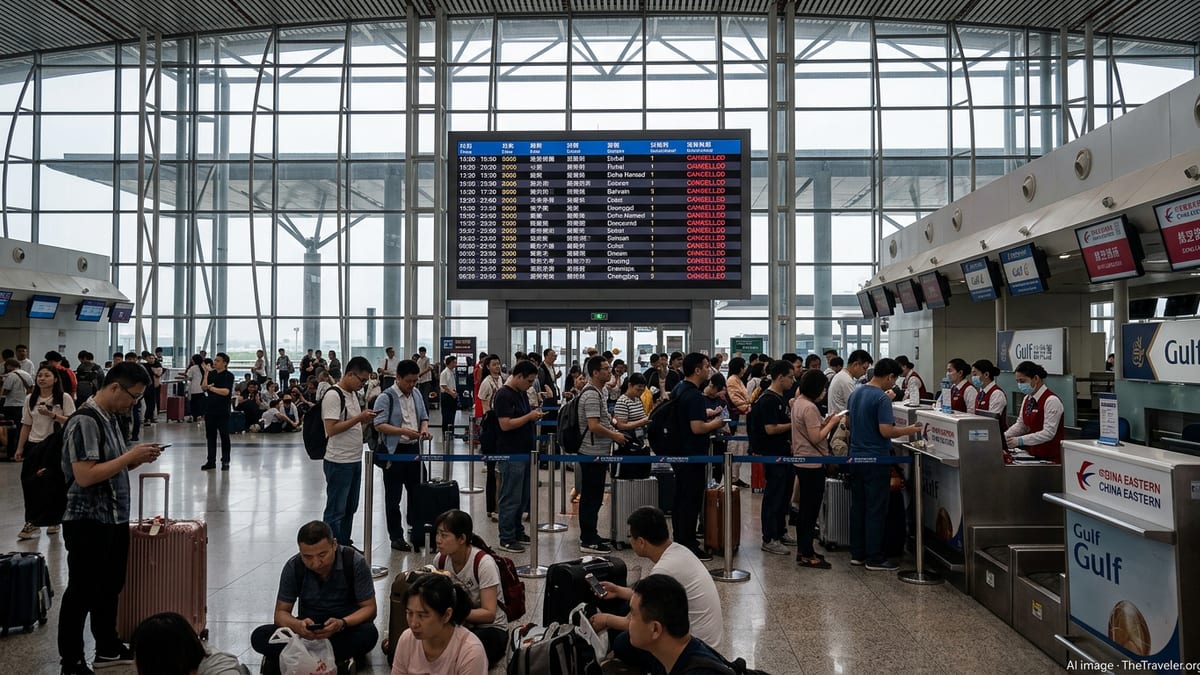
Wide-Ranging Cancellations Hit China–Gulf Corridors
Airline schedule data and airport advisories on Friday indicate at least 25 flights have been withdrawn over the latest scheduling cycle on routes linking Chinese cities with Dubai, Doha and Bahrain, as well as key domestic connectors feeding those international services. The cancellations span full-service giants China Southern and China Eastern alongside Gulf-based Qatar Airways and Gulf Air and regional operator China Express, according to industry notices and travel-agency alerts.
The affected network includes trunk routes from major coastal and interior hubs such as Urumqi, Chongqing, Changsha, Nanjing, Lanzhou, Wuxi, Xi’an, Xiamen and Shenyang. Several flights that typically connect via Guangzhou, Shanghai and other coastal gateways to onward services for Dubai and Hamad International have also been trimmed, leaving passengers with longer layovers or forced rerouting through alternative hubs.
While each airline has cited a mix of operational reasons, analysts say the cancellations are clustering around sectors that cross or skirt sensitive Middle Eastern airspace, as well as lower-yield feeder services that are easier to consolidate. The moves come during what is normally a shoulder period for international travel out of China, giving carriers slightly more flexibility to redraw schedules at short notice.
The reductions follow a volatile fortnight for Middle East aviation, with temporary airspace restrictions and capacity reshuffles prompting repeated timetable changes across multiple carriers operating to and from the Gulf. Chinese airlines have joined European and Asian counterparts in recalibrating their exposure on certain city pairs where demand has softened or routing has become more complex.
Key Chinese Cities See Cuts to International and Feeder Flights
Several of China’s most important regional hubs are at the heart of the current round of changes. Urumqi, which acts as a strategic western gateway for services skirting Central Asia toward the Gulf, has seen selected flights pulled or merged with neighboring departures, reducing options for travelers relying on one-stop itineraries to Dubai and Doha.
In the southwest, Chongqing and Xi’an, both major departure points for Chinese leisure and business travelers, have recorded cancellations and aircraft downgrades on flights that typically feed into long haul departures. Passengers connecting from secondary cities such as Changsha, Nanjing, Lanzhou and Wuxi are reporting itinerary changes that add extra stops in Beijing, Shanghai or Guangzhou, or shift travel to the following day.
Coastal cities Xiamen and Shenyang, which normally benefit from a growing network of point to point services, have also seen schedules tightened. Some overnight departures have disappeared from booking systems, replaced with daytime flights operating fewer days per week. Travel agents in eastern China say they are fielding a surge in requests to rebook itineraries that originally relied on seamless same day connections to Gulf-bound services.
Domestic reshuffling compounds the impact. China Express, which operates thinner regional routes feeding larger hubs, has cancelled a series of flights linking smaller inland airports to Chongqing and other connectors. That has narrowed options for travelers from second and third tier cities who depend on those links to reach international departures, especially on short notice.
China Southern, China Eastern, Qatar Airways and Gulf Air Adjust Operations
China Southern and China Eastern, the country’s two largest network airlines, have been at the forefront of the schedule revisions. Both carriers have removed selected frequencies on China–Gulf routes and trimmed some domestic connectors, opting instead to concentrate demand onto a smaller number of departures with higher load factors. In several cases, widebody jets have been swapped for smaller aircraft on days when loads are weaker.
Qatar Airways and Gulf Air have likewise pared back certain rotations to mainland Chinese cities, particularly those where demand has softened or routings have been made less efficient by changes in regional airspace availability. Although headline services from core hubs such as Beijing and Shanghai to the Gulf remain in place, travelers from inland cities now face more limited options for same day transfers.
Industry consultants note that the cancellations come against a backdrop of still evolving travel patterns between China and the Middle East. After a strong rebound in 2025, demand on some secondary routes has flattened, leaving airlines more inclined to pull marginal flights when external shocks or cost pressures emerge. Cutting a block of 25 or more flights across a complex network can help carriers preserve yields and reduce operational risk.
At the same time, the current disruption underlines the vulnerability of long, multi-leg itineraries that depend on tight banks of connections in both China and the Gulf. Any adjustment by one carrier on a feeder segment can ripple across several partner or codeshare flights, forcing wholesale rebookings for passengers who thought their plans were locked in weeks or months in advance.
Passengers Face Delays, Rerouting and Limited Alternatives
For travelers, the immediate impact is a patchwork of delays, reroutings and in some cases overnight stays. Reports from travel agencies and online booking platforms describe passengers originally booked on nonstop or one stop options between cities like Xi’an or Changsha and Gulf hubs being reprotected on itineraries involving two or even three stops, sometimes via entirely different regions such as Southeast Asia.
In major hubs including Guangzhou and Shanghai, check in counters for China Southern, China Eastern and partner airlines have seen longer queues as travelers seek clarification on last minute schedule changes. Some passengers have been offered voluntary rebooking onto later dates or alternative routes, while others have accepted refunds and are exploring options with other carriers that still have capacity on similar sectors.
Accommodation and duty of care arrangements vary by airline and the reason assigned for the cancellation. Where schedule optimization is cited as the driver, passengers may be entitled to hotel stays and meals during lengthy layovers. Where airspace restrictions or broader security concerns are referenced, some carriers are treating the changes as events beyond their control, limiting compensation to refunds or free date changes.
Travelers already en route have been urged by agents to keep boarding passes, receipts and written confirmation of disruptions in case they seek reimbursement through travel insurance. Insurers typically require clear documentation of cancellations or missed connections when processing claims related to schedule upheaval, particularly on multi-ticket itineraries involving different airlines.
Advice for Travelers Heading to or From China and the Gulf
With schedules still in flux, aviation experts recommend that anyone planning to travel between China and Gulf hubs such as Dubai, Doha and Bahrain in the coming days and weeks monitor their bookings closely. Checking reservation status directly on airline websites or mobile apps in the 24 to 48 hours before departure can provide earlier warning of changes than relying solely on third party booking platforms.
Where possible, travelers are being advised to build in additional buffer time for connections, especially when itineraries rely on domestic segments from inland cities like Urumqi, Lanzhou, Wuxi or Shenyang to reach coastal hubs. Opting for slightly longer layovers can reduce the risk of misconnecting if an upstream domestic flight is delayed or retimed as part of broader network adjustments.
Industry observers also suggest that travelers consider flexible fares or add on changeable ticket options when booking near term trips on routes that have already seen cancellations. While these products are typically more expensive up front, they may prove cost effective if further schedule revisions materialize and passengers wish to avoid lengthy refund processes or no show penalties.
For those yet to book, nonstop services from major Chinese gateways to the Gulf are currently proving more resilient than complex multi stop routings built around thinner feeder services. However, capacity on these core routes may tighten as displaced passengers seek alternatives, so early booking and careful review of fare conditions remain essential for anyone planning China–Gulf travel during this unsettled period.