

More news on this day
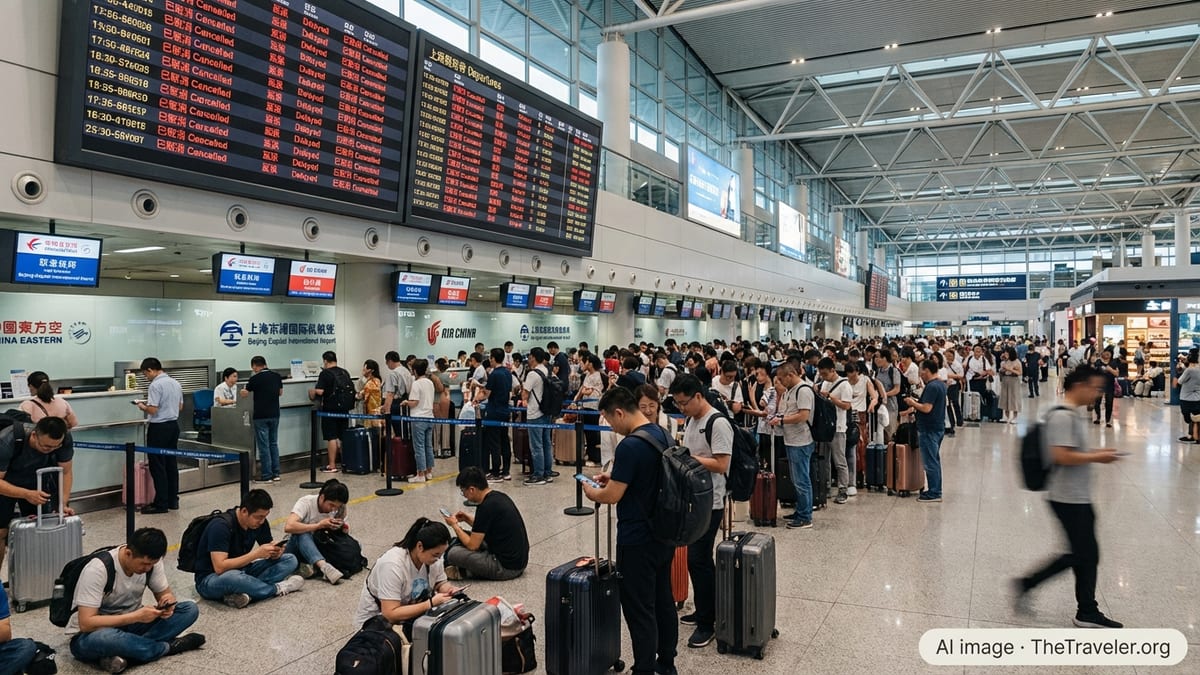
Travelers across China are facing fresh disruption after more than two dozen flights on major domestic carriers were cancelled, affecting key routes into Beijing, Shanghai, Guangzhou, Shenzhen, Xi’an, Hangzhou and other major hubs, according to airline schedules and airport information boards reviewed on Sunday.
Get the latest news straight to your inbox!
Major Chinese Carriers Among Those Affected
Publicly available flight information shows cancellations involving several of China’s largest airlines, including Air China, China Southern, China Eastern and Shenzhen Airlines. The affected services are concentrated on high-demand domestic corridors linking the country’s busiest metropolitan areas and regional centers.
Data from online flight-tracking platforms and airport departure boards indicates that the latest wave of cancellations has crossed the 25-flight mark across multiple carriers and airports. While this is a relatively small share of China’s overall daily flight volume, the impact is amplified because many of the routes connect primary business and transit hubs, where aircraft typically operate at high load factors.
Schedules show that the disrupted flights include a mix of early-morning and late-evening departures, limiting same-day rebooking options for some passengers. Many of the cancelled services were scheduled to operate between large city pairs where aircraft ordinarily turn around quickly, compounding operational pressures once irregularities appear.
Carriers have been adjusting day-of-operation schedules more dynamically in recent seasons, reflecting tighter crew rostering, evolving demand patterns and efforts to optimize aircraft utilization. The current cancellations sit within that broader pattern but are still causing localized disruption for travelers who had planned time-sensitive journeys.
Key Routes to Beijing, Shanghai and Southern Hubs
The latest disruptions are concentrated on routes feeding into the country’s four primary aviation gateways: Beijing, Shanghai, Guangzhou and Shenzhen. These airports handle a substantial share of China’s domestic and international traffic and serve as connectors for onward travel to secondary cities.
Flight information displays for Beijing and Shanghai show cancellations on trunk routes from inland and coastal cities, temporarily reducing frequency on corridors that normally see multiple departures each day. Passengers on these routes often rely on tight connections to other domestic legs, magnifying the inconvenience when a single link in the chain is removed.
In the south, Guangzhou and Shenzhen have also recorded cancellations on inbound and outbound services. These two hubs are central to the Pearl River Delta region, an area with dense business travel and manufacturing-related movements. Even a limited number of scrubbed flights can lead to congestion at customer service points as affected travelers seek new options.
Some cancelled flights were due to connect onward to smaller regional airports, tightening capacity on remaining services. With many routes already operating near capacity during peak travel periods, same-day alternatives may be limited, particularly for travelers needing to arrive by a specific time for work, study or family commitments.
Secondary Cities and Regional Connectivity Impacted
Beyond the flagship hubs, several key regional destinations such as Xi’an and Hangzhou are also seeing knock-on effects. These cities function as important connectors for central and eastern China, and reductions in frequency can disrupt both point-to-point and connecting itineraries.
Xi’an, a major transport and tourism hub in central China, relies heavily on domestic air links for access from coastal and western regions. Cancellations into or out of Xi’an can prompt longer waiting times for rebooking and, in some cases, require travelers to reroute through alternate hubs with limited spare capacity.
Hangzhou, a major technology and commerce center near Shanghai, similarly depends on frequent short-haul services to other large cities. When several of these flights are removed from the schedule in a short window, business travelers in particular are left with fewer timing options, which can have downstream effects on meetings, events and factory visits.
Smaller airports linked to these regional hubs may experience indirect disruption when feeder services are reduced or retimed. Travelers originating from secondary cities often require one or two connections to reach their final destination, and even modest schedule adjustments at a major node can cascade into missed links lower down the network.
Travelers Face Delays, Rebookings and Longer Journeys
Passengers caught up in the cancellations are being redirected to later flights or different city pairs where space allows, according to rebooking patterns visible on reservation platforms. For some, this can mean extended layovers, overnight stays in transit cities or the need to switch to rail services for the final leg of the journey.
Experienced travelers in China often treat high-frequency routes as relatively flexible, expecting that multiple daily options will provide a safety net in the event of disruption. When several departures on the same corridor are removed within a compressed timeframe, that margin narrows considerably, leaving fewer viable alternatives, especially at short notice.
In some cases, cancellations on evening departures have pushed rebooked passengers onto early-morning flights the following day, effectively adding an extra travel day to their itinerary. For international travelers connecting onto domestic legs after arriving in China, the disruption can be particularly challenging, as visa rules, hotel arrangements and onward transport plans may all need to be reworked.
Published guidance from airlines generally encourages affected travelers to use digital channels for rebooking where possible, reducing the need to queue at airport counters during busy periods. Nonetheless, terminal scenes often become crowded during waves of cancellations as passengers seek in-person clarification and printed confirmations for revised itineraries.
What Passengers Should Check Before Heading to the Airport
Given the current pattern of cancellations, travelers planning domestic journeys in China are being advised by publicly available airline guidance to monitor their flight status closely in the hours leading up to departure. Same-day schedule adjustments are not uncommon, and early awareness can provide more options for rebooking or route changes.
Passengers with connections through Beijing, Shanghai, Guangzhou, Shenzhen, Xi’an or Hangzhou may wish to allow additional buffer time between flights, especially if traveling on separate tickets. A missed onward leg can be harder to recover when capacity is tight and multiple flights on the same route are affected.
Travel planners also recommend having a backup plan in mind, such as alternate departure times, nearby airports or high-speed rail options on dense city pairs. China’s extensive rail network can sometimes offer a practical substitute on corridors where air capacity has been reduced for the day.
As airlines continue to refine schedules in response to operational and demand factors, travelers can expect occasional clusters of cancellations even outside major holiday periods. Careful advance planning, flexible itineraries where possible and close attention to live status updates remain key to navigating China’s busy domestic air network during periods of disruption.