

More news on this day
Travellers across China are facing fresh disruption as Air China, China Southern, China Eastern and several partner carriers cancel more than a dozen flights, disrupting key routes that link Beijing, Shanghai, Guangzhou, Chengdu and other major hubs just as demand for both business and leisure travel remains elevated.
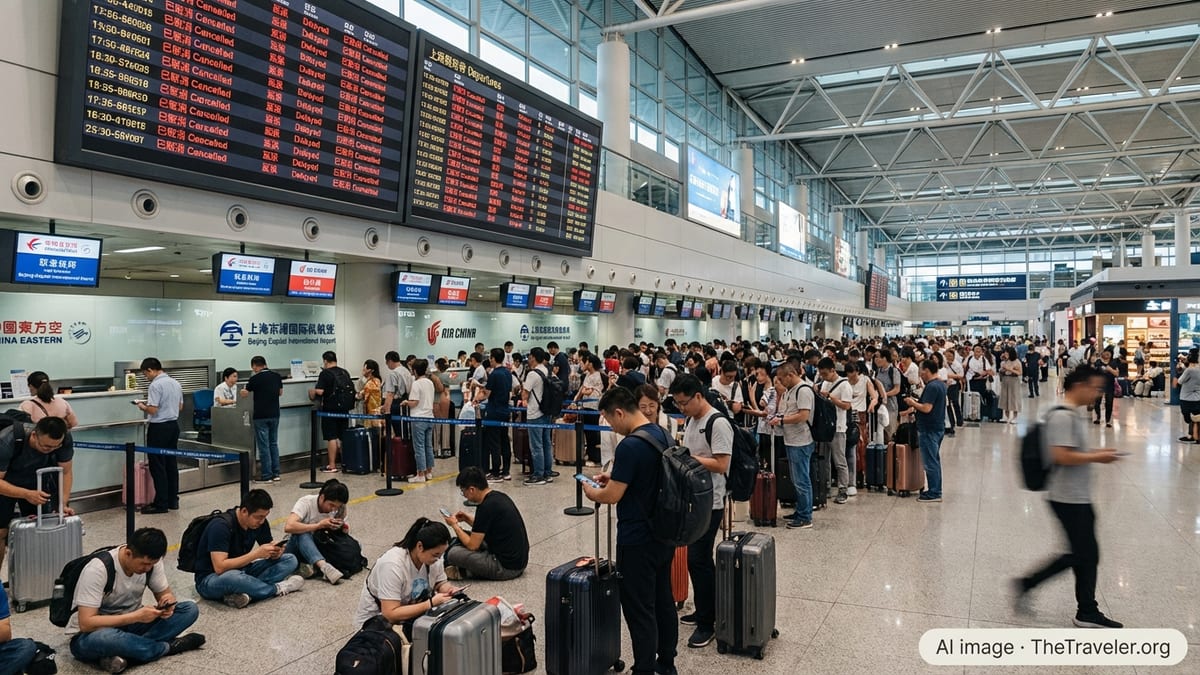
Latest Wave of Cancellations Hits Core Domestic Network
The latest operational update from Chinese aviation data platforms shows a new cluster of cancellations concentrated on trunk routes between Beijing, Shanghai, Guangzhou and Chengdu, as well as links to fast‑growing regional hubs such as Urumqi and Zhengzhou. While the number of outright cancellations this round is smaller than some of the large-scale disruptions seen earlier in the year, the affected flights sit on some of the country’s most heavily used corridors, magnifying their impact on passengers and downstream connections.
Schedules from Air China, China Southern and China Eastern indicate that a mix of morning and evening departures were withdrawn, a pattern that affects both same‑day business trips and long‑planned leisure journeys. Aviation trackers also show parallel cutbacks or operational disruptions involving airlines such as Shenzhen Airlines, Sichuan Airlines and Tibet Airlines at major hubs including Beijing Capital, Shanghai Pudong, Shanghai Hongqiao, Guangzhou Baiyun and Chengdu Tianfu.
Industry analysts note that these latest cancellations follow several weeks of heightened operational stress. Recent tracking days have seen dozens of domestic flights scrubbed within a single 24‑hour period and hundreds more delayed, with Beijing, Shanghai, Guangzhou, Shenzhen, Chengdu, Chongqing, Xi’an and Hangzhou recurrently appearing among the airports most affected.
Beijing and Shanghai Bear the Brunt at the Top of the Network
As China’s primary aviation gateways, Beijing and Shanghai once again figure prominently in the newest set of cancellations. At Beijing Capital International Airport, Air China has withdrawn multiple services linking the capital with major inland and western destinations such as Chengdu, Shenzhen, Xi’an and Urumqi on recent disruption days, forcing passengers to scramble for alternative departures or to route via secondary hubs.
Shanghai’s dual‑airport system has also been under strain. Shanghai Pudong International Airport, a key base for China Eastern and an intercontinental hub, has seen select departures to cities including Guangzhou, Shenzhen, Chengdu and Kunming removed from the day’s operating schedule in recent disruption rounds. Meanwhile, Shanghai Hongqiao, which concentrates much of the east China domestic shuttle traffic, has reported targeted cancellations on westbound services, disrupting the flow of both corporate travellers and tourists.
The concentration of cancellations at Beijing and Shanghai has a cascading effect across the network. These airports are pivotal connection points for passengers transferring between northern, eastern, southern and western China as well as to international routes. Even a relatively small set of cancelled flights can quickly translate into missed onward connections, overnight stays and the need for widespread itinerary changes.
Guangzhou, Chengdu and Other Hubs See Knock‑On Disruption
Further south and west, Guangzhou Baiyun International Airport and Chengdu Tianfu International Airport continue to appear prominently in disruption reports. Previous operational snapshots this year have shown Guangzhou experiencing cancellations to northern and western destinations such as Tianjin, Xi’an and Urumqi, while Chengdu has repeatedly seen flights to Beijing, Urumqi and Hangzhou pulled as airlines rebalance capacity and respond to operational limits.
Chengdu’s role as a bridge between central, western and southwestern China makes each cancellation particularly consequential. When departures on the Beijing and Urumqi routes are removed, travellers from the wider Sichuan region and beyond lose key connection options for both domestic and international journeys, including transfers to Japan, Southeast Asia and Europe via northern and eastern hubs.
Other airports, including Shenzhen, Hangzhou, Xi’an, Nanjing, Chongqing and Wuhan, have all featured in recent nationwide disruption tallies. While not every hub experiences heavy cancellations on the same day, the rotation of affected cities points to a network that is still adjusting to high demand, changing weather patterns and tight operational buffers.
Weather, Congested Airspace and Operational Strain Drive Irregularities
Recent reports on China’s flight operations highlight a mix of underlying drivers for the cancellations, with adverse weather frequently cited at the top of the list. In several instances over the past month, severe or shifting weather systems over northern and western China have grounded dozens of flights and delayed hundreds more in a single day, particularly at Beijing, Chengdu, Xi’an and Guangzhou.
At the same time, airlines are grappling with congested airspace and complex scheduling across a network that has largely recovered to, and in some cases exceeded, pre‑pandemic domestic traffic levels. The concentration of peak‑hour departures at major hubs leaves operators with little room to maneuver when storms or low visibility strike, often forcing same‑day cancellations rather than extended rolling delays that could ripple late into the night.
Fleet and crew allocations are another piece of the puzzle. Carriers such as Air China, China Eastern and China Southern are simultaneously restoring international routes, launching new services and managing maintenance windows for both narrow‑body and wide‑body aircraft. When disruptions occur early in the day or at key hubs, there is limited spare capacity to reposition aircraft or crews to keep every scheduled flight operating, and airlines are increasingly opting to consolidate loads onto fewer departures.
Passengers Face Long Queues, Missed Connections and Rebooking Challenges
For travellers, the latest cancellations translate into long queues at service counters, uncertainty at departure gates and, in many cases, missed connections that upend complex itineraries. At Beijing, Shanghai, Guangzhou and Chengdu, passengers have reported waiting for hours to secure new flights, particularly on days when cancellations coincide with high travel periods linked to business conferences, school holidays or regional festivals.
Where alternative same‑day options exist, they are quickly snapped up, often leaving only late‑night departures or next‑day services with available seats. This pressure is especially acute on the busiest trunk routes, where aircraft are already operating at high load factors. In some cases, passengers have opted to reroute via secondary cities, accepting longer overall journey times in exchange for the possibility of departure that day.
Accommodation and onward ground transport have become additional pain points. When late cancellations push travellers into unscheduled overnight stays, local hotel capacity near major airports can tighten rapidly. Moreover, missed last‑train services or long‑distance coach departures have added further complexity for passengers attempting to continue their journeys beyond the immediate airport city.
What Airlines and Airports Are Doing to Manage the Impact
Airlines have responded to the latest disruptions with a combination of fee‑free change policies on affected flights, expanded use of digital rebooking tools and redeployment of on‑the‑ground staff at key hubs. In previous disruption waves this year, carriers including Air China and China Eastern have offered passengers on cancelled services the option to rebook onto later flights or alternative routes without additional charges, or to claim refunds where same‑day alternatives are not available.
Airport operators, for their part, have been increasing real‑time information updates via terminal displays and mobile applications, in an effort to give passengers earlier warning of emerging delays or cancellations. At Beijing Capital, Shanghai Pudong, Shanghai Hongqiao and Guangzhou Baiyun, additional staff have been positioned at check‑in halls and transfer desks during peak disruption windows to help redirect travellers and answer queries about baggage handling and minimum connection times.
Industry observers note, however, that the scale and complexity of China’s domestic network mean that response measures often lag behind the speed at which operational conditions can change. When bad weather, airspace restrictions and tight schedules coincide, the result is a rapid accumulation of delays and cancellations that can be difficult to unwind within the same operating day.
Broader Pattern of Repeated Disruptions Across Early 2026
The latest cancellations form part of a broader pattern of repeated disruptions that has emerged across China’s aviation sector in early 2026. In January alone, several analytical snapshots showed hundreds of delays and more than one hundred cancellations across major hubs within a single day, with Air China, China Eastern, China Southern and key regional carriers all affected at different times.
Some disruption clusters have been linked to severe weather systems, while others coincide with busy holiday or travel seasons, when the network is operating near maximum capacity. There have also been periods where specific airports, such as Beijing Capital, Shanghai Pudong or Shenzhen Bao’an, have recorded an outsized share of cancellations on particular days, suggesting localized bottlenecks related to airspace flow management or airport operations.
For passengers, the cumulative effect is a sense of heightened uncertainty when planning trips that depend on tight connections or time‑sensitive arrivals. Travel agents and corporate travel managers report spending more time building contingency options into itineraries, such as allowing longer layovers, booking earlier flights in the day, or maintaining backup train reservations on key intercity corridors where high‑speed rail offers a viable alternative.
What Travellers Should Do If Their China Flight Is Affected
Travel specialists recommend that anyone flying within or through China in the coming weeks closely monitor their flight status from 24 hours before departure and again on the day of travel. Airline apps, airport departure boards and SMS notifications remain the primary channels for real‑time updates, but passengers are also encouraged to confirm details directly with carriers if they are travelling on separate tickets or via multiple airlines.
In the event of a cancellation, passengers are generally advised to act quickly to secure rebooking options, as seats on remaining services can disappear within minutes during peak disruption periods. Using airline mobile apps or official customer service hotlines often proves faster than queuing at airport counters, particularly at major hubs where large numbers of travellers may be affected simultaneously.
For international visitors, allowing additional buffer time between domestic and outbound long‑haul flights can provide a critical margin of safety if domestic legs are delayed or cancelled. Where practical, choosing through‑ticketed itineraries on a single airline or alliance can also simplify rebooking and baggage handling when irregular operations occur.
Outlook: Capacity Growth Meets Fragile Operating Conditions
Looking ahead, aviation analysts expect Chinese carriers to continue growing capacity on both domestic and international routes throughout 2026, especially as more long‑haul markets in Europe, the Middle East and Asia are brought back into regular schedules. Air China, China Eastern and China Southern all have expansion plans underway, supported by new aircraft deliveries and the gradual reopening of global travel corridors.
At the same time, the recurring pattern of weather‑related disruptions and airspace congestion indicates that operating conditions are likely to remain fragile, particularly during peak travel seasons and in regions prone to winter storms or summer thunderstorms. This tension between ambitious growth and constrained operating margins suggests that further pockets of irregular operations, including clusters of cancellations like those seen this week, are probable.
For both domestic and international travellers, the message is to plan with flexibility in mind. While the vast majority of flights across China continue to operate as scheduled each day, the experience of early 2026 shows that even a relatively small number of cancelled services on key trunk routes can have outsized consequences for those caught on the wrong side of a departure board update.