

More news on this day
Thousands of passengers across Asia are facing missed connections, overnight waits and disrupted travel plans as China’s major airlines and airports grapple with a spike of 244 flight cancellations and 3,704 delays concentrated in Beijing, Hami, Guangzhou, Chengdu, Shanghai and other key Chinese hubs.
Get the latest news straight to your inbox!
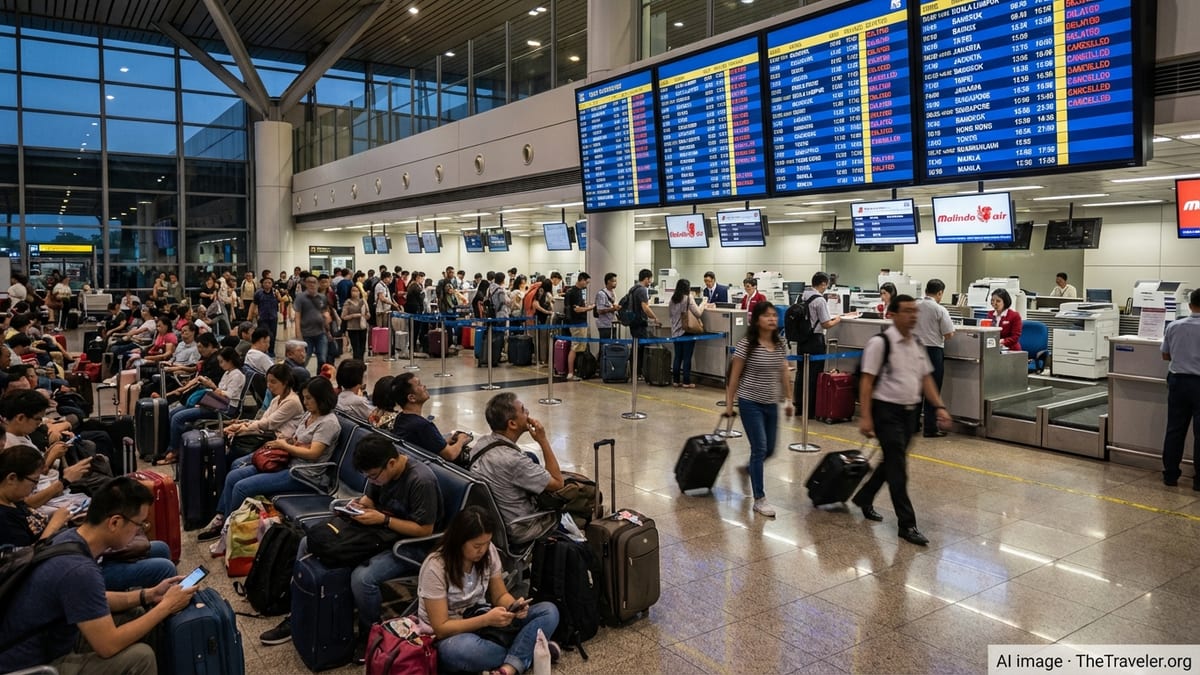
Disruptions Mount Across China’s Busiest Airports
Publicly available flight-tracking data for today indicates a broad pattern of disruption across China’s domestic network, with cancellations and delays clustering around the country’s most important aviation hubs. Beijing, Shanghai and Guangzhou are absorbing a significant share of the impact, while regional gateways such as Chengdu and Hami are also reporting elevated irregular operations.
The total of 244 cancellations and 3,704 delays reflects a system under strain rather than isolated technical glitches. China Eastern, China Southern, Air China, Sichuan Airlines, Hainan Airlines and several smaller carriers are all listed among the affected operators, highlighting that the disruption is network-wide and not confined to a single airline or route group.
Shanghai’s dual-airport system, covering Pudong and Hongqiao, has again emerged as a focal point of congestion, with knock-on effects visible on routes connecting to major Asian cities. Beijing’s main international gateways are reporting sustained departure queues and extended turnaround times, pushing many services beyond scheduled slots and rippling onward to connecting flights across the region.
In western and central China, Chengdu and Hami are seeing a disproportionate number of delayed departures relative to normal operations. While their absolute traffic volumes are smaller than those of coastal hubs, disruptions at these airports are complicating domestic connections for travelers heading onward to secondary cities.
China Eastern, Southern, Air China and Regional Carriers Under Pressure
China Eastern, China Southern and Air China, the country’s three largest state-linked carriers, account for a large share of the flights affected. Their dense domestic schedules at Beijing, Shanghai and Guangzhou mean even moderate schedule disturbances quickly cascade, leading to late arrivals, missed crew connections and aircraft rotations that no longer align with the planned timetable.
According to aggregated performance data and recent operational statistics, Chinese carriers have been running high capacity through the first quarter of 2026 as international demand recovers and domestic tourism remains strong. When demand is this robust, airlines have less slack in their fleets and crew rosters to absorb unexpected congestion or weather-related slowdowns.
Regional and privately owned carriers such as Sichuan Airlines, Hainan Airlines, Spring Airlines and 9 Air are also caught in the current wave of disruption. These airlines play a central role in linking provincial cities to national hubs, so delays on their services can leave passengers stranded far from primary international gateways, complicating rebooking options.
Operational notices and schedule data show that airlines are attempting to consolidate lightly booked services, substitute aircraft and adjust departure banks to regain punctuality. However, the volume of delayed flights reported today suggests that recovery is likely to be gradual, and uneven across different airports and time windows.
Weather, Congestion and Tight Turnarounds Drive Irregular Operations
Recent travel-industry coverage and aviation analytics for China highlight several structural factors behind the latest spike in cancellations and delays. Periods of adverse weather around coastal and southern hubs, including heavy rain and low visibility, have periodically reduced runway capacity and forced holding patterns, which then translate directly into late arrivals and missed departure slots.
At the same time, China’s busiest airports continue to operate near their declared capacity for much of the day. When runway and airspace usage are this dense, seemingly minor disruptions such as temporary ground stops, runway inspections or localized storms can quickly lead to an accumulation of delayed departures and arrivals that takes many hours to clear.
Airlines have also compressed turn times for many short-haul domestic flights as they try to maximize aircraft utilization. This strategy works smoothly when conditions are normal, but offers little buffer when inbound flights arrive late. A delay on one or two early-morning rotations for an aircraft assigned to multiple legs can ultimately affect passengers on routes many hundreds of kilometers away by late afternoon.
These pressures are not unique to China. Comparable waves of disruption in recent days in North America, Europe and the Gulf region underline how quickly modern, high-density aviation networks can seize up once adverse weather, operational limits and tight schedules intersect.
Travelers Face Long Queues, Missed Connections and Limited Alternatives
For passengers, today’s figures translate into very tangible challenges on the ground. Crowded terminals, long customer-service lines and rapidly changing departure boards are being reported at Beijing, Shanghai, Guangzhou and Chengdu, while smaller airports like Hami are seeing unusually long waits for rebooking as limited frequencies restrict same-day alternatives.
Travel reports indicate that many travelers on multi-leg itineraries across Asia are particularly vulnerable. Missed domestic connections in China can jeopardize onward flights to destinations such as Bangkok, Singapore, Tokyo and Dubai, especially when those international sectors are already heavily booked for early April travel.
With airlines juggling scarce seats, some passengers are being moved onto later departures or rerouted via alternative hubs, occasionally adding extra stops or overnight layovers. In certain cases, hotel rooms near major airports are reported to be in tight supply, increasing stress for stranded travelers trying to secure last-minute accommodation.
Families traveling with children, elderly passengers and those on tight schedules for business, cruises or events are among the groups facing the greatest disruption. For them, a delay of several hours or a forced overnight stay can mean missed meetings, forfeited reservations and costly last-minute changes to ground transport.
What Passengers Can Do if Traveling Through China Now
Given today’s cancellation and delay totals, travel experts and consumer advocates are advising passengers transiting Chinese hubs to build additional margin into their plans and to assume that departure times may change at short notice. Real-time flight-tracking platforms and airline mobile applications are generally updating faster than physical departure boards, making them a crucial resource for monitoring rapidly shifting schedules.
Travelers are also encouraged to check the status of both outbound and inbound legs of their journeys. Since many delays originate from late-arriving aircraft, knowing where the inbound plane is coming from can offer early clues about potential timing issues, even before a formal delay is posted.
For those who have not yet started their trip, airlines commonly offer limited fee-free changes during periods of widespread operational disruption. Passengers with flexible plans may benefit from moving flights to early-morning or next-day departures, when schedules are sometimes less congested and recovery efforts have had more time to take effect.
As China’s airlines and airports work to unwind today’s backlog of 244 cancellations and 3,704 delays, observers expect ongoing knock-on effects into the next operating day. Travelers scheduled to fly through Beijing, Hami, Guangzhou, Chengdu, Shanghai and other Chinese hubs in the coming 24 to 48 hours are likely to feel the residual impact, even if their own flights remain officially scheduled to depart on time.