

More news on this day
Travelers across China faced widespread flight disruption this week as 46 services were canceled and a further 1,565 delayed, with congestion and missed connections rippling through major hubs in Beijing, Shanghai, Chengdu and beyond.
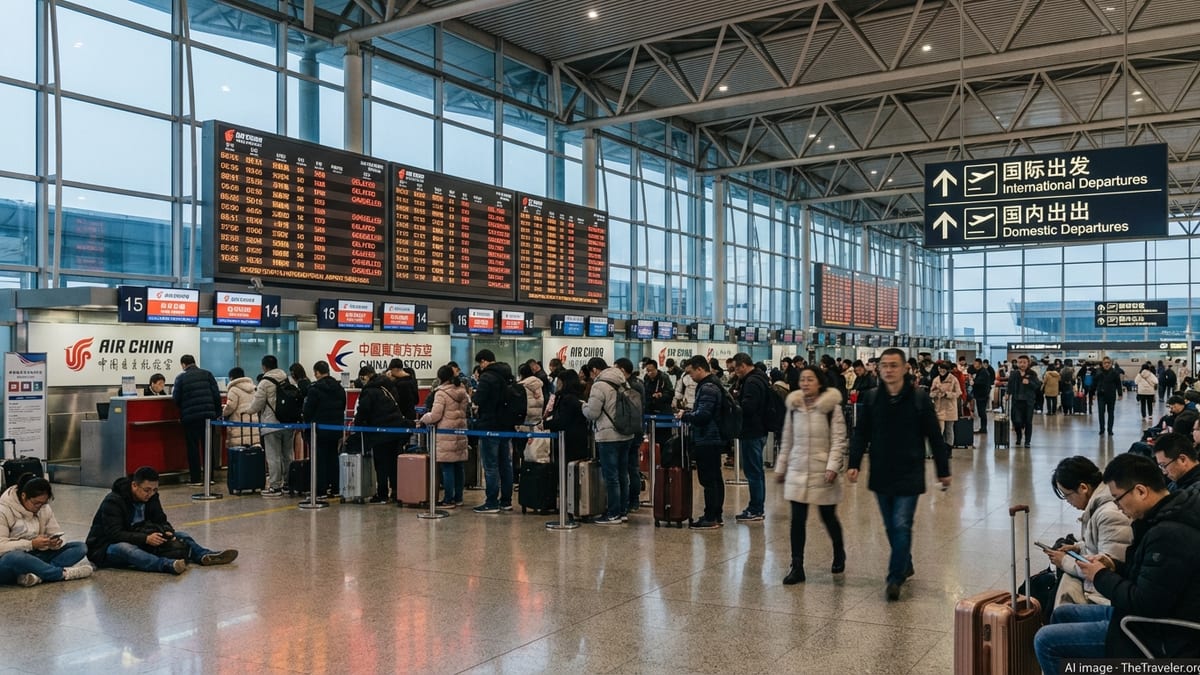
Weather Turbulence and Congested Skies Trigger Disruption
Operational data from Chinese aviation and flight-tracking sources indicate that a combination of fast-moving weather systems and already tight schedules pushed the country’s air transport network into fresh turbulence. Heavy rain, low cloud and unstable winds in western China, particularly across Xinjiang, coincided with low visibility and periodic storm cells affecting the approaches to Beijing and Shanghai. Those conditions forced airlines to slow operations, space out arrivals and departures, and in some cases hold aircraft on the ground for safety checks.
The resulting bottlenecks quickly radiated outward. Once early-morning and mid-day flights were delayed, crews and aircraft ended up out of position for subsequent rotations. Airlines trimmed some frequencies and consolidated services in an attempt to recover, but that in turn generated clusters of cancellations and further delays later in the day. By evening, departure boards at Beijing Capital, Shanghai Pudong and Chengdu Shuangliu were dominated by red markers, with delays measured in hours rather than minutes on many trunk routes.
While China’s aviation authority has not yet published a full breakdown, preliminary tallies show 46 outright cancellations and 1,565 delayed flights on the worst-hit day, affecting both domestic sectors and regional international links. The pattern mirrors earlier disruption episodes in late 2025 and early 2026, underscoring how quickly even routine weather can escalate into nationwide gridlock when traffic levels are high and turnaround times compressed.
Air China, China Eastern and Chengdu Airlines Under Pressure
Flag carrier Air China, major network operator China Eastern and regional specialist Chengdu Airlines were among the most exposed to the latest wave of disruption. With dense schedules centered on Beijing, Shanghai and Chengdu, these airlines rely on tight aircraft rotations and rapid turnarounds to keep capacity aligned with demand. When weather or air-traffic restrictions slow operations, there is limited slack in the system to absorb delays.
Air China saw multiple cancellations and rolling delays on routes linking Beijing and Shanghai with key secondary cities, as well as on some regional services connecting into its long-haul network. China Eastern reported similar pressure at Shanghai Pudong and Hongqiao, where congestion at peak hours forced further spacing of departures and arrivals. At Chengdu Shuangliu, Chengdu Airlines bore the brunt of disruptions on feeder routes into Sichuan and western China, with several flights scrubbed or pushed back by several hours.
Airlines have responded by waiving change fees on many affected routes, offering free rebooking within a limited window and, in certain cases, providing hotel accommodation or meal vouchers for severely delayed passengers. However, customer service desks and hotlines have struggled to keep up with the spike in inquiries, leaving many travelers queueing in crowded terminals or waiting on hold while seats on alternative flights disappear.
Impact on Travelers in Beijing, Shanghai and Chengdu
For passengers, the disruption has been felt most acutely at the country’s primary gateways. At Beijing Capital International Airport, early-morning delays cascaded into missed connections for both domestic and international journeys. Travelers arriving late from Xinjiang, Sichuan and northeast China often found that their onward flights had already departed or been rescheduled, forcing them to rebook or overnight in the capital.
In Shanghai, the effect was similar, with business travelers and families returning from inland provinces facing long queues at rebooking counters and inconsistent information on revised departure times. Crowded departure halls, full airport hotels and scarce seats on evening departures created frustration for those trying to reach nearby cities by air, prompting some to switch to high-speed rail where possible.
Chengdu Shuangliu, a key hub for western China, experienced extended gate holds and late-evening departures as airlines attempted to clear the backlog. Regional links to smaller cities in Sichuan and neighboring provinces were particularly vulnerable, as aircraft were reassigned to protect busier trunk routes. For some travelers, that meant same-day trips turning into overnight odysseys, with limited options beyond waiting for the next available seat.
What Travelers Need to Know Right Now
With schedules still recovering, passengers booked on Air China, China Eastern, Chengdu Airlines and other Chinese carriers are being advised to build in additional buffer time and to monitor flight status closely in the 24 hours before departure. Airlines are updating schedules frequently as crews and aircraft are brought back into position, which means departure and arrival times can change more than once in a single day.
Experts recommend checking flight status through official airline channels or airport information boards before leaving for the airport, and again upon arrival at the terminal. Given the risk of extended queues and security bottlenecks during irregular operations, arriving earlier than usual is prudent, especially at Beijing Capital, Shanghai Pudong and Chengdu Shuangliu. Travelers making tight connections should consider shifting to earlier feeder flights or, where available, to rail services that are less sensitive to weather-related airspace restrictions.
Passengers whose flights are canceled or significantly delayed should retain boarding passes, booking confirmations and receipts for meals, accommodation and ground transport. These documents are often required when seeking refunds, rebooking, or compensation where local regulations or airline policies allow. While Chinese domestic rules offer more limited automatic compensation than some international regimes, carriers may provide vouchers, partial refunds or alternative transport during large-scale disruptions.
How Long Will the Chaos Last?
Aviation analysts say that once weather conditions stabilize, most of the disruption can typically be cleared within 24 to 48 hours, provided no new storms or airspace restrictions emerge. The current pattern of 46 cancellations and 1,565 delays suggests a severe but short-lived shock to the system rather than a prolonged crisis. However, high load factors on many Chinese routes mean that even a short burst of cancellations can leave passengers struggling to find spare seats for several days, particularly on popular corridors between Beijing, Shanghai, Chengdu and other major cities.
Industry observers note that China’s aviation sector has been operating near full capacity at peak times, leaving little room to reroute traffic when the unexpected happens. As authorities and airlines review the latest episode, there is likely to be renewed discussion about schedule resilience, reserve aircraft and crew deployment, and improved real-time communication with passengers.
For now, travelers planning to fly within or via China in the coming days should assume that knock-on effects may still be visible on some routes. Allowing more time, staying flexible with routing, and preparing for possible last-minute changes remain the best strategies for navigating China’s crowded skies while airlines work to restore normal operations.