

More news on this day
Travelers moving between China and the Gulf region are facing fresh disruption after more than 20 flights were reportedly canceled or suspended on routes touching Bahrain, Riyadh, Doha, Xi’an and other key hubs, as Gulf Air, China Eastern, Qatar Airways and other operators adjust schedules in response to volatile Middle East airspace conditions.
Get the latest news straight to your inbox!
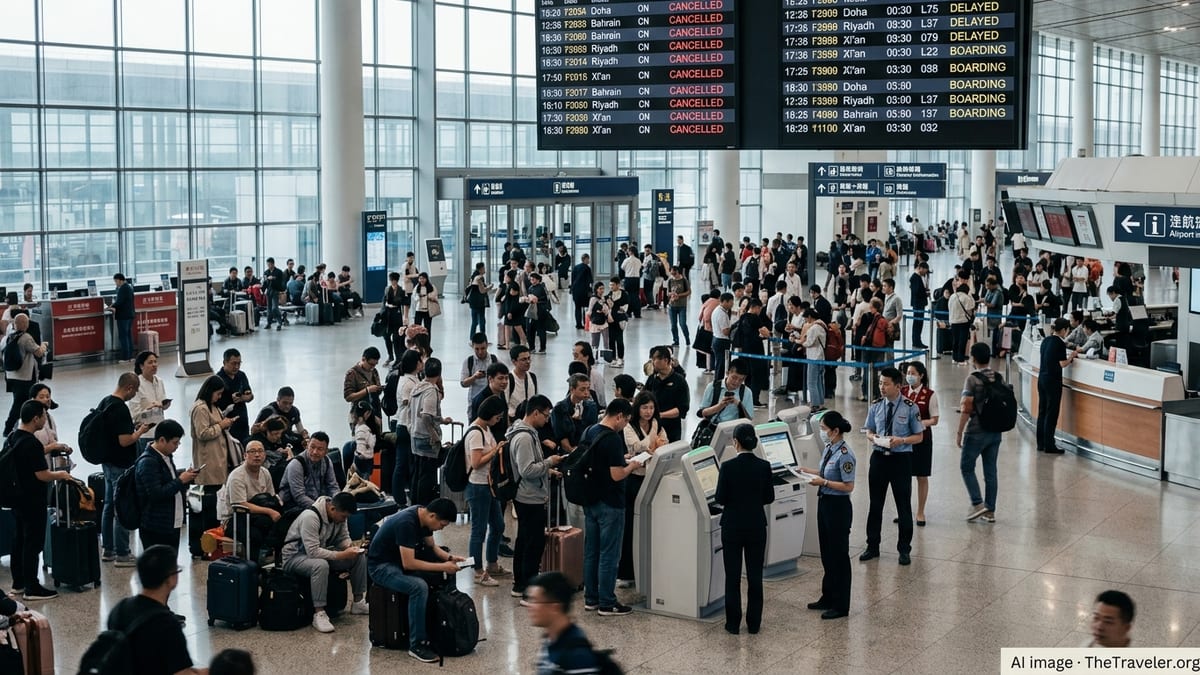
Wave of Cancellations Hits China–Gulf Corridors
Publicly available flight tracking data and regional media coverage indicate that airlines serving China–Gulf corridors have removed or suspended over 20 services in recent days, affecting both point to point links and long haul connections routed through Bahrain and Qatar. The adjustments follow weeks of turbulence across Middle East airspace, with closure notices and capacity limits rippling into airline timetables worldwide.
Chinese and Gulf carriers appear to be concentrating limited capacity on a smaller number of trunk routes, leaving some city pairs temporarily unserved or sharply reduced. Services touching Bahrain, Riyadh and Doha are among those most affected, while knock on changes are also being reported on links involving Xi’an and other interior Chinese cities that typically rely on Gulf hubs for onward travel to Europe, Africa and the Americas.
Schedule information shows that China Eastern has cut or retimed several flights feeding Gulf connections, while Gulf Air and Qatar Airways have consolidated operations as Bahrain and Qatari airspace move in and out of tighter restrictions. Industry analysts note that even when a specific route is not formally suspended, aircraft and crew rotations are being reworked in ways that can trigger last minute cancellations or extended delays.
Bahrain, Riyadh and Doha Remain Volatile Transit Points
In Bahrain, local and international reports describe periods in early March when flights were largely grounded, with Bahrain International Airport operating at a fraction of normal capacity. That reduction has had direct consequences for Gulf Air’s regional and long haul network, including services that normally link Manama with major Chinese gateways and secondary cities via partner connections.
Riyadh has been under similar pressure as airlines reroute around sensitive airspace and reassess overflight permissions. Chinese carriers that previously relied on Riyadh and other Gulf hubs to stitch together multi leg itineraries for passengers from cities such as Xi’an, Chengdu or Kunming have in some cases removed those options from booking systems, pushing travelers toward less direct routings through Europe or Southeast Asia.
Doha, usually one of the world’s most reliable long haul transfer points, has seen some of the most visible disruption. According to published coverage, Qatar’s airspace has experienced temporary closures and capacity restrictions since late February, with normal commercial schedules still limited. Qatar Airways has concentrated on evacuation and relief style flying on select days, while many regular services to and from Chinese cities remain canceled or listed as “not operating” for parts of March.
Chinese Carriers Tighten Flex Policies as Xi’an Feels the Impact
Large Chinese airlines have attempted to blunt the impact on passengers by expanding change and refund options on affected routes. Reports from Chinese business media indicate that carriers such as Air China, China Eastern and China Southern introduced temporary waiver policies for itineraries involving major Middle Eastern hubs, allowing date changes or full refunds when flights are canceled or rerouted.
Xi’an, a growing international gateway in central China, illustrates how quickly connectivity can shift. Flights that once offered one stop access from Xi’an to Gulf capitals and beyond via Bahrain or Doha have in several cases been removed from sale, leaving travelers dependent on domestic connections to coastal hubs before heading overseas. Similar patterns are being observed in other interior cities where Gulf and Chinese carriers previously cooperated on shared networks.
Travel platforms and online agencies in China are promoting alternative routings through East Asia and Europe, but these options often involve longer total travel times and higher fares. Industry observers note that some travelers who had chosen Xi’an or other regional airports specifically for their Gulf connections are now backtracking to Beijing, Shanghai or Guangzhou to reach international flights that remain in operation.
Passengers Scramble for Alternatives Amid Limited Clarity
For travelers caught in the middle of the disruption, the immediate challenge has been uncertainty. Social media posts and traveler forums are filled with accounts of passengers learning of cancellations only a few days before departure, sometimes after check in times have opened, and then struggling to reach airline call centers or online chat channels to secure rebooking or refunds.
According to these publicly shared experiences, some passengers have opted to buy entirely new tickets on other carriers such as China Eastern or regional Asian airlines, treating any eventual refund from their original Gulf based carrier as a secondary concern. Others are attempting to wait out the disruption in the hope that additional corridors through Doha or Bahrain will reopen before their scheduled travel dates, a strategy that can be risky as remaining seats on alternative routes sell out.
Travel agents in both China and the Gulf region are encouraging customers to monitor airline apps and official status pages closely rather than relying on third party booking engines alone. In several cases, travelers have reported that flights still appear bookable through external platforms even after they have been quietly removed from airline schedules, creating confusion about which services are genuinely operating.
What Travelers Should Expect in the Coming Days
While some reports suggest that limited corridors through Qatari airspace are gradually reopening for specific evacuation and cargo movements, regular commercial services remain constrained, and airlines are updating timetables only a few days at a time. That pattern is likely to persist as long as security conditions remain fluid, making it difficult for carriers to commit to stable long term schedules between China and the Gulf.
Passengers planning trips that involve Bahrain, Riyadh, Doha or secondary Chinese gateways such as Xi’an should be prepared for further short notice changes. Industry specialists advise allowing extra connection time, avoiding tight self transfers between separate tickets, and considering flexible or refundable fares where possible, even if they come at a higher upfront cost.
Publicly available information also indicates that many airlines have broadened their disruption policies for itineraries touching affected airspace, offering fee free changes or full refunds when flights are canceled or significantly rerouted. Travelers are being encouraged to review the latest policy notices on airline websites before making changes on their own, as conditions can differ by carrier and by departure date.
With tensions in the wider region still unresolved, aviation analysts expect Chinese and Gulf airlines to continue fine tuning their networks in the weeks ahead. For now, the combination of canceled flights, constrained airspace and rolling schedule updates means that journeys linking China with Bahrain, Riyadh, Doha, Xi’an and other hubs are likely to remain unpredictable, keeping many passengers in a holding pattern between rebooking attempts and rapidly shifting timetables.