

More news on this day
Air travel across China has been thrown into fresh turmoil as more than 100 flights were cancelled or severely delayed on March 11, stranding thousands of passengers at major hubs including Beijing, Shanghai, Guangzhou, Chengdu, Shenzhen and Hangzhou, with disruptions spreading across multiple domestic and international routes.
Get the latest news straight to your inbox!
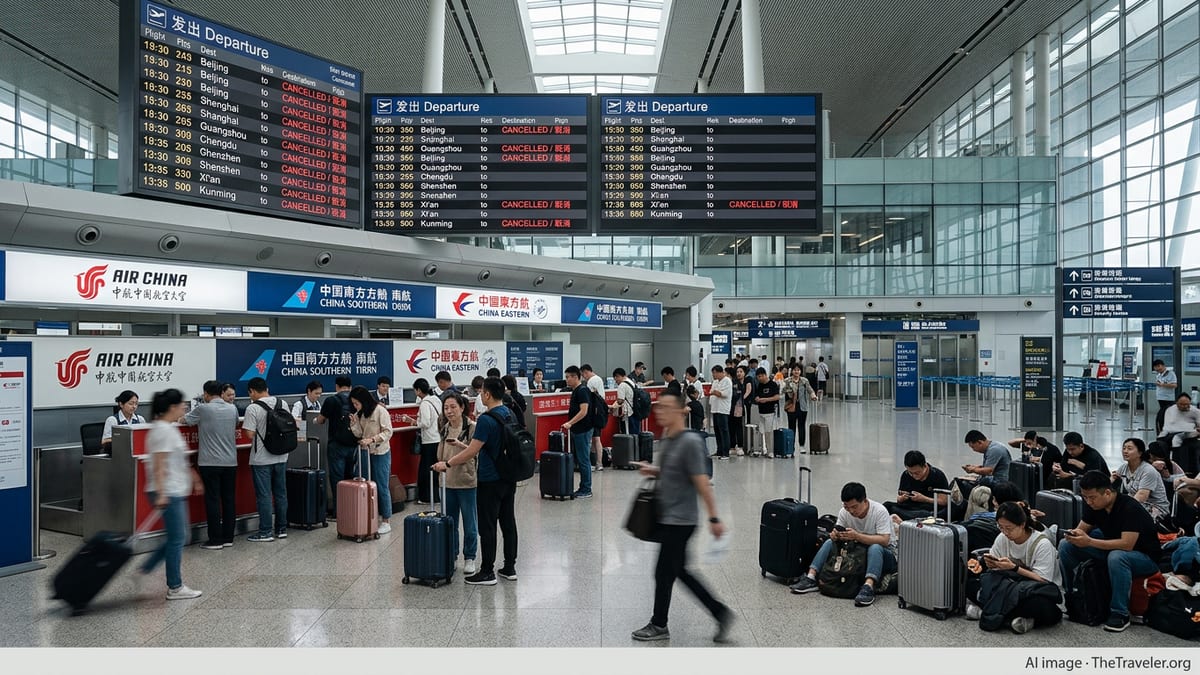
Widespread Disruptions Hit Major Chinese Airports
Data from aviation monitoring services and regional transport authorities on March 11 indicate that Chinese airports have been hit by a new wave of cancellations and rolling delays, compounding weeks of instability in regional airspace. Fresh figures show more than 150 flights cancelled and well over 1,500 delayed at mainland hubs such as Beijing Capital, Chengdu Tianfu, Urumqi Diwopu, Karamay, Yining and Xi’an, underscoring how quickly operational issues in one part of the network can cascade across the country.
While China has not experienced the same absolute volume of cancellations as some Middle Eastern gateways, the timing and concentration of the disruptions have amplified their impact. Beijing and Shanghai, which serve as key east Asia transfer points, have faced mounting schedule changes, with Shanghai Pudong and Hongqiao together recording hundreds of delays in recent days alongside a smaller but rising number of outright cancellations.
Travel industry analysts note that even modest cancellation figures in China can translate into severe crowding and missed connections when they involve trunk routes linking major population centers. With capacity on popular corridors such as Beijing–Shanghai, Beijing–Guangzhou and Shanghai–Chengdu already tightly optimized, the removal of a handful of peak-hour services can trigger knock-on delays lasting well into the evening.
By late Monday and into Tuesday, passengers reported long queues at check in and transfer counters, crowded gate areas and extended waits for rebooking assistance, particularly at Beijing Capital and Chengdu Tianfu. Social media posts displayed departure boards dominated by red "cancelled" and "delayed" notices, a visual reminder of the scale of the operational stress.
Air China, China Southern, Chengdu Airlines and Others Forced to Cut Services
Among Chinese carriers, Air China and China Eastern have been prominent in the latest wave of changes, alongside regional operator China Express Airlines and Chengdu Airlines. Recent operational tallies show around 60 flights grounded in a single 24 hour period by Air China, China Express and China Eastern on routes touching Beijing, Shanghai, Chengdu, Kunming, Urumqi and Xi’an, with separate datasets indicating more than 150 cancellations and over 1,500 delays when additional airports such as Karamay and Yining are included.
Chengdu Airlines and other secondary carriers have also been drawn into the disruption as congestion at key hubs forces schedule reshuffles. At Chengdu Tianfu, which has emerged as a central inland hub, services operated by Air China, Chengdu Airlines and several partners recorded a cluster of cancellations and a particularly heavy wave of delays, stretching airport resources and straining ground operations.
China Southern, one of the country’s largest airlines, has focused on reshaping rather than wholesale cutting of services, especially on its international network. The carrier has recently resumed or reconfigured several Middle East routes from Guangzhou and Shenzhen following earlier suspensions, but its domestic services are contending with the same airspace and flow management constraints affecting rival airlines. Passengers on Guangzhou–Shanghai and Guangzhou–Beijing sectors have reported schedule changes and rolling delays as the airline adjusts fleets and crews.
Low cost and regional airlines are also feeling the pressure as they depend heavily on tight turnaround times at congested airports. Operational experts warn that when large full service carriers like Air China or China Southern delay departures, smaller carriers can lose their assigned takeoff windows, leading to further knockbacks across the day’s rotations.
Qatar Airways and Regional Turmoil Add to China’s Travel Strain
The disruption in China cannot be viewed in isolation. A wider pattern of cancellations across Asia and the Middle East is playing directly into Chinese operations, affecting international services by foreign carriers such as Qatar Airways as well as Chinese airlines’ long haul schedules. Industry tallies for March 11 show 774 flights cancelled and more than 2,100 delayed at major airports across Asia and the Gulf, including Doha, Dubai, Abu Dhabi, Shanghai, Bangkok, Singapore and Tokyo.
Qatar Airways, which has been operating reduced and frequently adjusted schedules amid regional airspace constraints, has contributed to the instability felt by travelers booked on connecting itineraries through Chinese hubs. Limited relief flights and late stage schedule changes have complicated onward connections between Doha and cities such as Beijing, Shanghai and Guangzhou, forcing many passengers to rebook at short notice or face overnight stays.
Chinese carriers with exposure to Middle East routes, including Air China, China Eastern, China Southern, Hainan Airlines and Shenzhen Airlines, have responded by introducing temporary no fee refund and change policies for tickets issued before late February and scheduled for travel between late February and mid March. Officials have indicated that for many itineraries involving the Middle East, passengers can obtain full refunds or free date changes through their original point of sale, an unusually flexible stance in a market known for stricter fare rules.
Despite the emergency measures, travel agents and corporate travel managers report that securing replacement seats has become increasingly challenging. With many carriers still running reduced capacity to and from the Middle East, even passengers who successfully rebook face longer journeys, extra connections and extended layovers at Chinese hubs already grappling with domestic congestion.
Beijing, Shanghai, Guangzhou and Chengdu Bear the Brunt
On the Chinese mainland, Beijing and Shanghai remain the epicenters of disruption, reflecting their role as both domestic and international gateways. Beijing Capital has seen a concentration of cancellations on trunk routes to Guangzhou, Chengdu and Urumqi, alongside a heavy volume of delayed departures and arrivals. Shanghai’s dual airport system at Pudong and Hongqiao has offered some flexibility, but operational data for recent days show significant delay clusters, particularly at Pudong, where long haul and regional international flights must compete for constrained airspace and runway capacity.
Guangzhou Baiyun and Chengdu Tianfu, two of China’s fastest growing hubs, are under similar pressure. Guangzhou is juggling a resurgent international network with busy domestic banks, while Chengdu has emerged as a pivotal inland connection point linking western provinces with coastal metropolises. Reports highlight multiple cancellations and extensive delays at both airports, including for services operated by Air China, China Eastern, China Southern, Chengdu Airlines and several regional partners.
Secondary coastal and Yangtze River Delta hubs such as Shenzhen and Hangzhou are feeling the ripple effects. Shenzhen Bao’an, already managing complex flows tied to its proximity to Hong Kong, has experienced schedule compression as airlines reassign aircraft and crews, while Hangzhou Xiaoshan has reported elevated delay levels on flights to Beijing, Shanghai, Guangzhou and Chengdu. Even where outright cancellations remain limited, persistent delays are eroding on time performance across airline networks.
Airport authorities in Beijing and Guangzhou have recently reiterated long term expansion plans, citing the current turmoil as evidence of the need for additional terminal and runway capacity. However, planners acknowledge that infrastructure upgrades will not offer immediate relief to passengers facing today’s cancellations and missed connections.
What Travelers Need to Know Now
For travelers currently in China or scheduled to transit through Chinese hubs, the principal advice from airlines and travel experts is to check flight status repeatedly in the hours leading up to departure and to allow extra time for check in, security and transfer procedures. With schedules in flux, last minute gate changes and rolling delays are common, even on routes that appear unaffected earlier in the day.
Passengers booked on Air China, China Eastern, China Southern, Shenzhen Airlines, Hainan Airlines and other Chinese carriers with itineraries touching the Middle East through May are being urged to review the latest ticket change and refund rules. Many of the special policies apply only to tickets purchased before a specific cut off date and for travel within defined windows, and in most cases changes must be processed through the original booking channel.
Travel agents recommend that passengers connecting in Beijing, Shanghai, Guangzhou or Chengdu build in longer layovers than usual to reduce the risk of misconnecting, particularly when one leg involves a Middle East or long haul international sector. Where possible, rebooking onto earlier domestic feeder flights may provide a buffer against unforeseen delays later in the day.
While airlines stress that safety remains the overriding priority, there is little sign that volatility in schedules will ease in the coming days. With regional airspace still constrained and Chinese hubs operating close to their capacity limits, travelers should be prepared for continued disruption, frequent schedule changes and, in some cases, last minute cancellations on routes serving China’s biggest cities.