

More news on this day
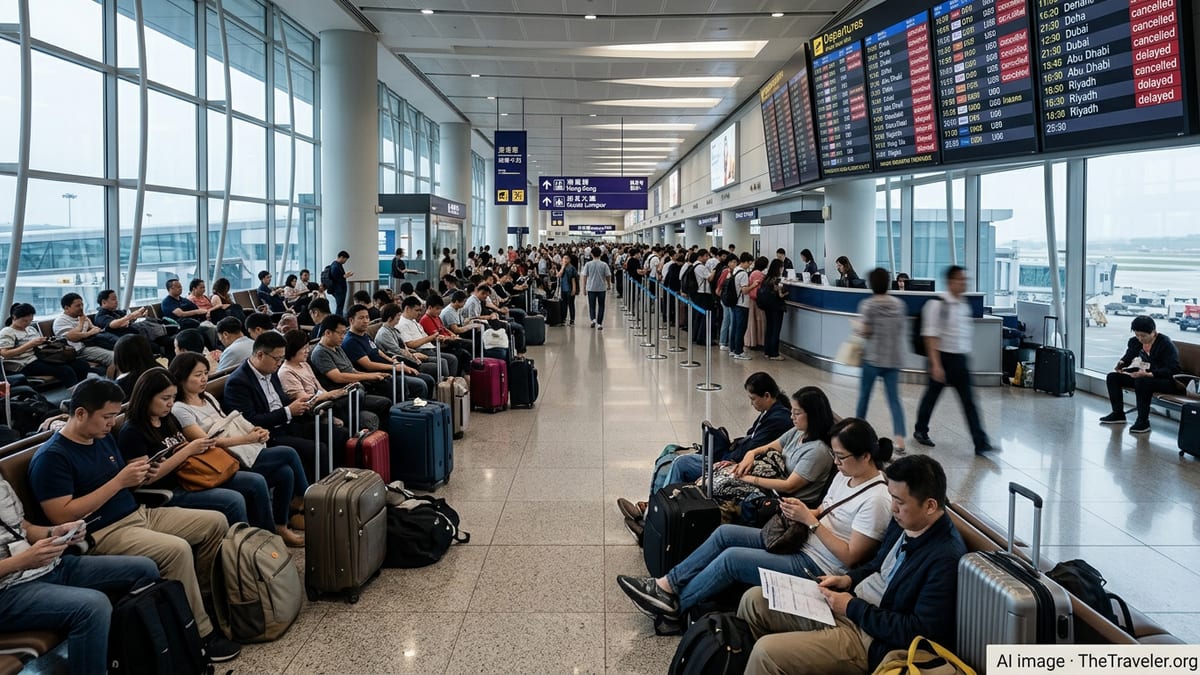
China’s major aviation hubs are grappling with a new wave of disruption, as 244 flight cancellations and 3,704 delays in a single day ripple across domestic and international routes, stranding passengers and stretching airline operations at the start of April travel.
Get the latest news straight to your inbox!
Major Hubs Struggle Under Heavy Operational Strain
Publicly available flight-tracking data for early April indicates that 244 flights departing from or arriving in mainland China were cancelled within a 24 hour window, while a further 3,704 were delayed, concentrating disruption at the country’s biggest hubs. The impact has been most visible at airports serving Beijing, Shanghai, Guangzhou and Shenzhen, which together handle tens of millions of passengers each month.
The pattern of disruption points to a mix of late-running departures, extended ground times and congested approach sequences around these hubs. Delays have been reported across both short haul domestic sectors linking interior cities with the coast and longer international services to hubs in East Asia, the Middle East and Europe, suggesting that the strain is system wide rather than confined to a single region or carrier.
China’s hub and spoke model magnifies the effect of such irregular operations. When aircraft and crews arrive late into a primary hub, knock on delays cascade through onward rotations, tightening turnaround windows and leaving less room to recover from additional weather or air traffic constraints later in the day.
Airlines operating dense schedules at peak morning and evening banks appear particularly exposed, with aircraft arriving out of sequence and departure slots at busy airports becoming harder to utilize efficiently once earlier disruptions have accumulated.
Weather, Airspace Constraints and Scheduling Combine
While no single cause fully explains the latest disruption, data and coverage of regional operations suggest a convergence of factors. Seasonal weather fronts across eastern and southern China have periodically reduced visibility and introduced thunderstorms, conditions that typically force wider spacing between aircraft on approach and departure and can trigger ground stops at the busiest fields.
At the same time, airspace over parts of the country remains tightly managed, with specific corridors reserved for non civil use and others subject to temporary restrictions. When traffic is already close to capacity, even modest route adjustments can translate into longer airborne holding, re sequencing of arrivals and tactical delays that cascade throughout the day.
Scheduling intensity is another element. Over the past year, traffic recovery on popular trunk routes has prompted carriers to concentrate more flights into narrow time bands in order to connect efficiently with domestic and international banks. This has helped restore capacity but leaves minimal slack when aircraft or crew rotations are disrupted, increasing the likelihood that an initial delay turns into a cancellation later in the day.
Published analyses of past disruptions in China and other large aviation markets highlight similar patterns: a combination of marginal weather, constrained airspace and tightly packed schedules tends to push complex networks past their tipping point, producing large clusters of delays and higher than average cancellation rates.
Ripple Effects for International Connections
The wave of 244 cancellations and thousands of delays has not been limited to purely domestic itineraries. International passengers transiting through Beijing Capital, Beijing Daxing, Shanghai Pudong, Guangzhou Baiyun and Shenzhen Bao’an have faced missed connections and prolonged layovers as banks of inbound flights arrived out of sequence.
Long haul services linking China with Europe and the Middle East are particularly sensitive to such disruption because they often depend on carefully timed feeder flights from secondary Chinese cities. When those domestic legs are cancelled or significantly delayed, transit passengers may be left with limited same day rebooking options, especially on routes where frequencies have not fully returned to pre pandemic levels.
Carriers in neighboring hubs, including Hong Kong, Seoul and key Southeast Asian gateways, can also experience indirect effects. Late arrivals from mainland China may force schedule adjustments, aircraft swaps or rolling delays on onward routes, adding to congestion in the wider Asia Pacific network.
Travel industry analysts note that within interconnected hub systems, disruption in one large market quickly becomes a regional issue, as crew and aircraft positioning, maintenance windows and slot obligations in multiple countries must be adjusted to accommodate missed rotations.
Passenger Experience Under Pressure
For travelers caught in the disruption, the statistics translate into crowded terminals, long queues at service desks and challenges securing alternative flights. Social media posts and traveler forums over recent days describe passengers queuing for hours to rebook, along with frustration over limited real time information on gate changes and revised departure times.
Consumer rights resources advise affected passengers to rely on multiple information channels, including airline apps, airport displays and third party flight tracking tools, rather than waiting for a single notification. Travelers are also encouraged to document disruption details, such as cancellation notices and delay durations, which can be important when filing compensation requests under carrier specific policies or seeking support from travel insurers.
Industry observers note that Chinese carriers, like counterparts elsewhere, have been working to modernize disruption management tools and automate some rebooking processes. However, sudden spikes involving hundreds of cancellations and several thousand delays in a short period can still overwhelm call centers and airport staff, leaving many passengers reliant on self service options and online updates.
Travel planners recommend that passengers connecting through China’s busiest hubs build in longer layover buffers where possible, especially during seasons prone to thunderstorms, fog or heavy rain, and consider earlier departures in the day, when schedules may be less affected by accumulated delays.
What the Disruption Signals for China’s Aviation Recovery
The latest bout of flight chaos arrives at a time when China’s aviation sector is advancing through a complex recovery phase, with traffic growth returning on key routes but operational resilience still being tested. The scale of the disruption highlights the challenge of operating high density schedules in an environment where infrastructure, airspace allocation and weather variability all impose limits on flexibility.
Analysts following the sector note that investments in upgraded air traffic management systems, additional runway capacity at major hubs and improved cross regional weather forecasting could help mitigate the severity of future disruption events. Incremental schedule adjustments, such as spreading peak banks more evenly across the day or adding reserve aircraft and crew capacity, may also provide more room for recovery when irregular operations begin to build.
The experience is likely to influence how airlines, airports and regulators in China plan for upcoming peak periods, including summer holiday travel and major national holidays, when passenger volumes climb sharply. Data from recent disruptions in other global hubs suggests that contingency planning, clear passenger communication and close coordination across carriers can limit the duration and spread of network instability.
For now, the tally of 244 cancellations and 3,704 delays serves as a reminder that even as international connectivity improves and demand rebounds, China’s largest airports and airlines remain vulnerable to days when weather, capacity constraints and ambitious scheduling collide, turning tightly synchronized networks into sources of widespread travel frustration.