

More news on this day
Thousands of travellers across China are facing lengthy waits and missed connections as more than 1,400 flights are delayed and over 160 cancelled at key hubs including Shanghai, Beijing, Chengdu, Guangzhou, Shenzhen, Xi’an and Wuhan, disrupting operations for China Eastern, Air China, China Southern and several other carriers.
Get the latest news straight to your inbox!
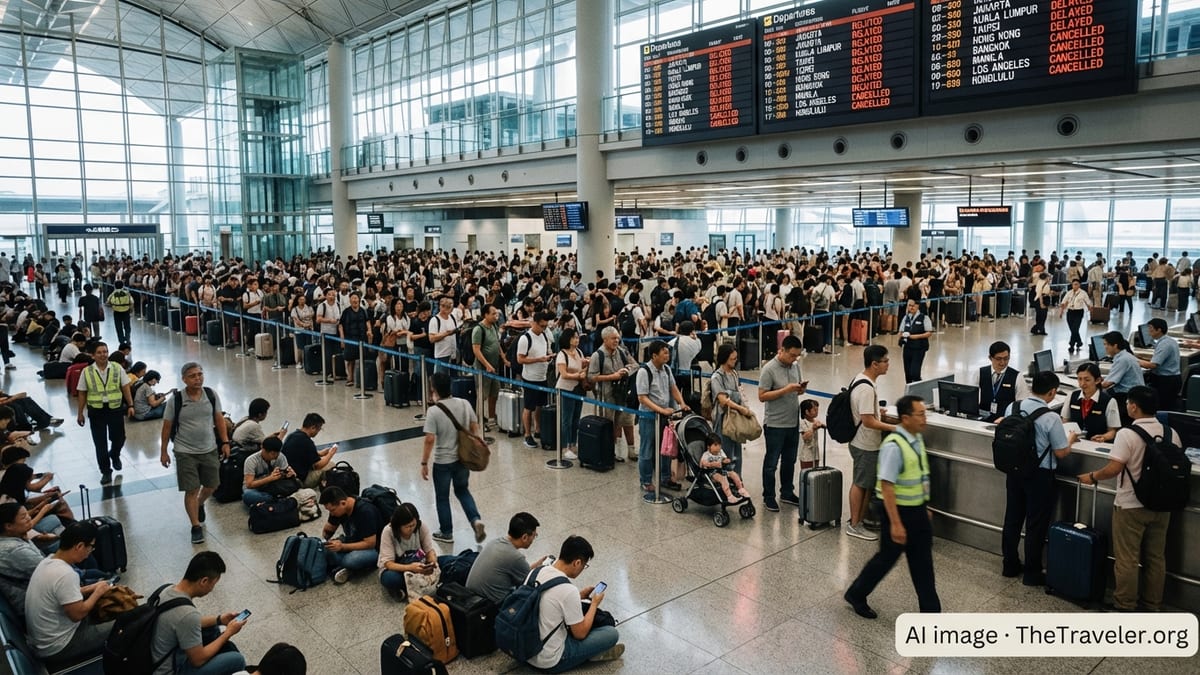
Wave of Disruptions Hits China’s Busiest Airports
Operational data compiled from multiple aviation tracking platforms for early April 2026 indicates that major airports across eastern and central China have been particularly hard hit, with 1,439 flights delayed and 164 cancelled in a single disruption window. The impact is concentrated at high-traffic hubs such as Shanghai Pudong, Shanghai Hongqiao, Beijing Capital, Beijing Daxing, Guangzhou Baiyun, Chengdu Tianfu, Shenzhen Bao’an, Xi’an Xianyang and Wuhan Tianhe, where dense schedules leave little margin to recover from cascading delays.
Published coverage of recent travel conditions in China describes repeated days of heavy disruption, including several instances where more than 4,000 delays and hundreds of cancellations were recorded nationwide. These latest figures continue that pattern, underscoring how quickly local weather, airspace constraints or ground handling bottlenecks can ripple across the domestic network.
Travellers report long queues at check in and security, crowded boarding areas and difficulty securing alternative routings as aircraft and crews fall out of their assigned rotations. Even airports experiencing only moderate weather or normal traffic volumes are feeling the knock-on effects as delayed inbound aircraft push departures behind schedule well into evening departure banks.
The disruption is especially visible on short haul trunk routes linking the country’s political, commercial and technology hubs. Flights between Shanghai, Beijing, Guangzhou and Shenzhen, among the busiest corridors in the world, appear frequently in delay rankings, which magnifies the number of affected passengers when schedules begin to unravel.
Major Carriers Bear the Brunt
China Eastern, Air China and China Southern, the country’s three largest network airlines, account for a significant share of the delayed and cancelled flights. Publicly available operational tallies from recent days show these carriers repeatedly appearing near the top of national disruption tables, reflecting their dominant presence at the affected hubs and their reliance on tightly banked schedules.
Earlier in April, one nationwide snapshot showed China Eastern and China Southern each recording dozens of cancellations and several hundred delays in a single day, with Air China also logging substantial disruption. Other full service and regional operators, including Shenzhen Airlines, Shanghai Airlines, XiamenAir, Sichuan Airlines, Juneyao Air and Hainan Airlines, are also listed among affected carriers, adding to the overall congestion as their aircraft compete for gates, slots and departure windows.
For passengers booked on these airlines, the immediate consequence is a sharp increase in missed connections and involuntary overnight stays. Disruption at one hub can strand travellers far from their final destination as onward services depart before delayed inbound flights arrive. In several recent cases documented by industry publications, passengers have been left waiting many hours for the next available seat on oversold routes.
The latest wave of irregular operations also comes at a time when airlines are still rebuilding international and regional networks. Some carriers have already trimmed schedules or adjusted capacity on certain routes, particularly to Japan, leaving fewer alternative options when domestic operations come under stress.
Weather, Airspace and Network Strain Drive Delays
Analysis of early April traffic patterns across the wider Asia Pacific region points to a combination of extreme weather, congested airspace and structural network pressures as likely drivers of the current disruption in China. Coverage focused on April 2026 highlights intense convective storms over southern China and the Pearl River Delta, which have periodically forced temporary runway closures and extended holding patterns around Guangzhou and Shenzhen.
These weather systems, even when short lived, can rapidly overwhelm airport punctuality, especially at hubs handling hundreds of departures and arrivals per day. Once traffic begins to back up, air traffic control restrictions and slot limitations can prolong delays for hours after skies clear, particularly when aircraft and crew duty time limits are approached.
At the same time, long haul traffic flows across Asia and into Europe are navigating altered routings due to geopolitical sensitivities in certain airspace corridors, which can lengthen flight times and complicate scheduling. Industry observers note that days with the heaviest disruptions often coincide with peaks in regional traffic, when airports have little spare capacity to absorb unexpected shocks.
Network complexity within China’s domestic system further amplifies these pressures. Multi leg rotations that send an aircraft from a morning departure in Shanghai through several secondary cities before returning to a hub in the evening can quickly fall out of sync. When an early sector is delayed, every subsequent flight in that rotation inherits some of the disruption unless the airline can substitute equipment or crews at short notice.
Impact on Travellers Across China and Beyond
The immediate impact for travellers caught up in the latest wave of delays and cancellations is measured in missed holidays, disrupted business trips and mounting costs for accommodation and rebooking. Reports from affected airports describe passengers queuing at airline counters for hours, with some sleeping in terminal seating as they wait for standby space on later services.
Because the disruption spans multiple hubs simultaneously, options for rerouting via alternative cities are limited. Busy connectors such as Chengdu, Xi’an and Wuhan, which often serve as relief valves when coastal hubs are constrained, are themselves experiencing significant schedule irregularities. This reduces the likelihood that a missed flight can be salvaged with a quick change of route.
International itineraries that rely on Chinese hubs as gateways are also vulnerable. Delays on inbound domestic legs can cause passengers to miss long haul departures to Europe, North America or Southeast Asia, with some travellers forced to postpone trips by a full day when long haul frequencies are limited. Travel industry reporting in recent days notes a growing number of such cases as the April disruption continues.
The strain is not limited to passengers. Ground handling teams, air traffic controllers and airline operations centers face mounting workloads as they manage the operational puzzle of gate changes, crew rotations and aircraft maintenance windows in a highly dynamic environment. Persistent irregular operations over several days can also lead to increased fatigue risk, prompting more conservative crew rostering that in turn reduces schedule flexibility.
What Travellers Can Do as Disruptions Continue
Given the pattern of repeated disruption across Chinese hubs in early April, travel analysts suggest that passengers build extra resilience into their plans. Public travel advisories and industry commentary commonly recommend choosing earlier departures where possible, allowing generous connection times, and avoiding last flight of the day options on critical sectors during periods of unstable weather.
Checking real time flight status data from airlines and airport information screens before departing for the airport can help travellers anticipate issues and adjust plans, while mobile notifications and airline apps provide additional channels for rebooking or requesting assistance when flights are significantly delayed or cancelled. In some recent disruption events, passengers who responded quickly to early alerts were able to secure scarce remaining seats on alternative departures.
Travel experts also note the importance of understanding airline irregular operations policies, including provisions on meal vouchers, hotel accommodation and rebooking options. Consumer guidance published in China and internationally emphasizes that entitlements vary by carrier, ticket type and cause of disruption, so passengers may benefit from reviewing the terms of carriage associated with their booking before problems arise.
With the combination of seasonal storms, evolving airspace dynamics and strong travel demand likely to persist into the coming months, observers expect that episodes of concentrated delays and cancellations at major Chinese hubs may recur. For now, the tally of 1,439 delayed and 164 cancelled flights across Shanghai, Beijing, Chengdu, Guangzhou, Shenzhen, Xi’an, Wuhan and other airports serves as a stark reminder of how fragile complex aviation networks can be under sustained pressure.