

More news on this day
Thousands of passengers were left sleeping on terminal floors and queuing at airline counters across Shanghai, Beijing, Shenzhen, Xi’an and Chengdu on March 6 as China reported 1,473 flight delays and 54 cancellations, intensifying a week of disruption already battering Asia’s air network and ensnaring carriers from China Eastern and Air China to Qatar Airways and Sichuan Airlines.
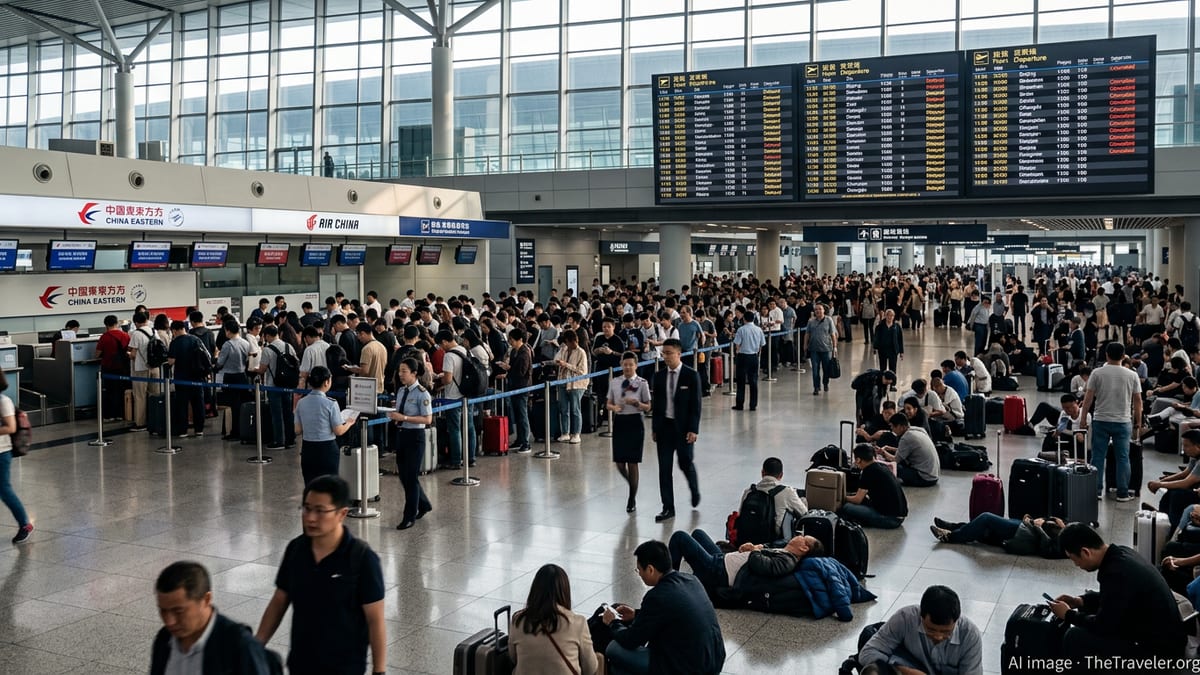
Major Chinese Hubs Buckle Under Mounting Delays
China’s key aviation gateways faced another punishing day on Friday as rolling delays rippled through Shanghai Pudong, Beijing Capital, Shenzhen Bao’an, Xi’an Xianyang and Chengdu Shuangliu. Aggregated operational data indicated 1,473 delayed services and 54 outright cancellations across the mainland network, turning normally efficient domestic corridors into bottlenecks and leaving aircraft and crews badly out of position for the weekend rush.
Shanghai and Beijing bore much of the strain, with long-haul and high-frequency trunk routes between the two cities among those seeing extended holds, schedule reshuffles and last-minute gate changes. Passengers described departure boards dominated by yellow “delayed” markers and repeated loudspeaker announcements as ground handlers and controllers tried to absorb the knock-on effects of earlier disruption.
At Chengdu and Xi’an, the pressure was keenly felt on domestic connections feeding China’s interior and western regions. Travelers bound for secondary cities reported missed connections and forced overnights as tight turnarounds collapsed under the weight of cumulative delays. Shenzhen, a critical tech and manufacturing hub, also saw business travelers scrambling to rebook as morning delays spilled into the afternoon bank of departures.
The latest figures come on top of earlier regional turmoil this week, with Asia already wrestling with hundreds of cancellations linked to wider airspace issues and operational constraints, further shrinking the buffer in tightly wound airline schedules.
China Eastern, Air China and Sichuan Airlines Among Hardest Hit
Flag carrier Air China and major state-owned rival China Eastern were among the airlines most visibly affected, reflecting their dominant presence at Beijing and Shanghai. Passengers on busy Beijing to Chengdu and Shanghai to Beijing routes reported prolonged waits on the ground, with some flights held for slot availability and others delayed by crew duty time limits as the day wore on.
Sichuan Airlines, a key player on services into and out of Chengdu, also faced disruptions, particularly on dense domestic routes that act as feeders from smaller provincial cities. With aircraft operating on tight rotations across multiple legs, even modest early-morning delays cascaded into multi-hour setbacks by midday, stranding travelers in intermediate hubs and forcing rebookings.
The impact was not limited to Chinese carriers. Qatar Airways and several other international airlines operating into Shanghai, Beijing and other coastal cities encountered schedule changes tied to congestion in Chinese airspace and ground operations. Connections onto long-haul sectors between China and the Middle East, Europe and North America were especially vulnerable, with some passengers warned at check-in of misaligned itineraries and re-routed through alternative gateways.
Industry analysts noted that while Chinese carriers have grown rapidly in fleet size and network breadth, their reliance on densely timed waves of arrivals and departures across a small number of mega-hubs leaves them particularly exposed when conditions deteriorate, whether due to weather, airspace constraints or regional geopolitical shocks.
Passengers Face Long Queues, Confusion and Limited Support
Inside the terminals, the operational chaos translated into frayed tempers and fraying travel plans. At Shanghai Pudong and Beijing Capital, snaking lines formed at airline service counters as passengers sought rebooking, refunds or accommodation vouchers. Social media posts showed travelers sprawled on luggage, makeshift sleeping areas on concourse floors and families camped beside power outlets to keep phones charged while they awaited updates.
Several passengers reported that self-service kiosks quickly became overwhelmed or failed to show the latest information, pushing more people toward already overloaded staffed desks. Foreign travelers in particular struggled with language barriers as they navigated changing gate assignments and partial announcements, with some relying on translation apps and fellow passengers for help.
Consumer advocates in China say that while airlines are generally meeting minimum obligations such as meal vouchers during lengthy delays, the consistency and clarity of communication remain a weak point. In earlier disruptions this week across Asia, passengers in Beijing, Shanghai and other hubs have complained about sparse notifications and last-minute cancellations that left little time to arrange alternative routes or lodging.
Travel insurers and passenger rights groups are urging affected travelers to keep detailed records of boarding passes, receipts and written confirmation of delays or cancellations, which may support later compensation or reimbursement claims depending on ticket conditions and policy terms.
Regional Turbulence Adds to Strain on Asia’s Skies
The fresh wave of Chinese delays comes as Asia’s aviation system is stretched by a complex mixture of local weather, crew rosters at breaking point and ongoing airspace closures linked to tensions in the Middle East. Across the region, data in recent days has shown thousands of disrupted flights in markets from Dubai and Delhi to Bangkok and Jakarta, with Chinese hubs increasingly drawn into the widening web of reroutes and missed connections.
Earlier on Friday, separate figures highlighted more than 1,500 delays and over 170 cancellations across Asia, with Shanghai, Beijing, Xi’an and Chengdu among the airports bearing a growing share of the fallout. International carriers including Qatar Airways and Emirates have had to repeatedly adjust timetables, while Chinese airlines re-time or suspend certain long-haul services to account for elongated routings and congested corridors.
The result is a tightly coupled system in which shocks in one part of the network quickly manifest in another. A delayed widebody arriving into Shanghai from the Middle East or Europe can cascade into late departures on domestic legs to Xi’an or Chengdu, which then disrupt onward services to smaller cities. With spare capacity still constrained after the pandemic, there is limited slack in fleets to absorb those shocks.
Aviation experts warn that passengers transiting through Asia should expect rolling disruption to continue as airlines and air traffic control authorities recalibrate schedules and routings in real time, particularly on multi-stop journeys combining Chinese domestic segments with international long-haul flights.
What Travelers Can Do If Their China Flight Is Affected
For travelers caught in the latest wave of delays and cancellations in China, timing and preparation are crucial. Industry experts advise checking flight status repeatedly in the 24 hours before departure via airline apps and official channels, rather than relying solely on initial booking confirmations or third-party platforms that may lag behind real-time updates.
Once disruption hits, passengers are urged to approach airline staff as early as possible to secure scarce seats on alternative flights. Those with flexibility may find better options by accepting re-routes through secondary hubs within China, such as Guangzhou or Kunming, rather than insisting on direct services between congested gateways like Beijing and Shanghai.
Travelers connecting between Chinese domestic flights and long-haul sectors on carriers such as Qatar Airways are also encouraged to proactively alert both airlines involved if their inbound flight is delayed. In some cases, agents can protect seats on later onward departures or secure hotel accommodation in advance, rather than forcing passengers to join last-minute queues at transit desks after a missed connection.
Looking ahead, frequent flyers in the region say they are building in longer layovers at Chinese hubs, booking earlier departures in anticipation of afternoon knock-on delays and ensuring that travel insurance explicitly covers missed connections and significant schedule changes arising from cascading operational disruption across Asia’s air routes.