

More news on this day
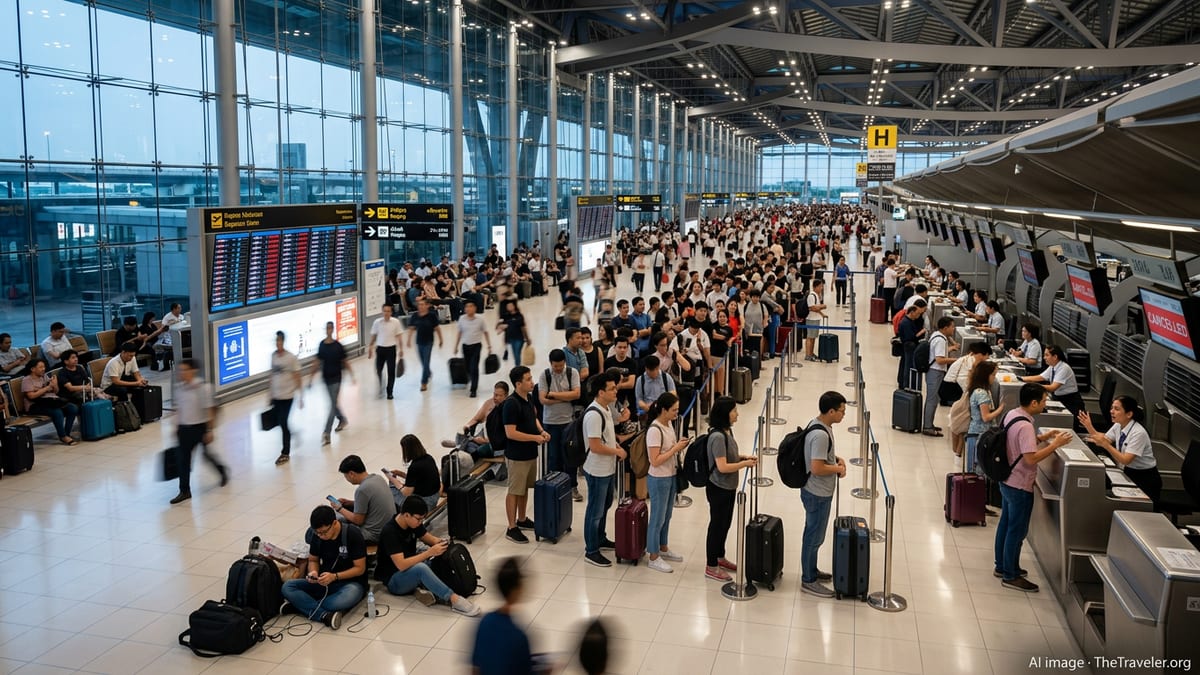
Thousands of travelers across China faced severe disruption today as major hubs in Shanghai, Beijing, Guangzhou, Shenzhen, Chengdu, Xi’an, Nanjing, Changsha, Wuxi and other cities reported 316 flight cancellations and 2,211 delays, snarling domestic and international networks for carriers including Air China, China Eastern, China Southern and Shenzhen Airlines.
Get the latest news straight to your inbox!
Major Hubs Buckle Under Widespread Disruption
Publicly available flight-tracking data for today indicates that China’s largest airports are experiencing one of their most challenging operating days of the season, with cancellations and delays concentrated at tier-one hubs. Shanghai’s dual airports, Pudong and Hongqiao, along with Beijing Capital and Beijing Daxing, are seeing sustained knock-on disruptions as aircraft and crew rotations fall out of sync.
Guangzhou Baiyun and Shenzhen Bao’an in the Pearl River Delta, both critical for domestic and regional routes, are also reporting elevated irregular operations. The combined impact from these hubs is rippling across the system, causing secondary delays at inland airports and smaller coastal cities that depend on feed from the big four gateways.
According to aggregated industry tallies, the 316 cancellations and 2,211 delays reported across Chinese airports today sit within a broader pattern of mounting disruption observed since late March 2026, when regional flight problems began intensifying across Asia. Aviation analysts note that China has repeatedly appeared among the hardest-hit markets in these spikes.
While precise conditions vary by airport and time of day, the scale of disruption suggests that large numbers of passengers are facing missed connections, extended terminal waits and last-minute changes to routing as airlines attempt to reposition aircraft and protect priority services.
Network Impact From Shanghai, Beijing, Guangzhou and Shenzhen
Shanghai, Beijing, Guangzhou and Shenzhen function as the backbone of China’s aviation grid, linking inland centers such as Chengdu, Xi’an, Nanjing and Changsha with international routes across Asia, the Middle East and beyond. When these hubs experience simultaneous disruption, the consequences quickly spread throughout the domestic network.
Published operational data and recent coverage of regional disruption show that flights on core trunk routes such as Beijing to Shanghai, Beijing to Guangzhou and Shanghai to Shenzhen are particularly vulnerable to knock-on effects when congestion builds. Even relatively short delays early in the operating day can propagate into lengthy holdups for evening departures as aircraft struggle to get back on schedule.
Air China, China Eastern and China Southern all rely heavily on these corridors to funnel passengers into long-haul services, while Shenzhen Airlines and several low-cost and regional operators depend on punctual turns at key hubs to maintain high aircraft utilization. Today’s combination of cancellations and rolling delays is therefore likely to be affecting both point-to-point travelers and those booked on multi-sector itineraries.
For passengers, the practical impact is often felt far from the original disruption. A delayed departure from Xi’an or Wuxi, for instance, can cause missed onward flights in Shanghai or Beijing, forcing rebookings that may not depart until the following day during peak travel periods or when capacity is tight on popular routes.
Secondary Cities Feel the Ripple Effect
Beyond the headline hubs, inland and secondary airports including Chengdu, Xi’an, Nanjing, Changsha and Wuxi are also reporting unusually high numbers of delayed departures and arrivals today. These cities serve as important connectors between interior provinces and the coastal megacities, and they can quickly become bottlenecks when upstream hubs are constrained.
Recent industry reporting on China’s early April operations highlights how disruption at a handful of major hubs has translated into waves of delays at airports such as Shenyang, Wuhan, Kunming and others, underscoring the interconnected nature of the country’s domestic network. Today’s figures suggest that a similar pattern is unfolding, with aircraft and crew shortages cascading along popular inland routes.
Travelers departing from or arriving into these secondary airports may encounter repeated schedule changes as airlines attempt to consolidate lightly booked flights, swap aircraft types or reroute services via less congested hubs. In some cases, same-day connections are being replaced with overnight stays when onward seats are unavailable.
Such patterns also complicate airport operations on the ground. Baggage handling, immigration lines for international segments and airport ground transport can all become saturated when multiple delayed flights arrive within compressed time windows, increasing the risk of further missed connections and traveler frustration.
What Today’s Turmoil Means for Airlines and Passengers
The sharp rise in cancellations and delays across China today comes on top of several weeks of heightened irregular operations across Asia, as documented by multiple aviation data providers and financial analyses of the sector. These reports describe a cumulative effect in which each new wave of disruption compounds earlier bottlenecks in aircraft maintenance, crew scheduling and airport capacity.
For carriers such as Air China, China Eastern, China Southern and Shenzhen Airlines, sustained periods of schedule instability can drive up operating costs through fuel burn on extended taxi and holding patterns, repositioning flights, crew overtime and passenger care obligations. At the same time, the reliability of their networks is closely watched by corporate clients and tour operators planning itineraries for the peak summer season.
Passengers facing disruption today are broadly encountering the same challenges documented in recent coverage of Asia-wide flight problems: long customer service queues for rebooking, limited spare capacity on alternative departures, and uncertainty over reimbursement for hotels, meals and missed onward arrangements. Consumer advocates generally advise travelers to retain receipts, document delay notifications and review the conditions of carriage and travel insurance policies once immediate journeys are stabilized.
While many flights are still operating, today’s figures highlight the value of proactive planning for anyone traveling within or through China in the current environment. Monitoring flight status frequently, building longer connection times into itineraries and considering earlier departures where feasible can help reduce the risk of becoming stranded when large-scale disruption sweeps through the network.