

More news on this day
Thousands of passengers across China are facing severe disruption as major airports in Beijing, Chengdu, Guangzhou, Shenzhen, Hangzhou, Kunming and other cities report 1,595 flight delays and 124 cancellations, snarling operations at China Southern, Air China, China Eastern, XiamenAir and several other carriers.
Get the latest news straight to your inbox!
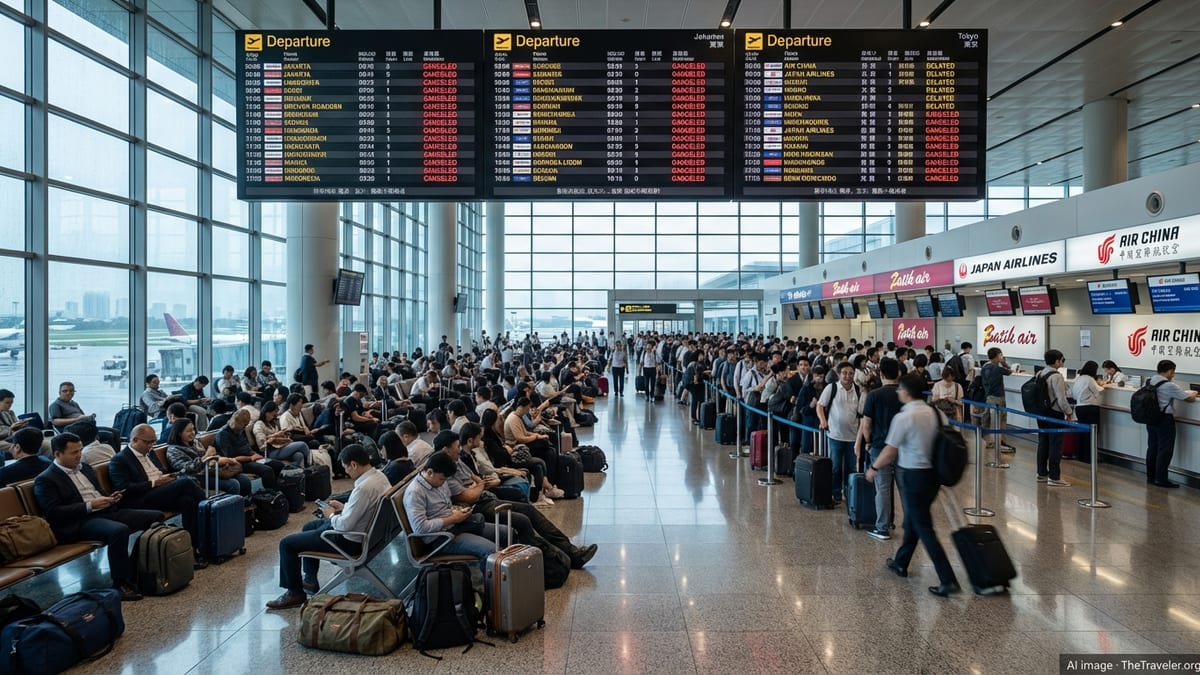
Major Chinese Hubs Log Heavy Delays and Cancellations
Publicly available aviation data and aggregated flight tracking figures for early April 2026 indicate that China’s dense domestic network is experiencing a fresh wave of operational disruption, concentrated at large coastal and inland hubs. Across key airports including Beijing, Chengdu, Guangzhou, Shenzhen, Hangzhou and Kunming, at least 1,595 flights have been delayed and 124 cancelled over a short window, leaving terminals crowded with stranded travellers.
Recent coverage focused on China’s aviation performance notes that similar patterns of disruption in recent days have already produced hundreds of cancellations and well over 1,700 delays at major hubs such as Beijing Capital, Shanghai Pudong, Shenzhen Bao’an and Guangzhou Baiyun. These figures suggest that the latest tally is consistent with a continuing period of elevated irregular operations rather than an isolated incident.
Reports describe departure boards across multiple airports dominated by late departures and rolling gate changes, as aircraft and crews fall out of position. With limited spare capacity in peak travel periods, these delays and cancellations ripple outward, affecting flights far beyond the initial problem airports and extending disruption into the late evening.
While the precise breakdown at each airport varies by day, earlier data from the same week highlights Guangzhou Baiyun and Shenzhen Bao’an among the hardest hit, along with Beijing’s dual airports and large secondary cities such as Hangzhou and Chengdu. This week’s figures for 1,595 delays and 124 cancellations across Chinese hubs align with that broader regional pattern of stress on the system.
China Southern, Air China and China Eastern Under Strain
The disruptions are placing particular pressure on China’s big three state owned carriers: China Southern Airlines, Air China and China Eastern Airlines. These airlines dominate domestic traffic flows through Guangzhou, Beijing and Shanghai respectively, and are heavily represented in delay and cancellation statistics compiled from airport departure boards and third party tracking platforms.
Coverage of recent irregular operations shows China Southern leading daily delay counts on some days, notably at Guangzhou Baiyun and Shenzhen Bao’an. With many of the affected flights operating trunk routes between Guangzhou, Shenzhen, Beijing, Chengdu and other large hubs, knock on effects can quickly impact connecting services across the network, including flights to secondary cities and international destinations.
Air China and China Eastern report similar challenges on core domestic sectors linking Beijing and Shanghai with other major cities. Historic performance data for these airlines already shows sensitive routes such as Beijing to Shenzhen and Guangzhou to Beijing as vulnerable to congestion related delays. When severe weather or air traffic control restrictions are introduced, on time performance on these routes can deteriorate rapidly.
Smaller and regional carriers are also caught in the disruption. Airlines such as XiamenAir, Zhejiang Loong and Dalian Airlines have previously been named among those affected when nationwide figures show dozens of cancellations and more than 1,700 delays in a single day. As they typically operate thinner schedules with fewer spare aircraft, even a small number of cancellations can leave passengers with limited immediate rebooking options.
Weather, Congested Skies and Systemic Vulnerabilities
Recent analyses of Asia Pacific aviation performance point to a combination of factors driving the latest wave of disruption. Periodic bouts of severe weather, including thunderstorms around Shanghai and strong winds in northern China, have contributed to departure restrictions and temporary ground stops at key hubs in the first days of April 2026.
One detailed report on Shanghai Pudong describes how a line of thunderstorms combined with an air traffic control system outage forced a halt to departures for several hours on April 5, triggering hundreds of cancellations and thousands of delays across several countries. With Chinese hubs already among the world’s busiest, any prolonged interruption to take offs or landings quickly results in queues of aircraft on the ground and in the air.
China’s airspace structure further complicates recovery. Large portions of upper airspace remain reserved for non civilian use, concentrating commercial routes into narrow corridors. When weather systems move through these corridors, controllers have fewer options to reroute traffic, increasing the likelihood of flow restrictions and extended holding patterns for inbound flights.
Industry commentary suggests that regulators are moving ahead with technology upgrades, including satellite based navigation and communication systems at major hubs such as Shanghai and Beijing, with implementation targeted over the next several years. However, these improvements will take time to deliver significant resilience gains, leaving passengers exposed to further bouts of disruption in the near term.
Passenger Experience and Knock On Travel Impacts
For travelers on the ground, the numbers translate into long queues at check in, customer service desks and security, along with crowded gate areas and scarce seating. Published images from recent days show congested terminals at several Chinese airports as passengers wait for information on rebooking and compensation, with some forced to spend extended periods in terminals.
Domestic passengers connecting to international services are among those most severely affected. Delays on internal routes from cities such as Urumqi, Chengdu and Hangzhou into coastal hubs can cause travelers to miss long haul departures to Europe, North America and Southeast Asia. Publicly available reports from travel industry outlets note instances where hotel vouchers have been exhausted by midday, forcing airlines and airports to look for alternative arrangements.
The disruption also spills into the wider tourism and business ecosystem. On previous days with similar levels of disruption, Chinese destinations such as Xi’an, Chengdu and Hangzhou have reported missed or postponed hotel stays, tour departures and restaurant reservations tied to delayed arrivals. For business travelers, missed meetings and rescheduled itineraries add to the cost and stress of already complex journeys.
Chinese consumer regulations generally entitle passengers on airline initiated cancellations to either a rebooked flight or a refund, and airlines often provide meal vouchers or accommodation when overnight stays become unavoidable. In practice, however, the scale of disruption on days with more than 1,500 delays and over 100 cancellations can overwhelm available staff and inventory, making it difficult to deliver assistance promptly to everyone affected.
What Travelers Should Watch in the Coming Days
Travel industry guidance in light of this latest disruption wave emphasizes preparation and flexibility for anyone flying into, out of or within China over the coming days. Aggregated aviation data for the region shows that once a system wide disturbance takes hold, recovery can take more than 24 hours, as aircraft and crews gradually return to their scheduled rotations.
Passengers are advised by public travel advisories and airline communications to monitor flight status frequently through airline apps and airport information channels, and to allow additional time at the airport for check in and security. For itineraries involving tight domestic to international connections, some experts recommend considering longer connection windows or even overnight stays when feasible.
Travel planners and corporate travel managers are also paying close attention to evolving conditions at Shanghai, Beijing, Guangzhou and Shenzhen, which function as critical gateways for both business and leisure trips. If weather systems forecast for the coming days intersect with peak departure periods, similar disruption figures to the current tally of 1,595 delays and 124 cancellations cannot be ruled out.
As China continues to rebuild international connectivity and expand domestic capacity, the latest episode serves as another reminder of the fragility of densely scheduled hub and spoke networks. For now, travelers moving through China’s skies may need to plan for occasional extended waits on the ground as the aviation system works to absorb and recover from shocks.