

More news on this day
Thousands of air travelers were left in limbo across China today as a new wave of flight disruption hit major hubs including Shanghai, Beijing, Xi’an, Guangzhou and Chengdu, with publicly available aviation data indicating at least 87 cancellations and around 100 significant delays affecting services on leading carriers such as China Eastern, Air China, China Southern and XiamenAir.
Get the latest news straight to your inbox!
Fresh Disruptions Hit China’s Busiest Aviation Corridors
The latest operational snarl comes on the heels of several days of heavily disrupted schedules across Asia, with flight-tracking platforms and industry outlets pointing to another difficult day for mainland travelers. Aggregated data for Chinese airports shows dozens of services scrubbed and many more delayed, disrupting carefully planned itineraries at some of the country’s most important domestic and international gateways.
Shanghai’s dual-airport system and Beijing’s twin hubs feature prominently in today’s figures, with cancellations and late departures concentrated on trunk routes linking the capital region with coastal and interior centers. Xi’an, Guangzhou and Chengdu, all central nodes in China’s fast-expanding domestic network, are also reporting knock-on impacts, as late-arriving aircraft and crew shortages ripple through the system.
Travel-focused outlets tracking the situation describe departure boards dominated by “late” and “rescheduled” tags across a broad mix of regional and long-haul services. Passengers on early-morning and late-evening departures appear particularly affected, as airlines and air traffic controllers attempt to compress operations into windows of more favorable conditions.
The pattern aligns with disruption seen over recent days, where the overall number of cancellations remained lower than during historic shutdowns, but delays were widespread enough to strand connecting travelers in large numbers across multiple hubs.
Major Chinese Carriers at the Center of the Turmoil
China Eastern, Air China and China Southern, together with XiamenAir and several regional partners, are bearing much of the operational strain. Publicly available statistics for these airlines already show high daily volumes of delayed services in early April, and today’s wave of cancellations adds further stress to networks that are closely intertwined across major hubs.
China Eastern, with its core bases at Shanghai’s airports and strong presence in Xi’an and other interior cities, is particularly exposed when weather or congestion affects eastern China. Air China’s leading role at Beijing’s two hubs, along with its reach into Chengdu and other western gateways, places it in the center of current disruption patterns. China Southern, anchored in Guangzhou and with extensive services into central and western China, faces similar challenges as aircraft and crews fall out of position when earlier flights run late.
XiamenAir, which operates dense schedules from coastal cities including Xiamen and serves Shanghai, Guangzhou and other hubs, is also listed among carriers with disrupted services today. Reports indicate a mixture of point-to-point cancellations and extended delays, with some flights held at gates or in departure queues as airports juggle changing conditions.
Industry coverage notes that, even when the absolute number of cancellations remains in the double digits, the interconnected nature of these large domestic networks can quickly magnify the impact, particularly for travelers relying on same-day connections between northern, central and southern China.
Weather, Congestion and Structural Pressures Combine
Recent reporting from regional travel publications highlights a confluence of factors behind the current turbulence, including unsettled early-spring weather in several Chinese provinces, chronic airspace congestion and tight scheduling at fast-growing hubs. Storm systems affecting parts of Guangdong and Sichuan, along with more marginal conditions further north, have already triggered dozens of cancellations and hundreds of delays in recent days.
Publicly available meteorological updates and aviation data suggest that many of today’s issues again relate to weather-driven air traffic control restrictions, compounded by busy holiday-period traffic and infrastructure operating close to capacity at peak times. When holding patterns, reroutings or temporary ground stops are introduced for safety reasons, airlines have limited room in their schedules to recover, especially on short-haul domestic routes with rapid turnarounds.
These operational pressures are unfolding against a backdrop of rising costs for Chinese carriers, including recently announced increases in domestic fuel surcharges by several major airlines. While higher surcharges are primarily a financial measure, analysts note that they underscore the challenging operating environment for airlines already managing thin margins, complex route networks and elevated passenger expectations after the reopening of international travel.
Travel-industry commentary emphasizes that, although weather and air traffic constraints are the immediate triggers, the scale of disruption illustrates the sensitivity of China’s aviation system to any shock, with even a single day of adverse conditions creating backlogs that can take days to fully resolve.
Scenes at Shanghai, Beijing, Xi’an, Guangzhou and Chengdu
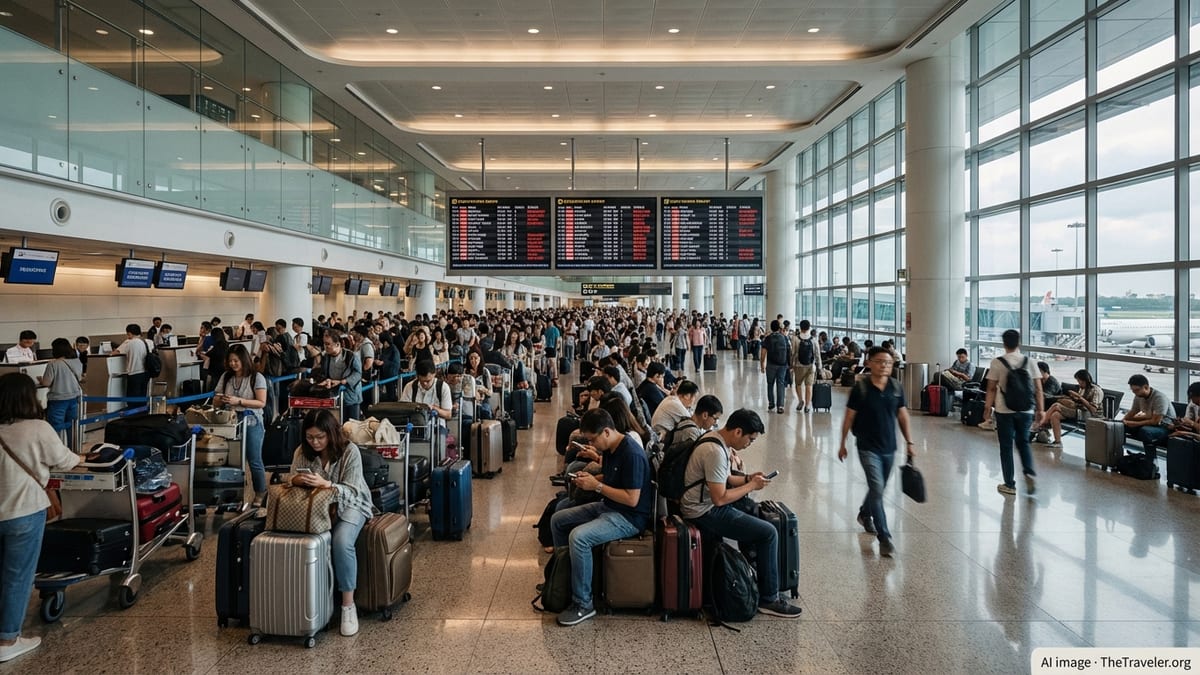
Across affected hubs, images and descriptions shared by local media and travel observers depict crowded departure halls, improvised queues at customer-service desks and long lines at self-service kiosks as travelers attempt to rebook. At Shanghai Pudong and Hongqiao, passengers waiting near heavily disrupted domestic gates have been reported sitting on the floor with luggage repacked and boarding passes repeatedly reissued.
In Beijing, where traffic is split between Capital and Daxing airports, disruption appears to be centered on dense shuttle routes linking the capital with Shanghai, Guangzhou, Shenzhen, Chengdu and Xi’an. Publicly visible flight-status boards show clusters of delayed services on these corridors, affecting both business travelers and tourists moving between key regions.
Guangzhou and Chengdu, major hubs for China Southern and important bases for other carriers, are again featuring in disruption metrics after already seeing heavy delay days earlier in the month. Xi’an, a crucial junction for central and western China, is experiencing secondary impacts as aircraft arrive late from coastal hubs and onward departures are pushed back or consolidated.
While many services are still operating, the concentration of delays at specific times of day has left thousands of travelers facing extended waits, missed connections and unscheduled overnight stays, especially for those without flexible tickets or alternative routing options.
What Today’s Chaos Means for Future China Travel
For international and domestic travelers planning trips through China’s major hubs in the coming weeks, today’s events serve as a reminder of the importance of building resilience into itineraries. Travel experts and recent case studies from similar disruption days point to longer layovers, earlier departures on critical travel days and flexible hotel and ground-transport bookings as practical ways to reduce risk.
Some analysis of recent operations suggests that secondary hubs can occasionally offer more stable performance during peak disruption, though this varies by day and by route. However, because carriers such as China Eastern, Air China, China Southern and XiamenAir concentrate their capacity at primary gateways, many travelers will continue to funnel through Shanghai, Beijing, Guangzhou and Chengdu, making robust contingency planning especially important at these airports.
Passenger-rights frameworks on the Chinese mainland differ from those in regions with more prescriptive compensation rules, and publicly available guidance indicates that weather-related issues are often classified as outside airline control. Even so, carriers frequently provide hotel rooms, meal vouchers or free rebooking in cases of severe disruption, though the level of support can depend on the specific circumstances and load conditions at the time.
With forecasts indicating further unsettled weather in parts of China and neighboring countries, aviation observers expect continued periods of strain on airline operations and airport infrastructure. For now, thousands of travelers caught up in today’s cancellations and delays are focused on a more immediate goal: securing the next available seat to their intended destination.