

More news on this day
Thousands of travellers were left in airport terminals across China today as new data showed dozens of cancellations and around one hundred delays affecting major carriers at some of the country’s busiest hubs, including Shanghai, Beijing, Xi’an, Guangzhou and Chengdu.
Get the latest news straight to your inbox!
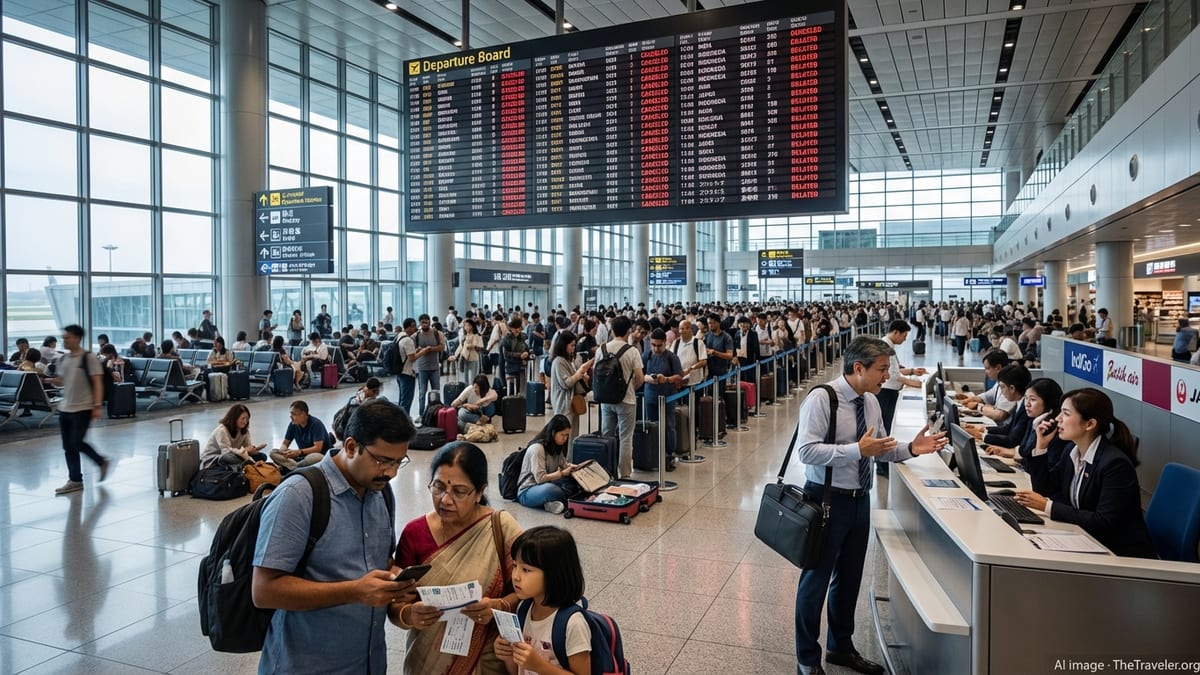
Fresh Wave of Disruptions Hits China’s Major Hubs
Publicly available aviation tracking data for early April indicates a new round of flight disruption across mainland China, with at least 87 cancellations and roughly 100 delays concentrated at key airports. The latest figures point to knock-on effects for passengers connecting through Shanghai’s dual airports, Beijing Capital and Daxing, Guangzhou Baiyun, Chengdu’s twin hubs and Xi’an Xianyang.
The impact has fallen heavily on the country’s largest carriers, including China Eastern, Air China, China Southern and XiamenAir, alongside several regional and affiliate airlines. Reports from Chinese and international travel news outlets describe crowded departure halls, long rebooking queues and passengers waiting hours for updated departure times as aircraft and crew are repositioned.
Today’s disruption follows a week of irregular operations across the domestic network, during which earlier data snapshots showed waves of cancellations and delays rippling through secondary hubs such as Nanjing, Changsha and Kunming as well as the primary coastal gateways. The cumulative effect has been to leave thousands of travellers facing missed connections, overnight stays and abandoned itineraries.
While the number of affected flights remains a fraction of the country’s total daily movements, the pattern has been highly concentrated at a handful of large airports that handle dense banks of connecting traffic. This has magnified the disruption for individual passengers, especially those relying on tight transfer windows.
Weather, Congestion and Operational Strain Converge
Available reporting from flight data services and regional travel media links the latest cancellations and delays to a familiar combination of factors: unstable spring weather, airspace constraints and wider operational strain in a system running close to capacity. Recent analyses of conditions over Guangdong, Sichuan and other populous provinces highlight thunderstorms, low cloud and poor visibility periodically reducing arrival and departure rates.
When bad weather constrains runway throughput at airports such as Guangzhou Baiyun, Chengdu Tianfu or Shanghai Pudong, airlines are often forced to hold, reroute or ground flights, creating a backlog that can take hours to clear even after skies improve. In parallel, air traffic management restrictions on certain routes add further complexity, limiting the ability of carriers to recover their schedules quickly once disruption sets in.
Operationally, tighter aircraft and crew rotations across China’s big three airline groups mean that a delay or cancellation on one sector can reverberate through multiple subsequent flights. Travel-industry coverage of recent days notes that China Eastern, Air China and China Southern have all appeared prominently in delay and cancellation tallies during these weather-affected periods, a reflection of their scale and dominance at key hubs.
Analysts following the region’s aviation performance suggest that, while today’s figures are not unprecedented, they underline how vulnerable tightly timed domestic banks remain to any combination of storms, congestion and logistical setbacks as the peak spring travel period approaches.
Shanghai, Beijing, Guangzhou, Chengdu and Xi’an Bear the Brunt
Within today’s disruption pattern, Shanghai and Beijing stand out as focal points. Shanghai Pudong and Hongqiao together form one of Asia’s busiest dual-airport systems, and even a limited number of cancellations can cascade through domestic and international connections. Flight-monitoring snapshots show China Eastern, which has a major presence in Shanghai, and Air China among the airlines most affected at these airports.
In the capital, both Beijing Capital and the newer Daxing airport have reported clusters of cancellations and delays, affecting services to and from cities such as Xi’an, Chengdu, Guangzhou and Xiamen. As passengers miss onward connections at these hubs, reports indicate growing queues at transfer desks, with some travellers opting to abandon their original itineraries in favor of high-speed rail or later flights.
Further south, Guangzhou Baiyun and Chengdu’s Tianfu and Shuangliu airports have experienced their own bottlenecks, with southern weather systems and air traffic flow measures slowing operations. Xiamen, Nanjing and other coastal and central cities are also appearing in recent disruption tallies, reflecting how network effects are spreading the impact well beyond the largest metropolises.
Xi’an Xianyang, a crucial link between eastern, central and western China, has featured in prior days’ delay statistics and is again seeing knock-on disruption. Passengers scheduled on China Eastern, China Southern and XiamenAir services through Xi’an have reported extended waits and schedule changes as aircraft arrive late from already delayed inbound legs.
Passengers Confront Long Waits and Limited Options
For travellers on the ground, today’s figures translate into long lines at check-in counters and service desks, crowded boarding areas and uncertainty about when journeys will resume. Visuals shared by local media and travel outlets over recent days show travellers stretched out on terminal benches and clustered around information screens as flight departure times shift repeatedly.
Consumer travel advisories circulating alongside the disruption encourage passengers to keep all documentation, including boarding passes and written confirmation of delays or cancellations, to help with any later refund or rebooking claims. Some guidance also recommends requesting formal delay or cancellation certificates from airline counters when possible, a common practice in the Chinese domestic market.
With many cancellations and lengthy delays being linked to weather and air traffic conditions, compensation options can be limited under standard airline policies. However, published passenger-rights guidance and past disruption patterns suggest that carriers may provide meal vouchers, hotel accommodation or free changes in cases of severe or overnight disruption, particularly when large numbers of customers are affected.
In practical terms, travellers are being urged by travel information services to rely on official airline apps and airport channels for the latest updates, to monitor gate changes closely and to act quickly on any rebooking offers. Those connecting to international sectors are being advised to contact their long-haul carriers as soon as delays become apparent, as onward options can sell out rapidly during major disruption events.
Ongoing Volatility Keeps China’s Air Network Under Pressure
The latest cancellations and delays arrive at a time when China’s carriers and airports are already juggling rising demand, seasonal weather swings and cost pressures such as higher fuel surcharges on domestic routes. Earlier this month, several major airlines confirmed adjustments to fuel surcharges, reflecting elevated operating costs across the network and underscoring the delicate balance between capacity, pricing and reliability.
Recent regional tallies of aviation performance show that China’s air network has endured multiple days of heavy disruption since the start of April, both within the country and as part of wider Asia-wide turbulence affecting hubs from Bangkok and Singapore to Delhi. For passengers, today’s events form part of a broader picture of volatility in schedules, one that can turn a seemingly routine domestic connection into an unpredictable, hours-long ordeal.
Industry observers note that, as China moves deeper into the spring travel season, the resilience of airline and airport operations will be closely watched. Any sustained pattern of weather-linked cancellations and delays at major hubs such as Shanghai, Beijing, Guangzhou, Chengdu and Xi’an could prompt further scrutiny of scheduling practices, contingency planning and passenger care standards.
For now, travellers booked on China Eastern, Air China, China Southern, XiamenAir and other carriers serving China’s busiest airports are being encouraged to build additional buffer time into their itineraries, to monitor conditions closely in the 24 hours before departure and to prepare for the possibility that today’s wave of cancellations and delays may not be the last this spring.