

More news on this day
Thousands of travelers across China are facing long queues, overnight waits and missed connections as more than 3,000 flight delays and over 250 cancellations ripple through major hubs including Beijing, Shanghai, Guangzhou, Shenzhen and Xi’an, affecting services on Air China, China Southern, Hainan Airlines and other carriers.
Get the latest news straight to your inbox!
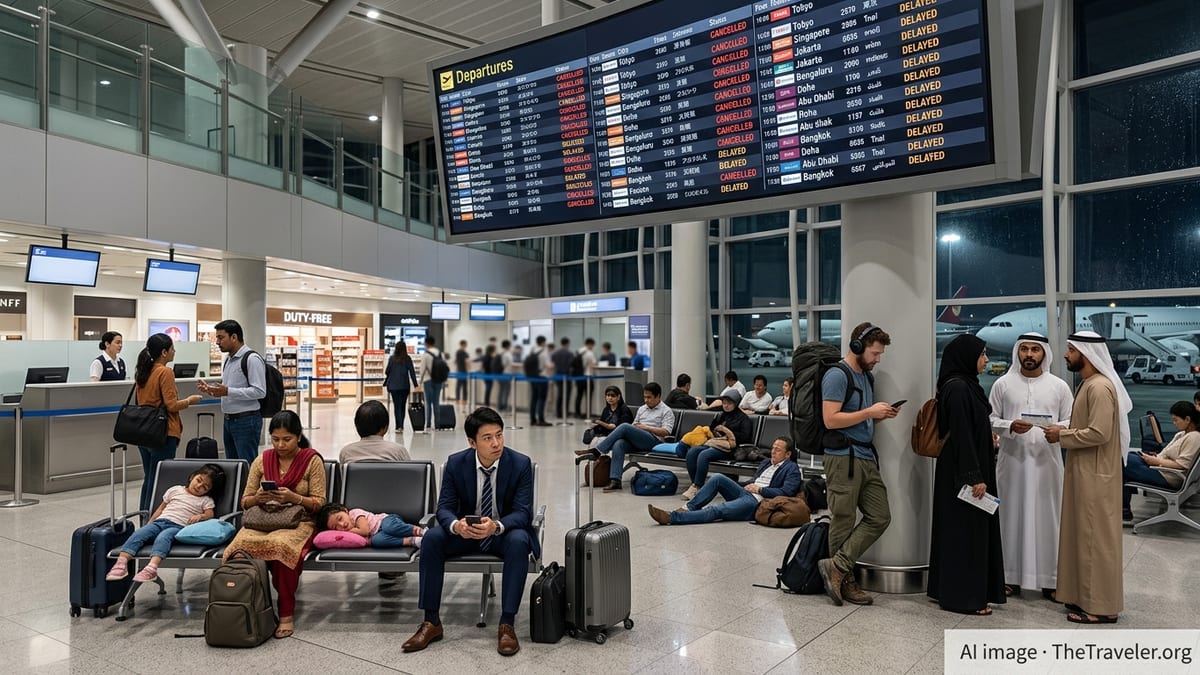
Major Hubs Struggle Under Wave of Disruption
Publicly available flight tracking data and airport monitoring dashboards on April 10 indicate that China’s busiest airports are experiencing a concentrated bout of disruption, with Beijing, Shanghai, Guangzhou, Shenzhen and Xi’an all reporting elevated levels of delays and cancellations. Combined, the data points to more than 3,000 late departures and arrivals and in excess of 250 outright cancellations within a compressed time window, impacting both domestic and regional routes.
At Beijing’s airports and in Shanghai’s dual hub system, knock-on effects are building as delayed inbound aircraft arrive late and then depart behind schedule, creating rolling slippages across the rest of the day’s timetable. Similar patterns are visible in Guangzhou and Shenzhen, where dense short-haul schedules and frequent shuttles to other Chinese cities mean that even relatively short delays can quickly erode available buffer time.
Xi’an, an important connecting point for central and western China, is also seeing a sharp rise in disrupted movements, with services into Shanghai and Beijing particularly prone to late running. As aircraft and crew end up in the wrong place at the wrong time, airlines are cancelling selected rotations outright to restore some stability to their networks.
The net effect for travelers is a patchwork of last-minute gate changes, rolling departure estimates and crowded customer service counters as carriers work within limited spare capacity to rebook affected passengers.
Multiple Airlines Affected Across Domestic Networks
The disruption is spread across a wide range of operators, with national flag carrier Air China, China Southern and Hainan Airlines among those seeing significant schedule pressure. Regional and privately owned airlines that depend on shared airspace and airport slots are also being swept up in the turmoil as congested taxiways and departure queues lengthen turnaround times.
For major airlines with dense domestic networks, the delays are amplifying existing operational challenges. Many carriers entered the spring travel period with high load factors and tight aircraft utilization, leaving little margin to absorb prolonged ground holds or temporary ground stops. When a flight is delayed at a busy hub like Shanghai or Guangzhou, the aircraft involved may be scheduled for two or three more sectors that same day, each of which then risks running late or being cancelled.
Smaller and regional airlines that rely heavily on connections into these key hubs are encountering particular difficulty when their passengers miss onward flights operated by larger partners. Reaccommodation options are limited at peak times, especially on trunk routes between Beijing, Shanghai, Guangzhou and Shenzhen that are already running near capacity in the lead-up to the busy spring and early summer travel season.
Published information from consumer advocates and regulatory summaries also suggests that compensation or care provisions can vary by airline and delay length, leaving some passengers unsure about what assistance they can expect for hotel costs, meals or alternative transport when delays stretch into many hours.
Airspace Restrictions and Weather Add to Bottlenecks
The disruption is unfolding against a backdrop of temporary airspace restrictions along China’s eastern seaboard and over waters off Shanghai, together with localized weather patterns that are constraining capacity at certain times of day. Notices to Air Missions describing multiweek restrictions in coastal sectors have prompted questions among travelers about how many flight paths may be getting funneled into narrower corridors around key hubs.
When controllers must route traffic around closed or restricted blocks of airspace, departure slots can become scarcer and holding patterns more frequent, further eroding punctuality. Even modest thunderstorms, strong crosswinds or low cloud ceilings at one or two critical hubs can then trigger capacity cuts that reverberate widely through tightly interconnected domestic schedules.
Operational data from Chinese civil aviation authorities in recent months has highlighted both strong overall growth in flight numbers and a continued focus on safety and compliance. The combination of a busier sky, constrained airspace and volatile spring weather is making it harder for airlines and airports to maintain on-time performance on days when several factors collide.
Travel industry analysts note that as China’s aviation system ramps up toward peak summer levels, short-term supply constraints in air traffic management and airport infrastructure are likely to remain a recurring source of stress whenever additional shocks such as military activity, large-scale exercises or regional storms arise.
Travel Demand Surges After Holiday and Fare Changes
The current wave of disruption is intersecting with heightened travel demand following the early April Qingming holiday period and in advance of the Labour Day public holiday at the start of May. Booking platform data published this week indicates that reservations for the Labour Day window have risen sharply year on year, reflecting both pent-up demand and increased willingness among Chinese travelers to fly longer distances for short breaks.
Recent fare and fuel surcharge adjustments on domestic routes have not dampened this demand significantly, according to coverage in regional media. Some frequent travelers reportedly chose to stockpile tickets ahead of price increases, which has further concentrated journeys into popular corridors linking major economic and tourism centers.
As a result, flights on key city pairs such as Beijing to Shanghai, Guangzhou to Shenzhen and Xi’an to coastal destinations are operating at high load factors. When disruptions occur, the lack of empty seats on alternative departures makes same-day rebooking more challenging, particularly for families or groups trying to travel together.
The convergence of full flights, surcharges and operational hiccups is leaving many passengers with limited flexibility to switch to different departure times or nearby airports, intensifying frustration when cascading delays stretch into the late evening and early morning hours.
What Stranded Passengers Are Being Advised to Do
Public guidance from travel agencies, passenger rights organizations and aviation commentators is urging travelers affected by the disruption to monitor airline apps and airport information screens closely, rather than relying solely on printed boarding passes or earlier departure times. Same-day schedule changes are common when major hubs are congested, and boarding can sometimes commence quickly once a delayed aircraft finally arrives at the gate.
Travel advisers also recommend keeping all boarding passes, receipts and records of expenses incurred during delays, such as meals or overnight accommodation, in case compensation or reimbursement claims can be pursued later under airline policies or local regulations. Passengers whose journeys involve tight connections are being encouraged to contact airlines as early as possible once significant delay becomes likely, as rebooking options shrink rapidly as the day progresses.
For travelers with upcoming itineraries through Beijing, Shanghai, Guangzhou, Shenzhen or Xi’an, current advice is to allow extra time at the airport, consider earlier departures where practical and build in longer connection windows, especially when connecting to international services. Those with flexibility in their plans may benefit from checking alternative airports within the same region, though surface travel times and local transport options need to be weighed carefully.
While conditions may ease as weather patterns shift and airspace restrictions are adjusted, the latest episode underscores how quickly disruptions at a handful of strategic hubs in China can spread across the wider domestic network, leaving thousands of travelers facing hours of uncertainty on any given day.