

More news on this day
Travelers moving between China and key Gulf and Asian hubs are facing a fresh wave of disruption, as more than 40 passenger and cargo flights have been cancelled or rerouted, affecting services operated by Gulf Air, China Cargo and several other carriers on routes linking Bahrain, Chengdu, Hong Kong, Shanghai and additional cities.
Get the latest news straight to your inbox!
Regional Airspace Turmoil Spills Into China Routes
Publicly available flight tracking data and airline notices indicate that a rolling series of airspace restrictions across parts of the Middle East has pushed fresh turbulence into China-linked networks. Bahrain’s airspace closure in particular has removed a critical waypoint for services that typically bridge East Asia and the Gulf, forcing airlines to cancel, consolidate or reroute flights at short notice.
China-bound and China-origin services that would normally overfly Gulf corridors are instead taking longer detours or being suspended outright when viable alternate routings are not available. This has resulted in a cluster of cancellations that now exceeds 40 flights over recent days, encompassing both passenger operations and dedicated freighters.
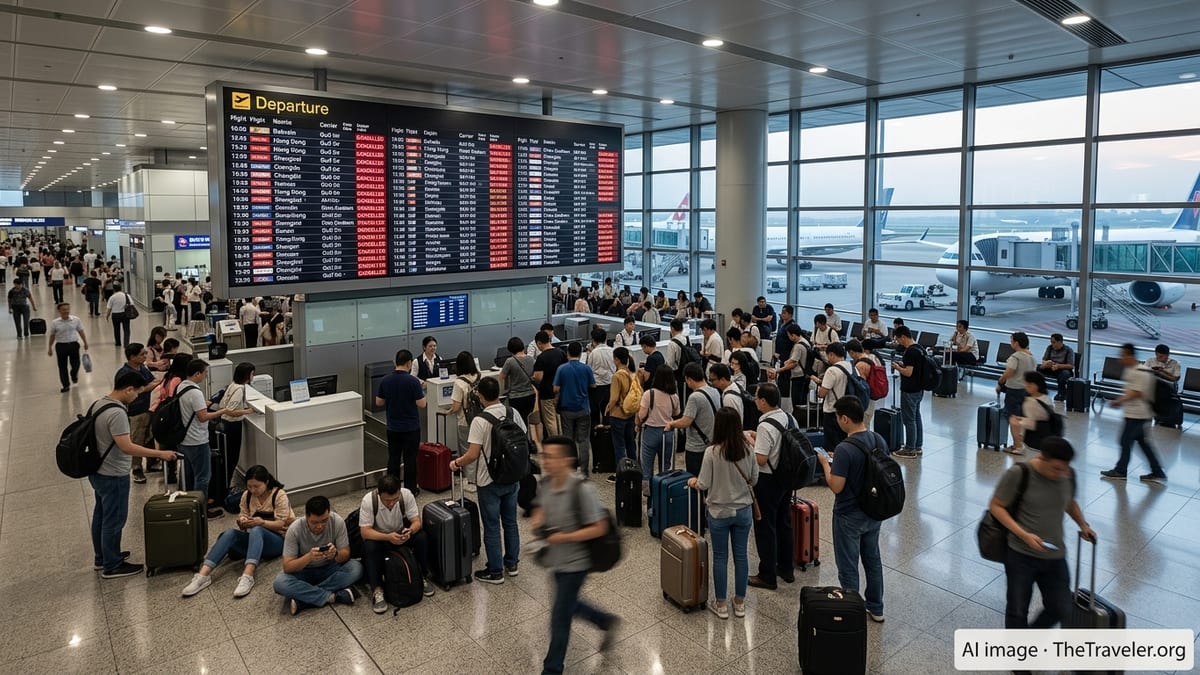
The knock-on effect is most visible on routes connecting Bahrain with major Chinese gateways and regional hubs such as Hong Kong and Shanghai, where schedules have been thinned and some rotations have been temporarily pulled. Travelers report crowded departure halls, rolling delay announcements and last-minute rebookings as carriers attempt to stitch together revised operating plans.
Aviation analysts say the pattern fits a broader reshaping of long-haul networks whenever a key corridor is disrupted: airlines scale back the most operationally complex sectors first, often those involving multiple overflight permits or tightly timed cargo connections, before gradually rebuilding frequencies once a level of predictability returns.
Gulf Air and China Cargo Among Affected Carriers
Gulf Air, Bahrain’s flag carrier, has been among the hardest hit. Public advisories and booking data show that the airline’s scheduled services to and from Bahrain have been sharply curtailed while the country’s airspace remains restricted, with ripple effects on connecting flows between the Gulf and Asia. Travelers attempting to book near-term itineraries involving Bahrain and Chinese cities report limited availability or complete absence of bookable seats on some dates.
Cargo operators have not been spared. China Cargo and other freight-focused airlines serving Shanghai Pudong, Chengdu and Hong Kong are adjusting schedules as they navigate longer routings that bypass sensitive airspace and contend with slot constraints at already busy Chinese gateways. In some cases, entire rotations have been scrapped when extended flight times render crews and aircraft unavailable for follow-on legs.
The cancellations are particularly disruptive on high-value corridors that usually rely on precise timing to link factory output in mainland China with distribution centers in the Gulf. Bahrain’s role as a transshipment and logistics node means that when its hub is disrupted, both passenger itineraries and freight movements between China and multiple Gulf states can be simultaneously affected.
Industry observers note that while some carriers have maintained a skeleton schedule using alternate routings, many have opted to proactively cancel selected services rather than operate heavily delayed flights that risk compounding crew and aircraft imbalances across their networks.
Impact on Chengdu, Hong Kong and Shanghai Hubs
China’s own gateway airports are absorbing much of the operational strain. Chengdu, an emerging long-haul hub in western China, has seen irregularities on services connected to the Gulf, with passengers facing day-of-travel changes, downgauged aircraft and occasional cancellations as airlines rotate capacity to more stable markets.
Hong Kong, one of Asia’s largest international aviation hubs, sits at the crossroads of several affected routes. Published schedules show a dense web of connections between Hong Kong and destinations such as Bahrain, Shanghai and Chengdu, supported by a mix of passenger and cargo operators. When Gulf-facing flights are withdrawn or retimed, it can undercut the connectivity that underpins Hong Kong’s role as a transfer point for both travelers and freight.
Shanghai, particularly Pudong International Airport, remains a cornerstone of China’s intercontinental network and a major cargo gateway. Disruptions to flights linking Shanghai with the Gulf and beyond have led to temporary gaps in service, especially on overnight and early-morning departures that typically feed into Europe and Middle East banks. Airlines are juggling scarce widebody capacity, sometimes consolidating multiple flights into a single rotation and cancelling others outright.
Operational documents and airport bulletins suggest that Chinese airports are coordinating closely with carriers to reallocate slots and manage peak-hour congestion created when rerouted long-haul flights bunch into similar arrival windows. For travelers, this often translates into longer queues, revised departure times and a higher risk of missed connections on multi-leg journeys.
Knock-On Effects for Passengers and Cargo Shippers
For passengers, the immediate impact is a familiar mix of uncertainty and inconvenience. Reports from affected airports describe travelers being advised to remain in terminals while airlines assess airspace conditions and crew availability, with some flights ultimately scrapped after hours of rolling delays. Rebooking options can be limited, particularly for those traveling between secondary Chinese cities and niche Gulf destinations that typically see only a handful of weekly flights.
Travelers with itineraries involving Bahrain, Chengdu, Hong Kong or Shanghai are being urged by travel agents and consumer advocates to monitor their bookings frequently, ensure contact details are up to date with airlines, and consider allowing extra buffer time for critical connections. Flexible tickets and travel insurance with disruption coverage are proving especially valuable for those needing to make last-minute itinerary changes.
Cargo shippers face a different set of challenges. Logistics providers report that some China to Gulf air freight is being moved to alternative routings via other Asian or European hubs, adding time and cost. Space constraints on remaining flights have pushed up spot rates on certain lanes, while time-sensitive shipments such as electronics and spare parts are being prioritized over less urgent cargo.
The combination of cancelled freighter operations and reduced bellyhold capacity on passenger flights has tightened supply chains that were already contending with periodic congestion. Businesses that rely on just-in-time deliveries from Chinese manufacturers to Gulf markets are reassessing inventories and, in some cases, shifting urgent loads to premium express services where flights are still operating.
What Travelers Should Watch in the Coming Days
With airspace conditions and airline schedules changing quickly, the situation remains fluid. Aviation authorities in multiple jurisdictions continue to update routing guidance and overflight permissions, and airlines are adjusting timetables in response. Industry specialists suggest that the overall number of cancellations could fluctuate from day to day as carriers test new routings or restore selected services when operationally feasible.
Travelers planning trips that involve Bahrain or connections through major Chinese hubs such as Chengdu, Hong Kong and Shanghai are advised to pay close attention to departure airport information screens and airline status tools in the days leading up to travel. Same-day schedule changes have been common during this disruption, particularly on long-haul flights that depend on stable overflight corridors.
Experts in airline operations note that once airspace restrictions begin to ease, carriers typically move in phases: first stabilizing core trunk routes, then gradually rebuilding secondary links and cargo-only flights. That means services cut in the initial wave of more than 40 cancellations may not reappear immediately, even if some long-haul traffic resumes using modified routings.
For now, the key message for both leisure and business travelers is to build flexibility into plans involving China and the Gulf. As airlines including Gulf Air, China Cargo and other regional operators continue to recalibrate their schedules, disruptions are likely to persist, and the routes linking Bahrain with major Chinese gateways will remain under particular pressure.