

More news on this day
Hundreds of air passengers across China are facing prolonged travel disruption as at least 278 flight delays and 24 cancellations were recorded at major hubs including Shanghai, Shenyang, Chongqing, Kunming and Nanjing, affecting services operated by Spring Airlines, China Express, China Eastern, China Southern, Jiangxi Air and several other domestic carriers, according to live tracking data and local media summaries on March 22.
Get the latest news straight to your inbox!
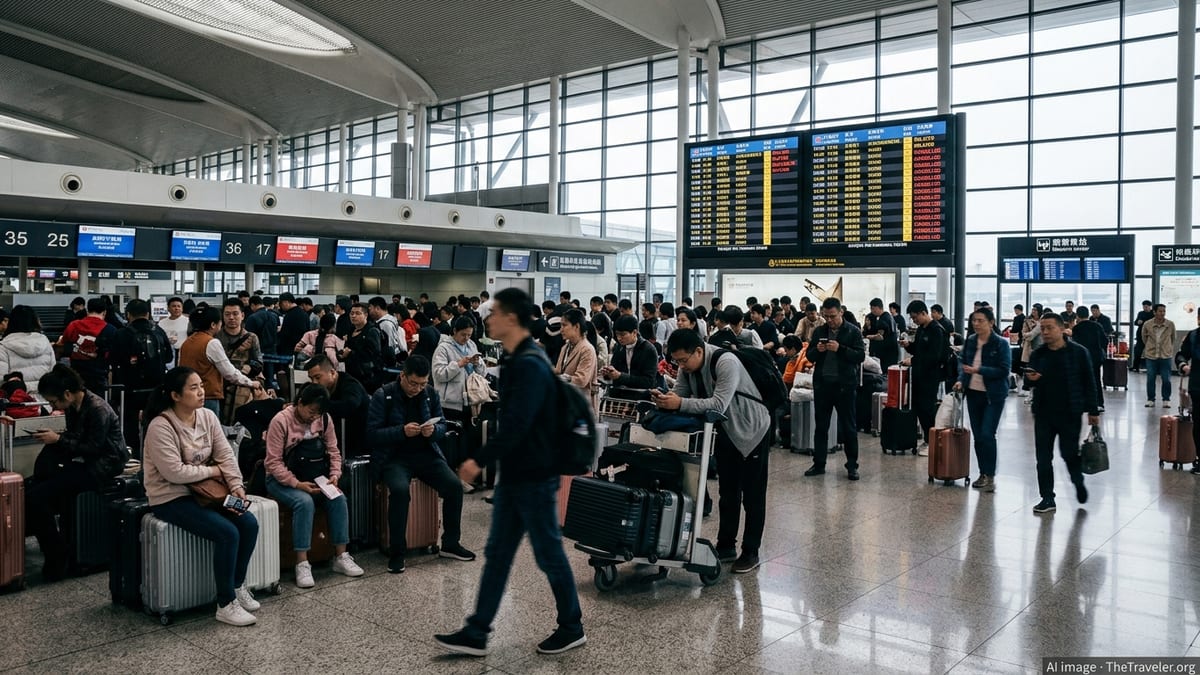
Widespread Delays Across Key Chinese Hubs
Flight tracking dashboards for March 22 show a dense pattern of late departures and arrivals across the Chinese network, with Shanghai, Shenyang, Chongqing, Kunming and Nanjing among the most impacted cities. The disruption spans both trunk routes linking major economic centers and secondary connections that feed into regional hubs.
Publicly available data indicate that delays account for the vast majority of operational issues, with more than ten times as many flights running late as being cancelled outright. Many affected services are departing between one and three hours behind schedule, creating rolling knock-on impacts across the day as aircraft and crews fall out of their planned rotations.
Shanghai, which is served by both Pudong and Hongqiao airports, appears to be carrying a significant share of the disruption because of its role as a primary hub for several of the airlines involved. Even modest slippages on Shanghai departures have a cascading effect on routes to inland cities such as Chongqing and Kunming, where turnaround times are often tight.
Airports in Shenyang and Nanjing, important gateways for northeastern and eastern China respectively, are also reporting multiple delayed departures on domestic routes. While operations continue, the cumulative effect for passengers is a day of extended waiting times, missed connections and altered ground transport plans at both origin and destination.
Multiple Carriers Affected, From Low Cost to Full Service
The disruption cuts across airline business models, affecting low cost, hybrid and full service operators. Spring Airlines, one of China’s largest budget carriers, features heavily in the lists of delayed flights, alongside regional operator China Express Airlines and full service majors such as China Eastern Airlines and China Southern Airlines. Jiangxi Air, a smaller carrier focused on regional links, is among the operators with impacted services.
For passengers, the distinction between carrier types matters less than the practical consequences of late or cancelled flights. Travelers on low cost airlines may encounter more limited options for rebooking and fewer complimentary services during extended waits, while those on full service carriers might find more established procedures for reaccommodation but still face long lines and uncertainty at airport service desks.
Reports from recent weeks on traveler forums have highlighted recurring frustration with call center wait times and self-service platforms when flight plans change unexpectedly. Some passengers describe difficulty in modifying itineraries online or through mobile applications, particularly for multi-sector journeys that include domestic Chinese segments and international legs booked under a single reference.
Despite these challenges, airlines generally continue to prioritize keeping as much of the published schedule operating as possible, even when departure times slip. For many carriers, especially those running high-frequency domestic networks, short-term delays are seen as a preferable outcome to widespread cancellations that would strand aircraft and crews far from their bases.
Potential Drivers: Weather, Congestion and Tight Scheduling
The precise causes of the March 22 spike in delays and cancellations are not immediately clear from publicly available information, but a combination of seasonal weather, airspace congestion and tight scheduling is likely to be at play. Late March is a transition period in many parts of China, with changing weather patterns that can bring low cloud, rain and occasional storms, all of which can slow air traffic flows.
Major hubs like Shanghai and Chongqing operate at high utilization levels during peak periods, leaving limited margin to recover from disruptions. When an early wave of departures is affected by low visibility, strong winds or traffic management initiatives, it can take several hours for schedules to realign, particularly on routes where aircraft are scheduled for multiple sectors per day.
China’s domestic aviation market has also seen a strong rebound in demand compared with earlier years, prompting airlines to restore and expand their networks. While this growth benefits travelers through more route options and frequencies, it also means that airports and air traffic systems are handling increasingly dense operations, which can amplify the impact of any operational bottleneck.
In such conditions, relatively minor issues such as extended turnarounds, last-minute crew changes or minor technical checks can materially impact departure times. Once rotations fall behind, it becomes harder for carriers to recover punctuality without cancelling selected services, a step operators appear to be trying to limit based on today’s ratio of delays to cancellations.
Knock-On Effects for Domestic and International Itineraries
The immediate impact of the disruptions is being felt on domestic routes, but the consequences are also rippling through to international journeys that rely on Chinese hubs for onward connections. Airlines such as China Eastern and China Southern use Shanghai and other large cities as transfer points for long haul flights to Europe, North America and the wider Asia-Pacific region.
Travelers who began their trips in regional Chinese airports are at particular risk of misconnecting if their first domestic leg arrives late into a hub. In some cases, passengers may be rebooked onto later same-day departures, while others could face overnight stays if onward services operate only once per day. Passengers with separate tickets for their domestic and international sectors may find that airlines treat the two parts of their journey independently, complicating reaccommodation.
The timing of today’s disruption also means that evening and overnight departures may see continued strain, as airlines work to reposition aircraft and crews. Some carriers might opt to consolidate lightly booked services or adjust aircraft types on particular routes in order to restore balance to their networks in the following days.
Ground transport options such as high speed rail may absorb a portion of the displaced demand on busy corridors between cities like Shanghai and Nanjing, or Shanghai and Chongqing, but these alternatives can be limited for passengers who need to make tight onward connections abroad, have checked baggage routed through to final destinations, or are subject to visa and immigration constraints.
Advice for Affected Travelers and Those Yet to Depart
For travelers already at the airport, information screens and terminal announcements remain the primary sources of real-time updates on departure times and gate changes. Given the high number of delayed flights, many terminals are likely experiencing crowded seating areas near busy gates and customer service counters, and passengers may need to allow additional time for security and boarding procedures that can be rescheduled at short notice.
Those whose flights have not yet departed are encouraged by consumer advocates to monitor flight status through airline channels and independent tracking tools before heading to the airport. With delays still evolving throughout the day, early awareness of schedule changes can provide extra time to adjust ground transport plans, notify accommodation providers of late arrivals, or explore alternative routing options.
Travel planners also point to the importance of leaving sufficient buffer time between separate tickets and self-arranged connections, especially when transferring between domestic and international flights in large hub airports. Recent traveler reports have underscored how tight, unprotected connections can quickly unravel when departure boards fill with delayed services.
With China’s aviation network continuing to operate at high intensity, today’s wave of disruptions serves as a reminder that even routine journeys can be affected by operational strains. Passengers planning trips through Shanghai, Shenyang, Chongqing, Kunming, Nanjing or other major Chinese airports in the coming days may wish to keep a close watch on schedule updates and remain flexible where possible.