

More news on this day
Air travel across mainland China is facing fresh disruption as more than two dozen flights operated by major carriers including China Southern, China Eastern and Shenzhen Airlines are cancelled, affecting busy routes into Beijing, Shanghai, Guangzhou, Chengdu, Shenzhen, Hangzhou and other key cities just as spring travel demand picks up.
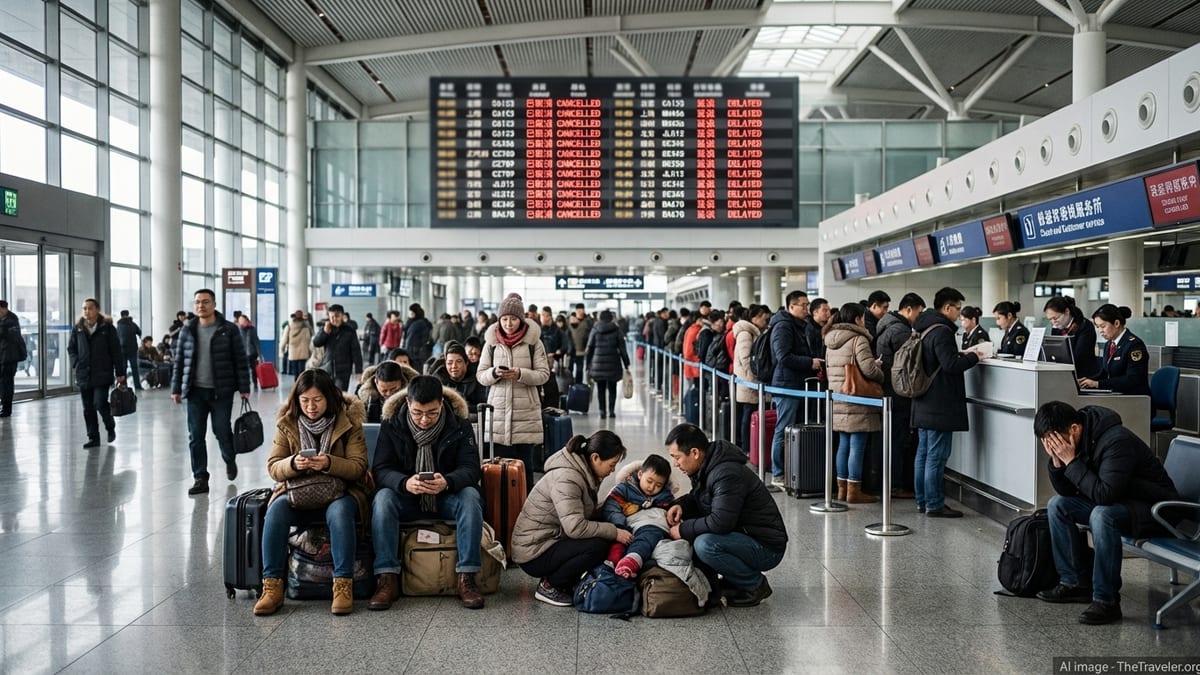
Fresh Wave of Cancellations Across China’s Aviation Network
The latest disruption comes on the heels of a series of operational setbacks reported throughout February, with domestic schedules under growing strain from capacity constraints, weather variability and knock-on delays. New cancellations logged this week add to an already elevated baseline of irregular operations across China’s dense air network.
Recent data compiled from major airports show that more than 25 services have been cut over a short window, including flights touching key hubs such as Beijing Capital, Beijing Daxing, Shanghai Pudong, Shanghai Hongqiao, Guangzhou Baiyun and Chengdu Tianfu. While the total number is modest compared with peak travel volumes, the concentration on trunk routes and banked departure waves has amplified the impact for connecting passengers.
Chinese carriers have already been navigating a turbulent start to 2026. Throughout January and February, multiple operational bulletins highlighted clusters of cancellations and hundreds of delays at leading hubs including Beijing, Shanghai, Shenzhen, Chengdu, Xi’an and Xiamen, underscoring how fragile on-time performance has become in the face of rising demand and limited slack in airline schedules.
The latest cancellation tally adds a new layer of complexity for travelers who had been counting on improving punctuality after earlier disruptions. Airports and airlines are now juggling same-day schedule changes alongside persistent delay backlogs, leaving many passengers facing last-minute rebooking or overnight stays.
Major Carriers Hit: China Southern, China Eastern, Shenzhen Airlines and More
China Southern and China Eastern, the country’s two largest carriers by passenger volume, are among the airlines most affected in the current round of cancellations, joined by Shenzhen Airlines and several regional operators. These carriers collectively handle a significant share of domestic capacity on routes linking northern, eastern and southern China, which magnifies the ripple effects when their flights are scratched.
Operational data reviewed by TheTraveler.org show cancellations across a mix of mainline and feeder services. China Southern and China Eastern have both pulled flights on high-frequency corridors, while Shenzhen Airlines has been impacted on routes feeding into southern hubs. Additional adjustments involving smaller airlines and codeshare partners are compounding the complexity for travelers who booked itineraries with multiple legs on a single ticket.
While precise cause codes vary by airport and route, industry sources point to a combination of factors including aircraft rotations affected by earlier delays, localized weather constraints, and tight crew scheduling windows after a busy Lunar New Year period. In several cases, cancellations appear to be a pre-emptive measure to stabilize the remainder of the day’s schedule rather than operating services that would depart excessively late.
Passengers are reporting instances in which outbound legs are cancelled while inbound flights operate with delays, reflecting airlines’ attempts to rebalance aircraft and crews. For travelers, however, that nuance matters little; the immediate reality is missed connections, reissued boarding passes and longer waits in already crowded terminals.
Key Hubs and Routes Affected from Beijing to Guangzhou and Chengdu
The disruption is being felt most acutely on China’s trunk routes linking Beijing, Shanghai, Guangzhou, Chengdu, Shenzhen and Hangzhou, which serve as the backbone of the national air network. These city pairs not only carry heavy point-to-point demand but also function as critical connectors for secondary cities such as Xi’an, Dalian, Fuzhou, Dongsheng and Yinchuan.
At Beijing’s airports, cancelled departures have recently impacted services out of the capital toward Inner Mongolia, Ningxia and Fujian, reducing connectivity for travelers heading onward to regional destinations. In eastern China, Shanghai’s dual airports have seen cancellations and knock-on delays affecting flights to and from Chengdu, Dalian, Kunming and other western gateways, limiting same-day transfer options.
Further south, Guangzhou and Shenzhen are contending with their own pockets of disruption, with cancellations intersecting with already busy departure banks for domestic business and leisure travelers. Hangzhou, a key tech and tourism hub, has also appeared in the growing list of affected destinations, underlining how the latest round of schedule cuts is spread across multiple economic regions rather than confined to a single corridor.
Because many of these flights sit within dense, hourly schedules, the removal of even a small number of departures can quickly erode flexibility, particularly for travelers trying to reposition between hubs for international connections or late-evening returns to their home city.
Passenger Impact: Long Queues, Missed Connections and Limited Alternatives
For passengers on the ground, the statistics translate into frayed nerves and hours of uncertainty. Reports from Beijing, Shanghai, Shenzhen and other hubs describe long queues at airline service counters, with travelers seeking new itineraries after receiving cancellation notices via app alerts, text messages or gate announcements.
Same-day rebooking has become challenging on certain high-demand routes as remaining services quickly fill. In some cases, travelers are being shifted to departures later in the day or even to next-morning flights, prompting a rush for nearby hotel rooms and forcing last-minute changes to onward plans, from high-speed rail connections to business meetings.
Families and international travelers appear to be among the hardest hit, particularly those with tight transfer windows to long-haul flights. With many carriers operating close to capacity on key routes, spare seats to accommodate disrupted passengers are limited, and alternative routings often involve additional stops or long layovers at secondary hubs.
Airports and airlines are urging passengers to arrive early, monitor flight status in real time and make use of digital self-service tools where possible. However, for those who have already arrived at the airport when a flight is cancelled, practical assistance still largely depends on in-person support from ground staff, whose desks are under heavy pressure during peak disruption periods.
What Travelers Should Do Now and Outlook for the Coming Days
Travelers planning domestic or regional trips in China over the coming days are being advised to build in extra buffer time and to prepare contingency plans. Checking flight status frequently on airline apps or airport displays, confirming terminal information and monitoring gate changes have become essential steps even after check-in is complete.
Experts recommend that passengers with critical same-day connections, particularly those linking domestic flights with international departures, consider booking earlier departures where feasible, or allowing longer layovers in Beijing, Shanghai, Guangzhou or Chengdu. Flexible tickets that permit free same-day changes can also offer a measure of protection when schedules suddenly shift.
Travel industry observers note that while the current round of cancellations numbers in the dozens rather than hundreds, it is occurring against a backdrop of sustained operational volatility across China’s aviation system in early 2026. That means even small disruptions can cascade quickly when weather, airspace congestion or technical issues arise at multiple hubs simultaneously.
For now, there is no indication of a prolonged, nationwide shutdown of routes, but the pattern of rolling cancellations and heavy delays suggests that travelers should expect intermittent turbulence in their plans. Those flying with China Southern, China Eastern, Shenzhen Airlines and other major carriers into or between Beijing, Shanghai, Guangzhou, Chengdu, Shenzhen, Hangzhou and secondary cities are urged to stay informed, stay flexible and factor potential disruption into their itineraries.