

More news on this day
China’s domestic aviation network is experiencing another turbulent start to April, with flight tracking data indicating at least 449 delayed services are rippling through already congested schedules at major hubs and regional airports.
Get the latest news straight to your inbox!
Delay Wave Adds To Early April Turbulence
The latest cluster of 449 delayed flights adds to a week of mounting disruption across China, where a mix of unstable spring weather, airspace congestion and tight aircraft rotations has left carriers with little room to recover when problems arise. Publicly available monitoring data for early April shows delay-heavy patterns at large coastal gateways as well as inland hubs, amplifying the impact on both business and leisure travelers.
Recent reporting on northern China highlights how even routine rain and low cloud have translated into rolling knock-on delays, as aircraft and crews fall out of position and later departures are forced to wait for inbound aircraft. In practical terms, this has meant longer queues at check in and security, late-night arrivals and missed onward connections, even when origin and destination airports appear to be operating normally.
The 449-delay tally sits within a broader regional picture in which Asia and the Gulf have already logged several severe disruption days this month, including events where thousands of services across multiple countries were delayed. For travelers relying on Chinese domestic sectors to connect to long haul flights, this has increased the risk that a short internal hop becomes the weak link in a complex itinerary.
Major Hubs Under Pressure As Networks Fill
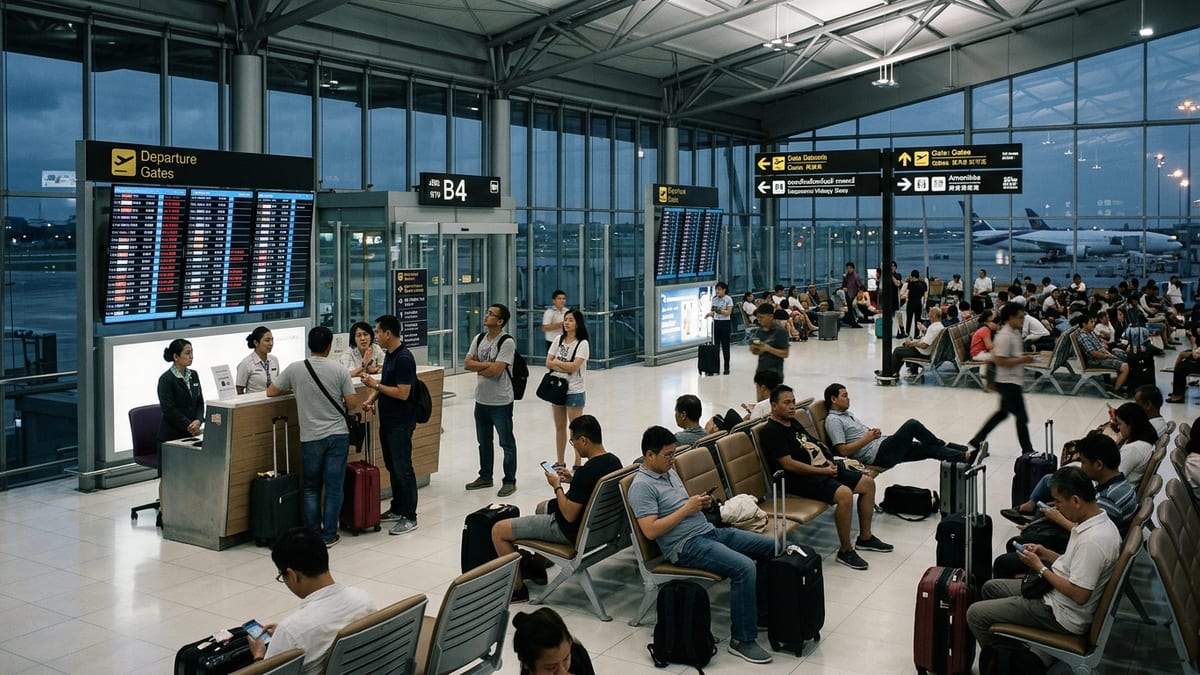
Beijing, Shanghai, Guangzhou and Chengdu continue to absorb a large share of the disruption, reflecting their role as central nodes in China’s aviation network. Reports from travel outlets describe packed departure halls and extended waiting times as airlines work through backlogs when weather or traffic control restrictions briefly ease. Once slot constraints bite at these busy airports, even modest schedule changes can cascade rapidly through the day.
Flight statistics published in late March and early April already showed elevated delay ratios at several of these hubs, with some days skewing heavily toward late departures rather than outright cancellations. For travelers, the distinction offers little comfort when multi hour waits become commonplace, but for airlines it reflects an operational preference to operate flights late rather than scrub them entirely and trigger large scale rebooking challenges.
Regional airports feeding these hubs are also feeling the strain. Travel coverage points to disruption at secondary cities that depend on tight turnaround times and limited daily frequencies. When an early morning flight leaves late, afternoon and evening services on the same aircraft type can be pushed back, narrowing options for passengers trying to reroute on the same day.
Weather, Airspace Limits And Operational Strain Intersect
Spring in China often brings volatile conditions, and this year is proving no exception. Fast moving weather systems have already produced days with more than one thousand delayed flights nationwide, and the addition of 449 fresh delays in April underscores how quickly localized storms or low visibility can spill into a network wide problem.
At the same time, Chinese carriers are operating against a backdrop of crowded regional skies. International traffic patterns in Asia and the Middle East remain in flux due to airspace restrictions and route changes, and rerouted long haul flights can push additional traffic into already busy corridors. When these flows intersect over eastern and central China, air traffic control measures such as flow restrictions and holding patterns can lengthen flight times and disrupt carefully planned schedules.
Operational constraints further compound the issue. Industry analyses repeatedly emphasize that high aircraft utilization and lean crew scheduling, which help airlines keep costs down in normal times, reduce the buffer available when something goes wrong. Once a morning delay forces crews toward duty time limits, airlines may have no choice but to delay or cancel later services, even if the original weather or traffic problem has eased.
Knock On Effects For International Connections
The surge in domestic delays carries particular consequences for travelers connecting to and from international routes. Several recent disruption days across Asia have shown how delays on short haul feeders into Chinese hubs can ripple outward, forcing last minute rebookings on long haul sectors or overnight stays when minimum connection times are breached.
Publicly available coverage points to cases where Chinese carriers have struggled to reposition aircraft in time for outbound international departures, especially on routes that are already operating at reduced frequencies after earlier capacity cutbacks. When a domestic leg into a hub arrives late, airlines may need to hold the onward flight to maintain connections, at the cost of further delays downline, or depart on time and leave connecting passengers behind.
These dynamics are particularly sensitive on routes linking China with other parts of Asia and Europe, where separate disruption episodes tied to weather and geopolitical tensions have already put schedules under pressure. For travelers, the result is a more fragile itinerary environment, in which even well planned connections that would normally be considered safe can become risky on volatile days.
What April Travelers In China Should Expect
For passengers flying within or through China in April, the pattern emerging from the latest 449 delays suggests a month of continued volatility rather than isolated bad days. Aviation data and recent reports indicate that while many flights are still operating broadly on schedule, the probability of encountering a significant delay has risen at several key hubs.
Travel advisories and consumer oriented guidance published in recent weeks emphasize the importance of close monitoring and flexible planning. Travelers are encouraged to check flight status frequently through official airline channels and airport information systems, build additional buffer time into connections, and consider earlier departures on days when severe weather is forecast along their route.
Experts also note that written confirmation of disruption causes, where obtainable from airlines, can help passengers navigate refund, rebooking and accommodation policies that may vary by carrier, route and ticket type. With April’s schedules already showing signs of cumulative strain, such documentation can be useful for those seeking to recover costs or rearrange complex itineraries if their plans are upended by another wave of delays.