

More news on this day
Hundreds of air travelers were left stranded across China this week as a cluster of at least 42 flight cancellations and about 150 delays rippled through major airports in Shanghai, Beijing, Nanjing, Chengdu, Changsha and other cities, affecting operations at several of the country’s biggest carriers.
Get the latest news straight to your inbox!
Major Hubs Hit by Wave of Disruptions
Publicly available flight-tracking data and local media coverage indicate that China’s busiest aviation markets bore the brunt of the disruption, with Shanghai and Beijing seeing some of the highest numbers of affected services. Shanghai’s dual-airport system and the capital’s main gateways form the backbone of the domestic network, meaning even a modest spike in cancellations and delays can quickly cascade nationwide.
Nanjing, Chengdu and Changsha, all key regional hubs, also reported clusters of off-schedule operations tied into the same pattern of disruption. These airports serve as transfer points for both business and leisure travelers, so irregular operations there can strand passengers whose journeys depend on tight connections.
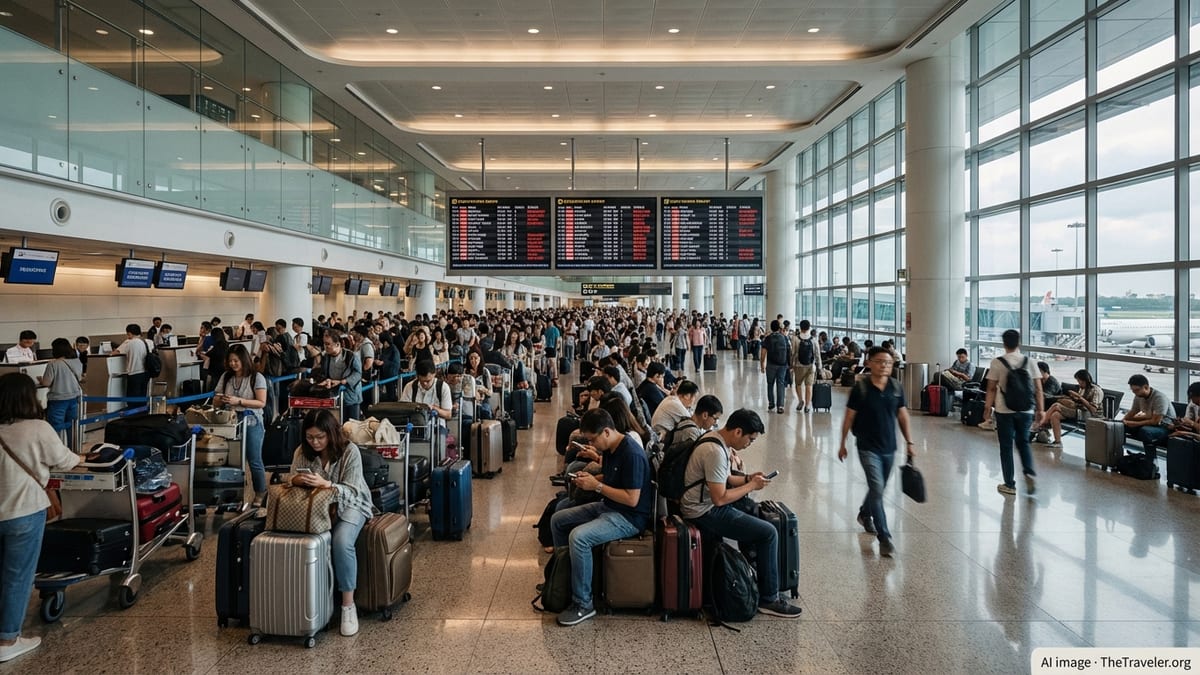
The figure of 42 cancellations and roughly 150 delays represents only a slice of daily air traffic in China, but the concentration of problems at multiple hubs on the same day magnified the impact. Travelers described crowded departure areas and long queues at service counters as airport displays updated to show rolling delays.
Operational information suggests that many of the disrupted services were tightly interconnected, with aircraft and crews scheduled to operate multiple legs across the country. Once a single flight fell significantly behind schedule, subsequent rotations were forced to depart late or be canceled altogether.
Multiple Chinese Carriers Affected
Flight status records show that the disruptions cut across several major Chinese airlines rather than being confined to a single operator. Services run by China Eastern, Air China, XiamenAir, Hainan Airlines and other domestic carriers all appeared among the list of affected flights, underscoring how problems in a shared airspace and airport system can spill over between competitors.
China Eastern, which maintains a large hub in Shanghai, saw some of its departures from the city’s main international and domestic terminals delayed as knock-on effects spread through its route network. Air China, with its core operations centered on Beijing, experienced similar issues on routes linking the capital with other major cities, including flights passing through Nanjing and Chengdu.
XiamenAir and Hainan Airlines, both important players on domestic routes that connect coastal and inland regions, also appeared in delay and cancellation tallies at airports beyond their home bases. Public tracking information showed disrupted services not only on trunk routes between large metropolitan centers but also on secondary city pairs that rely on connections through Shanghai, Beijing or other hubs.
The broad spread of affected carriers suggests that underlying causes were not limited to internal issues at a single airline. Instead, congestion within the wider network, air traffic management constraints and weather-related slowdowns at individual airports likely combined to limit flexibility for operators across the board.
Network Ripple Effects and Passenger Impact
When flights are canceled or substantially delayed at major hubs, the consequences extend well beyond the originating airport. Aircraft that arrive late into Shanghai, Beijing or Chengdu often form the next departure on a new route, so a delay on one leg can trigger missed departure slots and schedule reshuffles several hours later in another part of the country.
Reports from Chinese-language travel forums and domestic news outlets described passengers facing missed connections, overnight waits and last-minute rebookings as airlines attempted to realign their schedules. Travelers heading onward to smaller cities from Shanghai or Beijing were particularly vulnerable, since many rely on only one or two daily departures to complete their journeys.
Crowded terminals, especially in the evening peak, added further strain as stranded passengers sought updated information. Long lines formed at airline counters as travelers attempted to secure alternative flights, hotel vouchers or refunds. In some cases, passengers reportedly opted to switch to high-speed rail for medium-distance journeys once it became clear that departure times would continue to slip.
Families traveling with children and elderly passengers were among those most affected by extended waits, with widely available coverage highlighting concerns about access to seating, food and real-time updates as delays stretched into hours. For many, the experience underscored how quickly a tightly scheduled trip can unravel when irregular operations hit multiple hubs at once.
Likely Drivers: Weather, Congestion and Tight Scheduling
While specific causes for each individual cancellation or delay vary, aviation analysts frequently point to a mix of weather, airspace constraints and dense scheduling as the main drivers of similar disruption events in China. Even short-lived thunderstorms, low visibility or strong winds at a single hub can slow arrivals and departures enough to create queues of aircraft waiting for takeoff or landing clearance.
China’s core aviation corridors between cities such as Beijing, Shanghai and Chengdu are among the busiest in the world, with airlines competing for limited slots and building schedules that leave relatively little slack for recovery when problems arise. Once one segment of the system encounters difficulty, it becomes more challenging to reposition aircraft and crews quickly enough to protect later flights from knock-on delays.
Public data and previous reporting on China’s aviation sector also underline the role of shared airspace, where commercial flights must be carefully sequenced around other users. This can result in flow restrictions that slow traffic into heavily used airports during busy periods, amplifying even minor disruptions.
Industry observers note that these structural factors have contributed to recurrent clusters of delays in the past, and that improvements in forecasting, slot management and contingency planning remain key priorities for Chinese carriers and airport operators seeking to boost reliability.
Guidance for Affected and Future Travelers
Chinese civil aviation rules and airline policies generally provide for options such as rebooking, refunds or, in some situations, accommodation when flights are canceled or experience extended delays. The precise remedies can depend on the carrier involved, the cause of the disruption and whether the journey involves a single or multiple tickets.
Travel experts often advise passengers in China to maintain up-to-date contact details with their airline, use official mobile applications for real-time notifications and arrive at the airport with flexible backup plans when possible. In regions served by China’s extensive high-speed rail network, same-day train alternatives can sometimes help mitigate the impact of last-minute cancellations or severe delays.
The latest wave of disruptions serves as a reminder that travelers on domestic and regional routes should allow additional buffer time for connections and important appointments, particularly when transiting through large hubs such as Shanghai Pudong, Beijing Capital or Chengdu’s main airports. Building in extra time can lessen the risk that a missed connection cascades into a much longer, multi-day interruption.
As Chinese carriers continue to rebuild and expand schedules, and demand for both business and leisure travel remains high, the balance between efficient network planning and operational resilience will remain under close scrutiny from passengers who have experienced the consequences of even a single day of severe disruption.